Lucas alternator question for add a battery switch

Steeevo

New Member
Joined
8 Sep 2020
Messages
15
Visit site
Hi. I have a lucas A127MT and How do i workout if it has combined alternator and starter wiring or seperate?
As i need to know for wiring up a new add a battery switch
 

Attachments

  • 8E291DD4-3ED3-43FF-9916-C8B81A23AFE3.jpeg
    8E291DD4-3ED3-43FF-9916-C8B81A23AFE3.jpeg
    344.7 KB · Views: 50
  • 5C1B83B4-6E42-4345-A166-66C2907D5D6B.jpeg
    5C1B83B4-6E42-4345-A166-66C2907D5D6B.jpeg
    223.9 KB · Views: 43
Follow the wire from the B+ terminal of the alternator to where ever it goes. It's most likely the thickest red wire on the alternator and may just go to the battery terminal of the starter solenoid.
 
Hi. I have a lucas A127MT and How do i workout if it has combined alternator and starter wiring or seperate?
As i need to know for wiring up a new add a battery switch

You dont say what engine you have but usually in a basic single battery ( or two batteries and a 1,2,both switch ) the alternator output connects to the main feed from the battery at the starter solenoid , with a combined heavy connection between there and the battery switch.
Refer to the wiring diagram in the owners manual ( if there is one) or simply look at how the alternator output is connected

The Add a Battery package is a neat solution for adding a second battery but, although it includes a "Dual circuit Plus" switch, it does not allow you to parallel the circuits and leave a defective battery isolated A defective battery could always be physically disconnected of course
 
Last edited:
Thanks for the reply. I have a beta 20hp and it looks like the previous owner upgraded the alternator from the standard 40ah to a lucas 55ah.

It has a 1 2 both switch with one dedicated starting battery and a house battery for the gps/lights/vhf with no way of charging the leisure battery as the engine only charges the starting battery

i like the idea of the add a battery so just need to find out how the previous owner wired up the 1 2 both switch.
 
Follow the wire from the B+ terminal of the alternator to where ever it goes. It's most likely the thickest red wire on the alternator and may just go to the battery terminal of the starter solenoid.
Ok thanks. So if the B+ goes to the starter solenoid it is a seperate starter wire
 
Ok thanks. So if the B+ goes to the starter solenoid it is a seperate starter wire
Its a combined alternator and starter wired system like the main diagram in the Blue Sea instructions unless the PO altered it, but it sounds as though he wired the 1,2 both switch incorrectly. It should select either battery, or both, to be in service and be charged.

Assuming you want to go ahead and fit the Blue Sea dual circuit switch and VSR. Personally I'd probably keep the 1, 2 both switch ( wired correctly )but perhaps add the VSR.
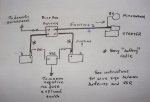
This diagram should provide the information you need . (The engine control panel remains connected to the engine via the existing wiring harness)

Dual circuit switch wiring.jpg
 
Last edited:
Its a combined alternator and starter wired system like the main diagram in the Blue Sea instructions unless the PO altered it, but it sounds as though he wired the 1,2 both switch incorrectly. It should select either battery, or both, to be in service and be charged.

The OP is yet to check where the wire goes, so how can you tell him that its a combined system and his switch is wired incorrectly ?

Assuming you want to go ahead and fit the Blue Sea dual circuit switch and VSR. Personally I'd probably keep the 1, 2 both switch ( wired correctly )but perhaps add the VSR.

The Blue Sea switch offers a much better system than the 1-2-B switch, as the OP has obviously concluded. It isn't a versatile as having separate switch, but i certainly would not recommend keeping the 1-2-B switch

This diagram should provide the information you need . (The engine control panel remains connected to the engine via the existing wiring harness)

Your diagram is a copy of the Blue Sea combined diagram in post #1 (with the omission of the optional circuits), seems pointless to post such a digram, when the OP has the factory one to hand. You are still advising the OP under assumption that his system is combined and we don't yet know if that is the case, this just adds confusing for someone who already isn't sure how to wire it.

I would suggest that the OP ignores post #7 and continues with his checks to see where the alternator is actually wired, only then can further advice be given.
 
This is my least favourite job on a boat!

Well the 1 2 both switch is not wired correctly and is damaged. Both batterys were connected to the same terminal on the switch so it all needs sorting out.

The positve from the starter goes to the original switch so i think it is a seperate setup like most inboards.
I couldnt see a B+ on the alternator as its very inaccessible.
 
This is my least favourite job on a boat!

Well the 1 2 both switch is not wired correctly and is damaged. Both batterys were connected to the same terminal on the switch so it all needs sorting out.

The positve from the starter goes to the original switch so i think it is a seperate setup like most inboards.
I couldnt see a B+ on the alternator as its very inaccessible.

You need to identify where the alternator wire goes.
 
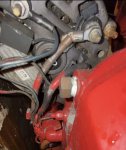
I took some video to try and get a good view of the alternator. It looks like the thick brown cable is the one i need to trace
 

Attachments

  • EEAC1263-18CB-446D-A277-FC0407E36F3D.jpeg
    EEAC1263-18CB-446D-A277-FC0407E36F3D.jpeg
    681 KB · Views: 15
I took some video to try and get a good view of the alternator. It looks like the thick brown cable is the one i need to trace
That,s right that,s the one.

I am expecting to find that it goes to the starter mortor solenoid where it meets the main positive battery cable as indicated in the diagram I posted last night. (That is how the engine would have been wired originally)

If it does that confirms that is a "combined" system.
 
I took some video to try and get a good view of the alternator. It looks like the thick brown cable is the one i need to trace

Yes, the brown wire is the one. If the switch was originally wired correctly it will go to the common terminal of the 1-2-B switch. If this is the case, fit this wire to the engine battery terminal of the Blue Sea switch. With a correctly wired 1-2-B switch, the wire should not go to the starter, so don't get side tracked by the previous post.
 
Last edited:
  • Like
Reactions: pvb
Yes, the brown wire is the one. If the switch was originally wired correctly it will go to the common terminal of the 1-2-B switch. If this is the case, fit this wire to the engine battery terminal of the Blue Sea switch. With a correctly wired 1-2-B switch, the wire should not go to the starter, so don't get side tracked by the previous post.

Nonsense!

The alternator output should be connected to the main battery + cable at the starter solenoid , just as it would be with a single battery and isolation switch

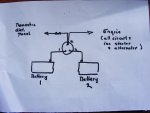
The 1,2 both switch should have been wired as in this ( rather rough) diagram

When position 1 is selected battery 1 will be connected for all purposes and will be charged
When position 2 is selected battery 2 will be selected for all purposes and will be charged
If "both" is selected both batteries will be connected in parallel for all duties and charging

The addition of a VSR will ensure that both batteries are charged irrespective of which is selected to be in use

1, 2, both switch (2).jpg
 
The origanl switch was not wired like that both batteries were connected to common then the battery 1 post went to the starter solenoid and the battery 2 post went to the electrics panel

i have found out that the thick brown B+ wire goes to the starter solenoid
 
The thick brown B+ wire goes to the starter solenoid
Good . As expected

All you have to do is wire the battery positives , the feed to the domestic electrics and the main positive feed to the engine to the switch as shown in the main Blue Sea diagram ( and my diagram)

Connect the VSR between the two battery positives ( or if more convenient to the corresponding terminals on the switch) and to a common negative point Fitting fuses where indicated.

The switch in the negative is optional. opening it will prevent a very small battery drain when not operating. (It can also be used to stop the VSR operating if so desired.)
 
The origanl switch was not wired like that both batteries were connected to common then the battery 1 post went to the starter solenoid and the battery 2 post went to the electrics panel

i have found out that the thick brown B+ wire goes to the starter solenoid

Your switch was incorrectly wired and makes no sense. The only way to have had the engine and domestic both on would be to use the "Both" setting.

Regardless, no need to change the alternator wire, just follow the diagram that you posted in post #1
 
Good . As expected

All you have to do is wire the battery positives , the feed to the domestic electrics and the main positive feed to the engine to the switch as shown in the main Blue Sea diagram ( and my diagram)

Connect the VSR between the two battery positives ( or if more convenient to the corresponding terminals on the switch) and to a common negative point Fitting fuses where indicated.

The switch in the negative is optional. opening it will prevent a very small battery drain when not operating. (It can also be used to stop the VSR operating if so desired.)

Why do you feel the need to post explanations of where to wire everything and hand drawn schematics, the OP has the Blue Sea diagram ?

All he needs to do is to wire it up as per that schematic.
 
Nonsense!

The alternator output should be connected to the main battery + cable at the starter solenoid , just as it would be with a single battery and isolation switch

The 1,2 both switch should have been wired as in this ( rather rough) diagram

When position 1 is selected battery 1 will be connected for all purposes and will be charged
When position 2 is selected battery 2 will be selected for all purposes and will be charged
If "both" is selected both batteries will be connected in parallel for all duties and charging

The addition of a VSR will ensure that both batteries are charged irrespective of which is selected to be in use

View attachment 99986

Still feeling the need to post your condescending drivel and hand drawn sketches telling me how things work, i see.

Still waiting for you to tell us what qualifications and real World experience you have regarding marine electrics ?

We know you have a Phd in Googling.
 
Top