
Lubricating ball valves on through hulls

Tim O

Well-Known Member
Joined
3 Jan 2010
Messages
582
Visit site
All being well I'm relaunching my boat this weekend and one of the things I was intending to do is to lubricate the ball valves.

I have heard tell of removing the hoses and pouring oil onto the closed valve then operating several times to distribute it.

However, as we all know, hoses which have been on there for some time can be a pain to take off, and unless they are in poor condition and in need of replacement there is no real need to do so and Id rather not go to all the effort if its not necessary.

I've come across another suggestion (on the Attainable Adventure Cruising site) which is to close the ball valve and use a long handled brush to apply the following grease to the ball surface:

https://www.lubriplate.com/Online-Store/1-75-oz-tubes/No-130-AA-1-75-oz-tube.html

However, this is an American product and difficult to obtain so I was thinking, is there a suitable cheap UK product?

I was thinking white Ramonol should do the trick? Any reason why not?
 
I understood that ball valves have a metal ball in a plastic seat and are water lubricated, grease should not be applied in case it affects the seat. Also the grease could turn into a hard deposit and obstruct the valve from operating.
If you really want to apply something how about a Teflon aerosol squirted up from outside?
 
The plastic seal on most ball valves id a PTFE based material so should need no lubricant but PTFE spray a Plevier posted may help.
 
Moving them is good, to wipe off any build-up on the face of the ball that will eventually stop it sliding past the seal. But do they need lubricating? I always believed that the seat was Teflon or something similar and didn't need it.

Think about these things installed in other situations, with lots of rigid pipework either side. Are those people dismantling their machinery on a regular basis to grease the valves?

Pete
 
Think about these things installed in other situations, with lots of rigid pipework either side. Are those people dismantling their machinery on a regular basis to grease the valves?

Pete

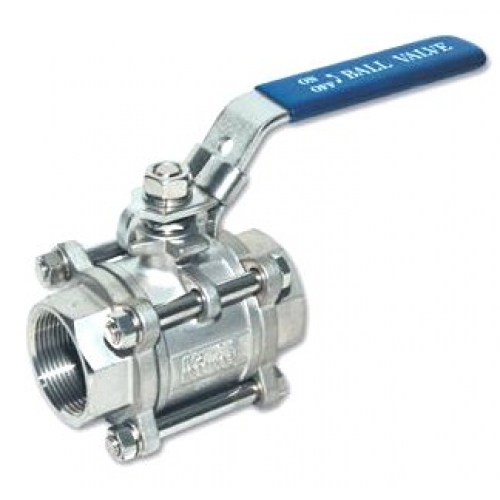
Three part ball valves are so easy to dismantle without disturbing the adjacent rigid pipework there's no problem with maintenance

3piece-500x500.jpg
 
I have one valve that's difficult to open fully and ten close. Several other 42DS owners have had the same problem and found that changing the valve didn't help. I have swapped it for a DZR one because the original was of poor quality and the replacement is just as stiff. It's obviously a combination of location and valve size (2").

I do 4 things to keep it moving reasonably easily:

1) Flush head with lots of water, so minimal Calcium deposits
2) Open and close regularly
3) I pump a little Hydrochloric acid to the valve twice each season and then close it to allow a couple of hours soak before flushing clear
4) Lubricate with Pro-Lube at start and end of season

It seems to work and the valve never gets too stiff.

I have a 90 deg. bend after the skin fitting and that makes lubrication a little more difficult. I use an extended tube on the Pro-lube can and it can reach past the valve. So it's just a matter of pushing the tube through the fully open valve and then my wife closes it partially before I start to spray. The tube is removed and the valve is opened and closed slightly and repeated in larger steps until fully open. This means that Pro-lube pools behind the inner face of the ball and is distributed on the surface when it is moved. The outer face is easy to spray with the valve closed.

Seems to work.
 
should be no need to lubricate ball valves - as said the seats are plastic which is self lubricating. Stiffness is caused by lack of regular operation leading to a buildup of deposits on the ball, particularly if they are left closed for long periods.

WD 40 squirted onto the ball can be effective in keeping the ball clean but is not a lubricant.
 
I used to do mine with a Teflon spray from outside when the boat was out of the water and whilst somebody inside manipulated the valve. I bought a HD Teflon bearing spray from Ashley Bearings in ashley Road, Poole. Worked fine for me over 10 years on that boat ( Jeanneau Sun Legende 41), ones before that had Blakes seacocks that could be dismantled lapped in if needed and greased.
 
Isn't WD40 a light mineral oil in a white spirit base?

I believe that WD40 has a significant amount of fish oil in it, and is useful for many other things - I had hard baked pine resin on the bonnet of my car - sprayed with WD40, left for 1 hour - just wiped off. Previously I had been to the paint shop and they sucked their teeth......
 
I've got a Blake's for my heads outlet - already cleaned and greased.

Then I have two large (2"?) Dzr ball valves for my cockpit drains plus 3 more smaller ones for sink, galley snk, and bilge pump outlets.

They are all currently moving as I've prob operated them 5 or 6 times over the last few months on the hard.

Sounds like Teflon spray not grease is the favoured option if any at all?
 
A generous spray of white grease with the sea cocks in the half open/closed position at the time of haul-out. Spray from outside the hull and leave for 6 months. Work each valve regularly during the sailing season. Has worked for me over many years with an AWB.
 
I would advise against soaking anything made of brass in hydrochloric acid (or indeed any type of strong acid). DZR is just brass with a few additions to limit dezincification. If you place a piece of brass in some hydrochloric acid it will fizz and the zinc will be dissolved away just leaving the copper.
 
Top