I see you did not get much help from the WOA forum, pity. Have you also tried the Yahoo group?
However, what sort of mast step is there. In other words what's the fitting on the deck look like.
Is it a proper tabernacle, where the mast can be pivoted on a bolt about a foot up from the deck?
Is it a type where there is a bolt close to the deck on which it can be pivoted?
Is it the type where the mast sits on an inverted T section extrusion & is located but not secured by bolts fore and aft of the heel? (Common on Westerlies)
Or some other type
hi VicS
thank's for your reply,i am a member of WOA you'd think someone would know how to lower the mast (be'ing a westerly owners club. I am very new to sailing, have bought a warwick and want to learn (hence have joined a club)the reason I want to lower the mast is because the vhf antenna is broken. I know the mast is bolted near the deck but have not really had a good look as weather is to bad to row out. Have a small pamphlet on the warwick and it says the mast can be easily lowered for trailering so it must be easy for one person to do this, any info will be very much appreciated
many thanks les.
ps sorry about the noise I type with one finger only or get the wife to do it
I imagine that the real reason you haven't had a huge response is because most people get a boatyard to do it for them when necessary. I don't have a Warwick, but have a similiar sized boat and whatever anyone tells you on this forum, my advice is that the mast is quite a handful, even with plenty of warps and lots of helping hands. I genuinely think you are best advised to get a boatyard to do this for you unless you are highly confident about doing it yourself.
IIRC the Warwick had its mast hinged at the aft side of the heel with a fairly hefty fitting. If so it is straightforward enough. 2 people minimium for the first time, preferably 3 or 4.
Firstly, wait for the wind to drop to no more than a moderate breeze - may be a longish wait this week!
Slacken off all the rigging screws so the shrouds are not under tension. Dont undo them yet.
Ensure the jib halliard is well secured at the base of the mast, and fasten a line at least the length of the boat, preferably longer, to it so that it can be lead out forward clear of everything. This line will control the rate at which the mast descends and will need 1 person to control it.
Now, with this line pulled tight, release the forward lower shrouds or inner forestay, then release the forestay. If you have a roller jib 1 helper needs to control that. Remaining crew support the mast as it starts to move aft, and prevent it twisting across the boat. As it comes down, the weight will increase, but until the mast is around 30degrees from horizontal it can be easily held by the man on the bow line. Below that the deck crew can control it fairly easily.
Its best to have a support - usually a wooden 'scissors' set up aft in the cockpit to place the mast once it has descended.
I have used this technique succesfully and safely with masts up to around 30ft in length, both raising and lowering, and 2 of us used to have the mast off my old 26footer in around 10 minutes flat.
With very little practice this can be done by 2 people, and I used to do it regularly single handed on various smaller boats - around 20ft LOA, by running the bowline through a block attached to the stem, and bringin the line back aft to where I was waiting to catch the mast. Only dropped it once!
But definitely first time, you need a crew of at least three, until you know what you are doing! Whatever you do, dont let the mast slip sideways out of line, that can break the heel fitting!
[ QUOTE ]
I genuinely think you are best advised to get a boatyard to do this for you
[/ QUOTE ] That is very good advice but plenty of people with boats bigger than a Warwick raise and lower their own masts. I often do mine single-handed, but it is a bit smaller and probably a good deal lighter, but that is despite the fact that the boatyard will do it without charging. (The yard next door by comparison charge £73 each way!)
The ease with which it can be done depends on the mast step and I did make that point on the WOA forum before Xmas and the reason I have asked again.
More recently, in fact, there has been some advice on the WOA forum from another Warwick owner who has offered to give further advice if wanted (Together with a suggestion to use a ladder to merely change an aerial.)
Maybe Leswatson has not been back recently to read that! Leswatson ????
The technique will depend on the mast step and the availability of some "strong young men" to help. Maybe not a job for geriatrics on the wrong side of 60 to attempt without help.
I see oldharry has now offered all the advice that is necessary if the mast is on a pivot at the heel.
Hi
I did send you a mail, I have lowered my warwick mast a number of time now it no great task, 3/4 peeps is a good number. asuming your harstanding use your halyards lower back onto a tripple alu ladder (this will help alot) Make sure to foot the mast the warwick does not have a tabernacle and will lift as you lower and can be fatal. any probs PM me il give you my number and run you through it.
cheers Paul
Getting some type of frame to lower it onto at the aft end of the cockpit is important otherwise with the mast still attached at the base and lowered backwards it may cause damage to the cabin roof.
see pic
30ft mast hinged at the the base lowered with 2 people and an A frame with block and tackle. (the crane wasn't used)
Funny I posted some pictures etc just yesterday. Sat morning we went out on a 27fter with heavy mast lowered it under bridges and up again.
Sat evening we did the whole exercise again but in the dark no probs.
However you must get organised with the right gear.
Contrary to what Oldharry says you must have a tackle on the forestay of at least 3 purchase 4 for a heavy mast. This MUST have props of some sort to maintain a decent angle for the mast lift. Usually 2 spin poles or pieces of tubing or wood. They pivot at points aprox. abeam the mast on deck. The other ends join together at the bottom of the forestay. So when the mast comes down the props go up raising the bottom of the forestay so the tackle can pull the mast up rather than just along its length. If you don't use the legs (one leg can work) the pull on the forestay as the mast reaches near horizontal will become uncontrolable.
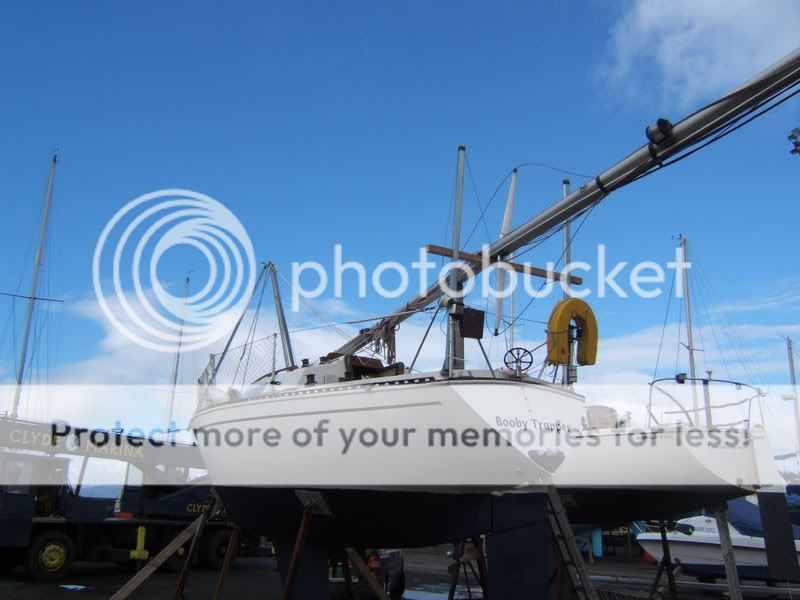
The photo of Booby Trapper has the props up but apparently the forestay has been disconnected.
Secondly you must have a frame (crutch) at the transom (scissor legs) to support the mast when it is down. This should be as high as possible comensurate with you being able to stand it the back and lift the mast off the scissors onto a lower support if you need to. ie about 6ft above the top of the transom.
The other concern with mast lowering is to ensure the mast does not sway sideways until it is safely in the crutch. This can often be done by a man on the cabin top. If you are in rough water however you need to be able to keep the cap shrouds tight all the way down to support the mast. Have eplenty of helpers for your first try.
I would suggest if the boat is in the water that you lower it next to a high jetty so you can work on the mast top from the jetty. Twist the boat stern into the jetty. If you are on the hard take a long step ladder to enable you to reach the mast top from the ground.
I had a westerly 25 once, it had a tabernacle, take out the bottom bolt, after taking off the caps and babystay and loosening the lowers, take a haliyard to the stem as a temp forestay, take off the forestay and ease away with the temp forestay (haliyard). a couple of helpers to take the mast as it comes down. The wife and I used to do it alone, never needed any special tackle, it,s not a big/heavy mast, just make sure no plonkers go by making a wash. Bill.
My frame does not pivot like yours. My A frame is actually a tripod the A section is fixed to the toe rail and a third leg is fixed at the mast base it forms a very strong structure. the whole weight of the mast was taken with the block and tackle arrangement fixed at the top of the "A" about 8ft high and also connected to the mast at the same height. The end of the tackle was led back through a couple of blocks to a sheet winch and controlled from there. Once tensioned the forestay was disconnected. The cap shrouds were loosened just enough to allow the mast to be lowered back. The reverse was done to step the mast with the lifting effort done with the winch and one person on the mast.
" Contrary to what Oldharry says you must have a tackle on the forestay of at least 3 purchase 4 for a heavy mast."
Never have used a tackle, never needed to. Even doing it alone (up to 22ft).
Warwick masts are not all that heavy anyway: I regularly took my Westerley Nomad mast down on my own in the 70s using this technique. Same size boat and spar.
If the line from the mast head is taken at least a boats length out forward, a single person (even Swmbo has done it, under protest!) can easily handle the weight.
Better still if there is some sort of staging or dock they can stand on to increase the angle between mast and line. The nearer horizontal the bow line is, the better.
Thank you all for your advice, it was very helpful. I have not been on the WOA site for some time as I didn't think anyone new how to do this. This will be done on the hard in the near future and I will keep you informed as to progress.As I have not learned how to sail her yet. Once again thank you all for the advice.
Many thanks Les
[ QUOTE ]
This will be done on the hard in the near future
[/ QUOTE ] Make sure you work out what you are going to do in advance and properly brief the helpers.
It's a good idea to a give specific tasks to specific people.
If you don't have the mast in a tabernacle or on some other pivot bolt give one person the sole task of keeping the heel under control.
If you have a foresail reefing spar keep an eye on it. If you are not using it to control the lowering have one person allocated to looking after it.
If you have enough bodies have one either side to steady the mast as it comes down. Be aware of what is behind the boat as about half the length of the mast will be overhanging the back
DONT let anybody stand underneath. Hard hats all round goes without saying!
Don't drop it on your car ~~ more importantly dont drop it on my car!
Cant you borrow some ladders?haul em up on your main haliard and tie to the mast as you go up.it seems silly to go to the trouble of mast lowering for what might be a 5 min job,wait for the wind to drop first of course.
[/ QUOTE ] My earlier post says [ QUOTE ]
More recently, in fact, there has been some advice on the WOA forum from another Warwick owner who has offered to give further advice if wanted (Together with a suggestion to use a ladder to merely change an aerial.)