
Low friction ring Vs stainless rings

[3889]

...
Joined
26 May 2003
Messages
4,139
Visit site
I'm looking to fit a barber hauler system for my genny which involves running the sheets through rings. Intuitively, I would think that the friction, using 8mm line, on a stainless round ring .
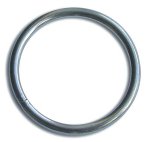
Ring-big.jpg
would be less than that of a "low friction" ring.
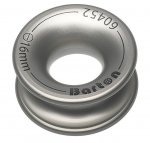
Bartonhighloadeyes6045_5.jpg
The round rings are also a tenth of the price, though this is a marginal issue. The attachment point of the control line would be diametrically opposed to the sheet contact point using the round rings.

The advantages of the LF ring are?
 
Last edited:
The stainless ring is much weaker and will deform into an oval. Also how would you attach it? The LF rings are normally held by a dyneema spliced around the outer groove. The thinner stainless ring would have a much sharper turning angle and a much smaller surface in touch with the line, leading to potential chafe. Friction wise you are probably right, but that's not the most important aspect.
 
The stainless ring is much weaker and will deform into an oval. Also how would you attach it? The LF rings are normally held by a dyneema spliced around the outer groove. The thinner stainless ring would have a much sharper turning angle and a much smaller surface in touch with the line, leading to potential chafe. Friction wise you are probably right, but that's not the most important aspect.

I can displace the sheets under maximum load with my body weight. My body weight will not (yet:() deform a 5mm stainless ring. I would attach the control line with a splice, which would be well clear of the sheet contact point during operation. The turning angle would never exceed 30 deg.
 
Last edited:
Stainless rings are indeed cheaper by about an order of magnitude. Should friction/chafe be a concern, use two in each position..... and attach the control line by means of a spliced eye and a Cow Hitch.

Same idea for the falls of Lazy Jacks.

Keep your beer tokens for their proper purpose....
 
OP's intuition is wrong. Friction is effectively independent of the contact area, as well as the fact that the s/s ring will induce a sharper curve in the line. Whether this is important is a different matter.
 
Does it need to be a ring? I would consider using plain thimbles, either stainless or nylon. On my boat I use for high loads I use SS round thimbles that I salvaged from discarded sails simply because I had them. When I run out of them I shall use 'normal' shaped thimbles.
 
Not my experience wben I brake on a wet road on a) 50mm mountain bike slicks b) 22mm Road bike tyres. The difference is extremely noticable.
Classic friction theory (Amonton's Law) says that friction is independent of contact area but that's for unlubricated or slightly lubricated conditions. Tyres on a wet road brings in issues such a ability to displace the film of water by means of tread design etc.
 
Classic friction theory (Amonton's Law) says that friction is independent of contact area but that's for unlubricated or slightly lubricated conditions. Tyres on a wet road brings in issues such a ability to displace the film of water by means of tread design etc.

Thank you for that. I started to type something similar last night but it was turning into a tribological treatise so I canned it.
 
Classic friction theory (Amonton's Law) says that friction is independent of contact area but that's for unlubricated or slightly lubricated conditions. Tyres on a wet road brings in issues such a ability to displace the film of water by means of tread design etc.

OK, thanks for that. I'll leave the thinking to others and just get the LF rings like everbody else does.
Though I was taught to spread-eagle if I started sliding off a roof. Maybe this was suggested as a suitable position for prayer rather than for practical purposes?
 
Last edited:
OK, thanks for that. I'll leave the thinking to others and just get the LF rings like everbody else does.
Though I was taught to spread-eagle if I started sliding off a roof. Maybe this was suggested as a suitable position for prayer rather than for practical purposes?
That was why I qualified my comment with "effectively", because other factors can come into play. Water has been mentioned, but with irregular surfaces the ability of the surface irregularities to lock into each other will play a part. Spreading yourself when engaged in burglary and failing may let you interlock with the tiles and other roughnesses.
 
Line type also matters. Rings are all the rage for Dyneema line and tackles,

I suspect you're correct, but for the reason that if you can afford Dyneema lines, you can afford Low Friction rings.

but if the sheets have a polyester cover, that is totally different. With polyester, use a small block.

I did a "proof of concept" using nylon thimbles then changed to small plastic blocks.
 
OK, thanks for that. I'll leave the thinking to others and just get the LF rings like everybody else does.
Though I was taught to spread-eagle if I started sliding off a roof. Maybe this was suggested as a suitable position for prayer rather than for practical purposes?

Better than tumbling perhaps. Better, keep weight on the good rubber on your shoes and you won't slide.

Another proof would be to ask an experienced climber. If they want to reduce the friction where the rope runs over rope at a sharp angle (top safety rope) they run it over 2-3 carabiners, not just one. It isn't he increased safety factor, it is the smoother run.

The surface area is probably not a major factor either way, but the internal friction as the rope makes a very tight bend is considerable and is the main problem.
 
Top