
sogood
Well-Known Member
After recently taking my boat out for the off season, mostly to do some needed remedial work, including scraping barnacles and applying it's first antifoul (as mentioned in another post), I also wanted to investigate a serious leak. When on it's mooring, my boat sits on a mud flat at low tide, which means the leg must be kept fully raised. I don't think this does the bellows any great favours, keeping it stretched and under tension. So I felt this was the most likely source of the leak. The water only appeared at high tide and disappeared again at low tide.
While waiting for a parts delivery, including some "Special Mercruiser tools, I set about cleaning the hull, which is now 99% back to nice clean original gel coat!
Then I removed the leg, followed by the gimble housing. The bellows itself was in very good shape, but it had come adrift from the flange in front of the gimble bearing, and likewise at the opposite end, on the other flange. Closer inspection revealed why. Both flanges were severely corroded and missing a sizeable section along their bottom edges, right where most of the tension and stretch was with the leg raised.
So, to correct this and do it right, the gimble housing must be replaced.
( I've sourced a nice clean, freshwater used one on ebay ) I've seen youtube videos of various fixes, but none really appeal to me.
Besides, replacing the housing means removing the transom assembly, which means pulling the engine, which means I'll have full access to the bilge and transom. So I'll be checking out the transom etc. in detail, with a view to replacing it if needed, which I suspect.
My work season will begin again by the end of February, so time will be limited, and maybe I wont see much of the water in 2019, but I hope at the end of it, I'll have a much better boat with many more years left in her. All bits and bobs, such as bearing, all bellows, lower shift cable etc. will be replaced, as was my original intention.
I'll post and update as I progress. In the meantime, I'm looking for any info, tips, suggestions etc. regarding pulling a Mercruiser 5.7 from a 25'Wellcraft Sportsman.I can't find anything very specific online, so any input is most welcome. I'm handy with spanners, wood, fibreglass etc. so not too daunted, but interested in any do's and don'ts. Included is a picture of the damage/corrosion to the flange and it's just as bad on the opposite flange.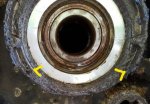
While waiting for a parts delivery, including some "Special Mercruiser tools, I set about cleaning the hull, which is now 99% back to nice clean original gel coat!
Then I removed the leg, followed by the gimble housing. The bellows itself was in very good shape, but it had come adrift from the flange in front of the gimble bearing, and likewise at the opposite end, on the other flange. Closer inspection revealed why. Both flanges were severely corroded and missing a sizeable section along their bottom edges, right where most of the tension and stretch was with the leg raised.
So, to correct this and do it right, the gimble housing must be replaced.
( I've sourced a nice clean, freshwater used one on ebay ) I've seen youtube videos of various fixes, but none really appeal to me.
Besides, replacing the housing means removing the transom assembly, which means pulling the engine, which means I'll have full access to the bilge and transom. So I'll be checking out the transom etc. in detail, with a view to replacing it if needed, which I suspect.
My work season will begin again by the end of February, so time will be limited, and maybe I wont see much of the water in 2019, but I hope at the end of it, I'll have a much better boat with many more years left in her. All bits and bobs, such as bearing, all bellows, lower shift cable etc. will be replaced, as was my original intention.
I'll post and update as I progress. In the meantime, I'm looking for any info, tips, suggestions etc. regarding pulling a Mercruiser 5.7 from a 25'Wellcraft Sportsman.I can't find anything very specific online, so any input is most welcome. I'm handy with spanners, wood, fibreglass etc. so not too daunted, but interested in any do's and don'ts. Included is a picture of the damage/corrosion to the flange and it's just as bad on the opposite flange.

