Looking for the correct wind indicator for a 24 foot bilge keel boat

kyle2643

New Member
Joined
25 Aug 2016
Messages
2
Visit site
Hello everyone, first post here and pretty much brand new to the yachting world. I am looking to purchase a wind indicator to help me out with, well the direction of the wind obviously. I thought this would be a very simple purchase but now I've started looking I see things like "for upto 26 foot" or "for fin keel" and its left me confused. How can the wind indicator know the size of the boat or what keel you have?

If someone could explain that it would be great but most imporatnly I just need to be pointed in the direction of the best wind indicator for me.

My boat is a Trident 24 with the bilge keel.

Thanks in advance
 
Hello everyone, first post here and pretty much brand new to the yachting world. I am looking to purchase a wind indicator to help me out with, well the direction of the wind obviously. I thought this would be a very simple purchase but now I've started looking I see things like "for upto 26 foot" or "for fin keel" and its left me confused. How can the wind indicator know the size of the boat or what keel you have?

If someone could explain that it would be great but most imporatnly I just need to be pointed in the direction of the best wind indicator for me.

My boat is a Trident 24 with the bilge keel.

Thanks in advance

Either of these will be easily visible from your deck (I Have the Windex on my 22ft boat as I like the more visible red coloured undersides of the wind angle reference tabs):

http://www.seamarknunn.com/acatalog...or-1502.html?gclid=CO2kiY3r3s4CFcsp0wodp94E_g

https://marinestore.co.uk/Merchant2...re_Code=mrst&gclid=CKCClL3r3s4CFWEq0wod-XIIvg
 
Budget is a consideration, of course.
Electronics will give lots of information on a display at the helm, some not essential, especially if cruising.
I have, on that sized boat, the two 'no-go' marks and a simple weather vane on the VHF aerial. The sailing masthead light illuminates the three hi vis marks it has for night sailing.
My last boat had nothing and I did several hundred miles with two 15cm strips of bin liner plastic taped to the side stays... :o ...
edit- Welcome to the Forum- N
 
Last edited:
How about a burgee? You can make one with a bit of stick, some wire and some nylon fabric. You also do need a small halliard block and some string.
 
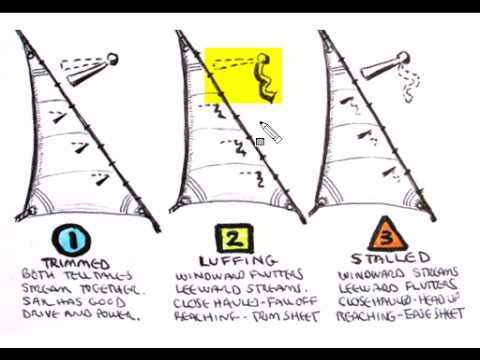
What do you want the wind indicator to do for you? If it's to help with sail trimming, consider telltales. I wouldn't have a sail without them! The difference they made to me when I was dinghy racing was huge. However I'll happily sail without a wind indicator.

hqdefault.jpg


http://thefinalbeat.com/categories/equipment/telltales-tufts-ticklers-flies
 
Full range of Hawk indicators shown on their website. http://www.hawkmarineproducts.com/wind.htm

If you prefer the Hawk to the Windex I'd suggest the Great Hawk for a Trident, but I am sure a Hawk, which is slightly smaller, will be adequate. I have a Great Hawk

Aso available combined with VHF antenna. Hawk Marine Products are located in Hayling Island and have proved helpful when parts have been need by other forumites

Windex is Swedish Full range here http://www.windex.se/products.html

Not familiar with Windex indicators but I am sure Windex 10 will be adequate for a Trident . Windex 15 if you fancy a larger version.

Which ever you opt for fit it on the centreline. I fitted mine offset to one side initially ........... I moved it to the centre line after one year!

I also have luff telltales on the genoa. No substitute really for getting optimum sail trim.

The best will of course be an electronic wind direction indicator with a cockpit mounted display. Great having the display at eye level rather that having to look up at the top of the mast all the time esp in bad weather conditions.
 
Last edited:
Hello everyone, first post here and pretty much brand new to the yachting world. I am looking to purchase a wind indicator to help me out with, well the direction of the wind obviously. I thought this would be a very simple purchase but now I've started looking I see things like "for upto 26 foot" or "for fin keel" and its left me confused. How can the wind indicator know the size of the boat or what keel you have?

If someone could explain that it would be great but most imporatnly I just need to be pointed in the direction of the best wind indicator for me.

My boat is a Trident 24 with the bilge keel.

Thanks in advance

Strip of rag tied to the shrouds.
 
Strip of rag tied to the shrouds.

As long as you pay the royalties to the original designer - http://www.keepturningleft.co.uk/blogs/ktl-tell-tales-patent-applied-for/

But in all seriousness, rag on shroud and wool on sail and you do basically have all bases covered better than the electronics for 50p. In fact I've just been convinced not to replace the broken wind instrument on my new old boat.

I did have a Hawk on the Hurley - one built on to the VHF antennae - but it didn't really tell me anything I didn't already know...
 
Last edited:
I have the Hawk as part of my VHF aerial. Works well. I used t have a couple of red / gree dingy tell tales on the shrouds and found them easier than looking up and useful when working out col-regs in the stressful early days.
 
Size is mainly to do with visibility from the deck. I cant see how the keel form makes any difference though! Many Trident24 owners have fitted something like the Hawk or Windex to their boats.

Why not come and talk to other Trident Owners on our Facebook site and tell us about your new boat: https://www.facebook.com/groups/trident24/

You will also find a lot of info on our website https://trident24.com/

See you there!

Jon
Commodore, Trident Owners Assocn
 
Last edited:
I had a combined wind indicator and VHF aerial (a Hawk, I think but am not certain). It was fine as a wind indicator but soon failed as an aerial as the connection with the coax cable came apart (and the cable was rather skinny). For the last few years I have had a combined Metz aerial and Windex from Salty John which has performed both functions well.
 
Around here we have a problem with parrots. (Corellas to be precise) The more expensive the wind pointer or transducers the more they like to chew on them. I made a home made pointer that has lasted quite a few years.
I had some carbon fibre cloth that I laid out on a flat smooth surface. I laid cling wrap on that so it would not stick. I cut it out to look like an aeroplane fin about 40cms high with a long "fuselage" about 15mm high. One layer of cloth was good for the fin but I used several layers on the fuselage laying a piece of stainless steel tube about 15mm long with 3mm hole
vertical in the fuselage about 1/3 from the fin leaving 2/3 of fuselage pointer. You can use polyester resin best or epoxy needs paint. Hold it sideways on a thin shaft to get balance right. Either trim the pointer or add lead to the tip.
I used a bit of 3mm stainless rod with a loop in the bottom to take a screw into the side of the mast and a little flat plate of ss screwed in to support the post near top of the mast.
To hold the pointer on I use brass tube with screws from chocolate block electrical connectors one above and one below.
I do not have or need markers for close hauled etc. I use sail trim for that but it is useful in predicting a gybe.
good luck olewill
 
Around here we have a problem with parrots. (Corellas to be precise) The more expensive the wind pointer or transducers the more they like to chew on them. I made a home made pointer that has lasted quite a few years.

good luck olewill

The only parrots we have are red necked parakeets in few areas in the south east.
 
Simple tufts of wool - say 6" long - tied with a few turns around your cap shrouds about 6' up will do the trick nicely for 50p, or free if the Mrs has a sewing box handy.

They are in line of sight - like the Head Up Display on a fighter - and don't rely on dodgy designs, links and battery power as the electronic jobs do.

A masthead windex / hawk is worth having - especially if for example you're in a sheltered spot between high banks like Hayling Yacht Co & River Frome to mention two, or in a lock, the clue to what the wind is doing outsde as is tacking angle is useful and it's not deflected by sails.

Another + for Windex & Hawk, they have refelective bits ( some have a little light but that of course means wiring ) so a masthead nav' light should show it to give a reliable reading at night.

Traditional masthead burgees are not easy to see in sunlight, may mask masthead lights at night, and most importantly vibrate down the mast like a B**ger when one is trying to sleep - the halliards can be frapped - tied - away but really they're a pain; if you want to show your club wear an all cloth burgee at the starboard signal halliard, below the spreaders.

The one good thing about electronic displays is you can see them at night- especially if you have an amplified ' close hauled / running ' sector display as well - BUT that's only when they work, and even the expensive ones have poor life lengths - nb above re windex at night.

If one is used to the boat and sailing before night sailing electronic wind instruments won't be necessary for casual cruising.
 
Last edited:
Simple tufts of wool - say 6" long - tied with a few turns around your cap shrouds about 6' up will do the trick nicely for 50p, or free if the Mrs has a sewing box handy.

They are in line of sight - like the Head Up Display on a fighter - and don't rely on dodgy designs, links and battery power as the electronic jobs do.

A masthead windex / hawk is worth having - especially if for example you're in a sheltered spot between high banks like Hayling Yacht Co & River Frome to mention two, or in a lock, the clue to what the wind is doing outsde as is tacking angle is useful and it's not deflected by sails.

Another + for Windex & Hawk, they have refelective bits ( some have a little light but that of course means wiring ) so a masthead nav' light should show it to give a reliable reading at night.

Traditional masthead burgees are not easy to see in sunlight, may mask masthead lights at night, and most importantly vibrate down the mast like a B**ger when one is trying to sleep - the halliards can be frapped - tied - away but really they're a pain; if you want to show your club wear an all cloth burgee at the starboard signal halliard, below the spreaders.

The one good thing about electronic displays is you can see them at night- especially if you have an amplified ' close hauled / running ' sector display as well - BUT that's only when they work, and even the expensive ones have poor life lengths - nb above re windex at night.

If one is used to the boat and sailing before night sailing electronic wind instruments won't be necessary for casual cruising.
 
Top