Long Keeler going astern

Yes there is a solution. When going astern don't keep power on blip the throttle and the boat will go straight. If you have gone bows to on a pontoon then before leaving tie a slip spring from a centre cleat to a cleat on the pontoon level or close to the stern. Run the engine for 4 minutes at 1,200 rpm that gets water flowing over the rudder and the boat will go straight. I'm amazed this has never been published in a sailing mag and it isn't common knowledge among the long keel community. It's easy and not a rudder issue, all long keel boats do the same as you say.

I wonder if the skittish behaviour has something to do with the bilge keels perhaps they don't like going slowly, I've never known in a single keel boat be skittish unless it's vey lightweight. Hopefully another bilge keel owner will be along soon and knows the answer.
 
If you have gone bows to on a pontoon then before leaving tie a slip spring from a centre cleat to a cleat on the pontoon level or close to the stern. Run the engine for 4 minutes at 1,200 rpm that gets water flowing over the rudder and the boat will go straight.

I wish someone had told me that 20 years ago. If it works it's genius. Thanks
 
If you have gone bows to on a pontoon then before leaving tie a slip spring from a centre cleat to a cleat on the pontoon level or close to the stern. Run the engine for 4 minutes at 1,200 rpm that gets water flowing over the rudder and the boat will go straight. I'm amazed this has never been published in a sailing mag and it isn't common knowledge among the long keel community. It's easy and not a rudder issue, all long keel boats do the same as you say.

It sounds like a good idea and Oldvarnish obviously gets it.

I am totally lost .

Are you suggesting motoring forward on the spring for 4 minutes and then reverse out ?

Many Thanks
 
It sounds like a good idea and Oldvarnish obviously gets it.

I am totally lost .

Are you suggesting motoring forward on the spring for 4 minutes and then reverse out ?

Many Thanks

Even if it works, which I doubt, why four minutes? As soon as you get the prop up to speed you've got maximum flow and hanging around can't make any difference. Unless you're in a goldfish bowl.
 
Every boat that has enough rudder authority when going forwards will also steer in reverse.

You have to give it a chance, and then it will.

In no breeze at all, stop fwd motion with reverse. When you can see (by looking at the water surface stuff) that you are moving backwards, try just a few degrees of tiller in the prop-walk direction. It will turn. Stop, and do it again. It will turn, but take longer. Establish a speed that won't make the tiller load too high if you need to increase the rate of turn. Too many degrees and the rudder becomes almost negligible, despite what you might think!

With wind, that won't work. You have to put the bow directly downwind. That's where it must be when you stop (and will be where it ends up if the tiller is centered with no sails up. Again, make sure that you really have stopped. As before, engage reverse. It will steer. I promise. Keep the speed manageable. If you aren't sure of the wind direction, leave it reverse idle for a minute or two. Your mast has now blown the bow downwind, and you've had a cup of tea.

Sometimes you really have to plan for the only one option that will work. So start reversing well away from the berth (in my learning case it was outside the harbour) get steerage and know that you'll be reversing into the berth. It may gos wrong, fwd will stop it hurting.

The biggest mistake is to decide that the boat "won't steer in reverse" without spending ten minutes of a flat calm day finding that it will.

How did I discover this?

The only boat that "wouldn't steer" had been a Southerly 28. Until 1991 and a Nonsuch 30. Lovely boat, but with a mast two or three feet from the bow (consequently even more likely to steer upwind in rev to start with), and a very short rudder, and then the 'merican twin lever engine controls. One for fwd/rev, other for revs. Compounding the problems:-

Idle stop was not adjusted correctly. Don't drop to idle, or it will stop. Berth was downwind, but I wanted to be stern-to.

This was to be a one-off. If it didn't work, then fwd had to be engaged to avoid. But mustn't let the revs drop too low. (Or try to change rev to fwd at too high because gbox won't like it.

Dear reader, it worked.

I'd love to go back to that Southerly and park it like I meant to. Last year I reversed a CO32 out of a berth in Yarmouth to a ripple of applause (propwalk not on my side but a gentle breeze was - wafted the bow downwind).

My point is this.

People worry about honing their boating skills.

Break it down into chunks.

My first one would be to moor up in such a way that I could do it on my own.

If you've read this far, and are still awake, the last two might be 'how to tack with minimum speed loss' or some such.

Yer just have to spend a lot of time doing it.


This may be reproduced from time to time...
 
Try to always look as though that is where you meant to end up, works every time.
 
>Are you suggesting motoring forward on the spring for 4 minutes and then reverse out ?

Sorry I wasn't clear, obviously put the engine in reverse.

>Tried that. It does not work.

If it didn't work it's likely you didn't stay in reverse for long enough, try again and look over the stern and wait until you see water going back over the rudder it will happen.

>Even if it works, which I doubt, why four minutes? As soon as you get the prop up to speed you've got maximum flow and hanging around can't make any difference. Unless you're in a goldfish bowl.

Fin keelers have a big gap between the prop and keel, so in reverse there is instant water flow over the rudder. Long keelers rudders are hung on the back of the keel so put it reverse and prop walk will take over immediately, hence the four minutes, you could probably do less but I prefer to be to be certain that water is flowing.

>Every boat that has enough rudder authority when going forwards will also steer in reverse.

Not long keelers for the reasons I've said above.
 
Last edited:
Tried that. It does not work.

OK. Let me be more precise. In dead calm conditions - no waves and no wind whatsoever, after a run up at pull power in reverse for about 1/3 of a mile - by which time I get to about 5 knots, if I put the engine in neutral, the boat will go more or less straight and with a little bit of rudder I can persuade it to go in either direction or keep it straight. But once the speed drops off below 5 knots, then the boat veers off to one side or the other (more often port than starboard - no idea why) and no amount of rudder in either direction has any noticeable effect.

I.e. to all intents and purposes, (e.g. backing up a marina access channel), it does not work.
 
OK. Let me be more precise. In dead calm conditions - no waves and no wind whatsoever, after a run up at pull power in reverse for about 1/3 of a mile - by which time I get to about 5 knots, if I put the engine in neutral, the boat will go more or less straight and with a little bit of rudder I can persuade it to go in either direction or keep it straight. But once the speed drops off below 5 knots, then the boat veers off to one side or the other (more often port than starboard - no idea why) and no amount of rudder in either direction has any noticeable effect.

I.e. to all intents and purposes, (e.g. backing up a marina access channel), it does not work.

That's bonkers in my case.

If I tried even half throttle astern due to prop walk I simply do a clockwise 360.

I've found the best approach (in calm conditions) is to come to a dead stop from ahead. Then use very short bursts of astern at idle revs which is just enough for the rudder to work. This way the prop walk is minimal but the rudder is on the large side which helps.
The worst thing I can do is to rush the old girl by trying to go too fast, having to use too many revs and being too ambitious with the manoeuvre.
 
>

Sorry I wasn't clear, obviously put the engine in reverse.

tie a slip spring from a centre cleat to a cleat on the pontoon level or close to the stern. Run the engine for 4 minutes at 1,200 rpm that gets water flowing over the rudder and the boat

Thanks. I understand now.

It was the slip line you mentioned from the centre cleat on the boat connected to the pontoon close to the stern that threw me.

Will definitely give it a go. I doubt there would be much flow over the rudder in reverse though.
 
>Will definitely give it a go. I doubt there would be much flow over the rudder in reverse though.

As I mentioned 1,200 revs astern and look over the stern and watch until there is a good flow over the rudder, when there is leave the power on and you/crew release the spring. 1,200 works for me but if it doesn't for you try increasing revs slowly until there is a good flow.
 
I have read all the replies and also searched other threads to do with the problem of long keelers going astern. I believe that there is no cure for the lack of control when trying to go astern! There seems to be partial cures which will entertain onlookers and frustrate the crew using some of the suggestions. I have tried the power blips with some success in calm conditions. However add some wind and its anybodies guess where we end up. There isn't much space to allow experiment when trying to get the boat out of the pontoon mooring finger. I have heard it said that the rudder size on this particular boat is small so I am tempted to add a bit more area. This can be a long term experiment as the boat only comes out of the water for two weeks in the summer. If it's not right then I will have to wait another year to rectify the issue.

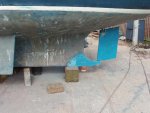
I have added a picture of the rear end! The prop has been removed for cleaning .. reminder the waterline length is 28 ft the length of the rudder is 1.7 ft and the depth is 2.5ft there is approx 10% balance in front of the rudder post.
 

Attachments

  • Port Aft.jpg
    Port Aft.jpg
    95.7 KB · Views: 1
Last edited:
>so I am tempted to add a bit more area.

If you do that it will make going astern even worse, keep practising what I've suggested and all should be well. I take your point about calm conditions, crosswinds blow all boats off the only way to counter it is to try to use the prop walk to get the right angle to stop it, it is difficult.

>There isn't much space to allow experiment when trying to get the boat out of the pontoon mooring finger.

Just try using the spring and watch over the stern for water moving over the rudder, do that the number of times that gives you confidence to use the technique. Then just loosen the spring a few feet and see what happens.I can assure you it works.
 
My experience, acquired after years of failure and embarrassment, is that my Twister is more affected by the wind than prop walk when trying to manoeuvre astern.

She generally tries to seek the wind with her stern but does not do so very accurately and follows a gentle curve due to prop walk until she has put the wind sufficiently on one side to push the bow back again. Thus she follows a sort of oscillatory path. So, if leaving a finger berth with a wind dead aft, there is a chance of getting clear of the finger, and other boats, before going ahead and making as tight a turn as possible towards open water with a burst of ahead power and the rudder well over.

But if the wind is not dead aft when leaving the finger then, depending on its direction, it will either try to push the bow into the pontoon or into the neighbouring boat. This can be countered initially by the use of warps (or a shove) but once clear of the pontoon the bow will blow off. If that points me towards open water then it's my lucky day. If it points me towards the dead end, and there is not room to make a 180 degree turn (and there often isn't :(), then I have to do something to force the bow to face the wind. The only ways I know are to use a riding sail (which I don't have), a lead weight on a line from the bow (works very well) or, following advice from Vyv Cox, stream a bucket from the bow (not tried it yet but it seems a good idea).

The disadvantages of the riding sail or the bucket is that the boat will be moving astern, although facing the wind, and there may not be room to go very far if you are near the dead end.

The lead weight acts as a temporary anchor and holds the boat where she is. A 25lb weight will hold the bow of my 28' Twister in place in a force 6. The disadvantages of the lead weight technique are:
- you end up with a dirty mess on the foredeck and on your clothes from the mud and God knows what else is in the marina,
- someone has to manhandle the weight, but this is easier than dealing with a 25lb anchor because a 25lb lead weight is very compact
- you are sailing around with a 25lb weight that is no use for anything else except, occasionally, as a kellet.

Suggestions about building up speed astern are useless to me. If I have room to reach 3 knots astern then I have room to turn round; and there is no way I am going to risk charging astern at that sort of speed between two lines of expensive and shiny boats :eek:
 
Last edited by a moderator:
Suggestions about building up speed astern are useless to me. If I have room to reach 3 knots astern then I have room to turn round; and there is no way I am going to risk charging astern at that sort of speed between two lines of expensive and shiny boats :eek:

If I try building up speed of 3 knots in reverse, all hell will break loose and the yacht will be zig zagging everywhere and the rudder will be forced either one way or the other uncontrollably; however, keeping the speed to below 1 knot, things are very different and if there is no much tide or wind I have much more control; when the boat decides to go left or right on its own accord, I kill the speed and it corrects itself, and then carry on.

It would have been nice if I had a quick removable bow thruster that drops at one side near the bow and then lift up and pack away; but I don't and there is none in the market.
 
It would have been nice if I had a quick removable bow thruster that drops at one side near the bow and then lift up and packs away; but I don't and there is none in the market.

There is something similar. Son Owen has used an electric outboard very successfully as a stern thruster on his steel yacht. With some ingenuity I guess it could be used forward.
 
There is something similar. Son Owen has used an electric outboard very successfully as a stern thruster on his steel yacht. With some ingenuity I guess it could be used forward.

Thanks for this, its a good idea which I think I will try out with the first opportunity; perhaps a cheap new electric o/b could be the solution to the problem.
 
Top
