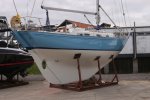
long keel rudder mod?

we should all wait for the pictures really. once you have those uploaded we should between us be able to to say whether the area looks reasonable compared to our own various long keelers.

starter for ten, heres mine. I have outlined the rudder in red as the picture is not great. 32 LOA. 13000 lbs displacement. wheel steering x2.
under power:fine forwards. RH prop but its anyones guess (or more likely wind/current dependent) which way she goes in reverse. under sail: a joy to be at sea with; sails her self for hours. Sail balance is everything. Just a touch of weather helm required for decent windward work of course.

lets get some other line drawings up of owner boats then we can compare once the OP gets a good sideways shot on here
 
well, I aint no naval archetect but Id say that rudder is plenty big enough. it got more area wrt the rest of boat than mine or parsifals, although parsifals high aspect one must surely be the most efficient.

I must say. either that prop is tiny or the cutout is enourmous! even in ahead get a bit of lock on that and the propwash is straight through. theres actually far more meat behind the prop than I have on mine.

my perkins 4108 spins a 15x13 RH.
 
I think the OPs rudder looks definitely on the small side, and is an odd shape - not enough of it higher up, behind the prop, to my eyes. (Also the bottom, where there is some area, continuing the line of the bottom of the keel looks vulnerable in a grounding). The rudder also looks to me very thick and poorly profiled. Tapering the thicknes of the aft two thirds to nearly a point would make it more effective, I'm fairly sure, even if the area stays the same.

Agree the prop looks undersized.
 
Agree - rudder looks fine with the area low down, although that huge cutout does not do it any favours. Prop is small, looks like the designer intended a 15" or thereabouts. Need to check the gearbox ratio to see if a bigger diameter finer pitch prop can be fitted. Put the boat and engine/box data into the Propcalc programme on www.castlemarine.co.uk. a bigger prop would improve motoring performance, but may reduce speed under sail - a feathering prop is the answer.

Don't think the lack of control in reverse is anything to do with the rudder - just a consequence of that long underwater plane! The rudder would be improved however by filling in a fair chunk of that cutout, particularly if you are stuck with that little prop.
 
Here's a couple of pix of the OP's boat:


I reckon the props too small.

That's a big trim tab on the keel, shouldn't there be a rudder at the back of the boat?
I don't think you can enlarge that much, it is already too long for its height.
A bigger prop tuning slower might work a bit better.
If it works OK ahead, I'd just avoid going astern.
Or get a big steering oar, some sort of aux rudder (self steering gear type of thing?) or side-mount the outboard?
 
just looked back to the OPs post on prop size -circa 12". thats way too small for the perkie as indicated by 1500rpm = 5kts. I get 6 to 7 knots with 1100 rpm from my 4108 in the flat calm the rest of the 50hp is there to punch through the rough. if you have the hurth box I do then I can tell you a 15x13 works fine.

so, i'd say 1st port of call, get a much bigger prop on there. try it out. once bigger prop is fitted see how the clearance on that huge hole is maybe fill a bit in. finally you could reduce its tendancy to stall with a bit of fairing more wing shape less plank shape - but thats more for under sail than reversing under power.
then thats it im afraid. you certainly dont want that low aspect ratio rudder any bigger in chord. your keel is a very traditional long keel without much cutaway at the forefoot.

accept it or fit bow thruster or buy new boat!
 
Try 'Skenes 'Elements of Yacht Design'' for rudder design, shape and proportions.
IIRC he states that after 35 degrees a rudder simply becomes a brake. The book was first published in 1904 so there might be a more modern view.....

20 yrs ago I did a weekend course of 'Close quarters Handling' with John Goode's Southern Sailing - and very good it was !
On a long keel yacht (deliberately chosen) we finally managed to do a figure-of-eight in REVERSE !!
It would only go one way and only with the rudder at a very specific angle and only at a certain speed. Out of the wind.
I learned from this that you can do it - but it takes a lot of experimentation and practice.

Good luck
 
Not related to the OP's problem, but here is an interesting variation on a theme of transom hung rudders often being 'heavy' because they don't have any counter balance.
Chuck Paine has managed to introduce some area forward of the pivot point, and it looks like it should be very effective - I don't think that they have actually built any Expannies yet though, to test the idea.
http://www.chuckpaine.com/boats/36-offshore-voyager-expannie/
 
Reagarding checking the gearbox, I have looked at it and it is so well hidden that I cant see any makers plate, how do I tell which make of gearbox it is and how do I find out what the ratio is. As far as the prop size goes yes it does look small but would fitting a bigger prop make the reverse situation better or just the forwards in bad weather. Got to say it iks economical with this prop, on the hol motored a lot and was using half a gall per hour which I thought was good, so does that say the prop is right and if I cut the apperture down would that affect the speed at 1500 rpm or sploil the fuel consumption. Who is the best place to see about a prop?

Richard
 
Not sure what gearbox you have, but it may be a direct i.e. 1:1 or a reduction box at say 2:1. A 12" prop suggests a 1:1, but without knowing the pitch of the prop it is difficult to say. There will be a plate on the gearbox casing giving its ratio, but probably covered in muck! The only way of physically checking i to turn the engine over by hand and count the revolutions of the shaft when in gear, but this means taking the injectors out. It is the shaft speed that determines the size of prop you can use, so essential to get the ratio. Running at 1500 is not necessarily a good idea on an engine that is rated at over 3000. Fuel consumption is a function of the power you are drawing from the engine, which in turn is a function of the load the prop is putting on it.

A bigger prop will likely help in reverse because you will get more thrust which may help turning the boat using power as others have suggested but is not magic.

There are plenty of prop suppliers who can recommend a prop size for you, but they will want to know the reduction ratio (as well as other boat data) as they will use a calculator such as the Propcalc to work out what is best.
 
Obviously getting a new bigger prop is a reach in the dark an I imagine an expensive one,
most posts seem to think that the space around the prop is too great as the prop wash is going through the hole, has any one any experience of a prop hole say I inch from the prop on a long keeler as to how it would affect forwards travel as I have got to think it will improve astern travel. When I say I inch I mean at the nose of the prop not at the top and bottom, or would anyone suggest closing the gap to 1 inch all around, the inch at the nose is easy to fabricate the top and bottom less so.

Richard

Not sure what gearbox you have, but it may be a direct i.e. 1:1 or a reduction box at say 2:1. A 12" prop suggests a 1:1, but without knowing the pitch of the prop it is difficult to say. There will be a plate on the gearbox casing giving its ratio, but probably covered in muck! The only way of physically checking i to turn the engine over by hand and count the revolutions of the shaft when in gear, but this means taking the injectors out. It is the shaft speed that determines the size of prop you can use, so essential to get the ratio. Running at 1500 is not necessarily a good idea on an engine that is rated at over 3000. Fuel consumption is a function of the power you are drawing from the engine, which in turn is a function of the load the prop is putting on it.

A bigger prop will likely help in reverse because you will get more thrust which may help turning the boat using power as others have suggested but is not magic.

There are plenty of prop suppliers who can recommend a prop size for you, but they will want to know the reduction ratio (as well as other boat data) as they will use a calculator such as the Propcalc to work out what is best.
 
Problem there is you may not be able to remove the prop from the shaft if you need to without taking the rudder off or moving the engine forwards. You could reduce that cutout quite a lot, particularly if you kept the small prop. Around 16" vertically and enough clearance aft for the hub of the prop to clear the end of the shaft. Obviously props work better in clear water and you may find the leading edge of the rudder interferes with the water flow. At the very least you would benefit from shaping the rudder to an aerofoil section. Having said that my rudder is like that - just enough clearance aft to remove the prop and the rudder is about 2" thick - but my prop is 15" so the blades are not masked significantly. Seems to work OK.
 
Thanks for all the help guys, think I am going to do the following. Fix 2 stainless steel 2mm thick plates to either side of the rudder around the prop hole, then fit a top cap that is tapered to a point to aid flow and fit it to an inch clearance, unless someone can tell me that would impede the prop working and how that would show in operation. I imagine that the clearance at the nose of the prop is not that important and that such a small clearance there should not affect things.
I also intend to tapper the rudder to a point at the rear, at present it has a 3/4 inch wide and deep scallop down the back leaving a blunt 1 inch rear most part, any thoughts.


Richard
 
One day, departing from our anchorage where there was plenty of space, I set the Helm amidships and engaged astern and observed. I could see the path taken due to the disturbed water and now use that to my advantage in close quarters. Nothing much happened to start with but once underway, we would have gone around in circles! The rudder has a supporting role astern but is certainly not the dominant factor. Astern, the thrust of water from the Prop is over the keel effectively making that double up as your Rudder. A fixed one! There is a sweet spot though when the Rudder is aligned to the direction of travel determined by your prop walk. Imagine an equal flow of water either side of the Rudder. If attempting a 'three point turn' in close quarters using engine driven forward and astern, don't even bother to adjust the helm. Put your faith in prop walk and account for wind and tide accordingly.

Mastering the characteristics of your boat astern is a joy to behold and a skill to be proud. Effective use of prop walk is the key to mastering that skill.
 
The rudder does look a bit small for the size of boat but it has been like that since it was built and I would not alter it in any way without consulting one of the local naval architects. The prop is definitely too small. For comparison, my 28 foot Commando class had a 15 inch prop driven by a direct drive BMC Captain 30 HP diesel and my current Renown has a 16 inch prop driven through a 2:1 reduction box by a Watermota Sea Panther 27HP diesel. I renewed the prop on Wight Dawn a few years ago (the old one was losing its zinc content) and managed to pick up a new one for £150.

If you think your boat is hard to steer astern, talk to Ashonavega about the Albin Vega or anyone who has owned a Commando. Both of these had the prop offset and AFT of the rudder. Going astern was a nightmare and even starting off ahead was a problem as you could only steer once you had built up a bit of speed. Add in viscious prop-walk and life was very interesting. Despite this, I owned the Commando for 11 years and Ash still has his Vega I think. We just don't spend too much time reversing. My first keel boat did not reverse at all. With a side-mounted Seagull for power, that was not an option! Even Wight Dawn with its skeg and rudder behind the prop and a keel that is more fin than long keel, reversing is not exactly easy and involves starting with the boat 10 degrees to the right of the intended direction of travel.
 
Top