Long cruise with MAN 1360 at low speed!

It depends who you believe, others with far more experience than me will come along with their views but as long as the RPM is adjusted periodically I don't see a problem.

I'll take cover now 😏
 
It depends on the load , which you can access from the MMDS screens .

What rpm s are you talking about ?
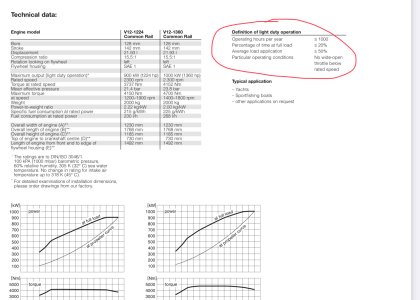
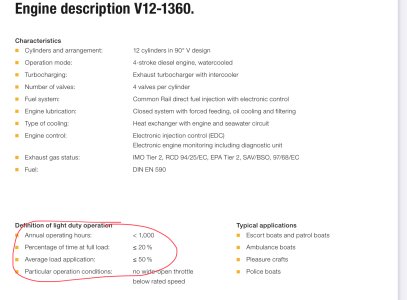
The manual has the ave load % times s for its ratings

Tick over ie 600 rpm for long periods is a no no according to the manual with MAN s from that era .I have a pair of 2876 s le 401 . Rated @ 700 Hp .From 2003 so identical tech wise just 1/2 the size .

It does say I can spend a certain amount of running time at say under 50 % load .
60 % load as it happens for my boat which equates to around 900 rpm , 9.5 knots .Burns 22 L per side .

Here find these for your boat .This is for the CR 1360 .It’s not clear from your post if yours are CR as you haven’t given the full engine designation codes .2004 was a cross over yr when CR was starting to be rolled out .

BD29D081-DBFA-4F8E-8200-A7732A25D5CF.jpeg852C07B1-D115-48BC-9095-AFB148341BAE.jpeg
 
Last edited:
Tick over ie 600 rpm for long periods is a no no according to the manual with MAN s from that era
We already discussed this.
The recommendation you are referring to is specifically related to unloaded idling, i.e. with gearbox in neutral.
A time limit to running the engines at low rpm with the gear engaged just doesn't exist.

I have a pair of 2876 s le 401 . Rated @ 700 Hp .From 2003 so identical tech wise just 1/2 the size .
[...]
It’s not clear from your post if yours are CR as you haven’t given the full engine designation codes .
2004 was a cross over yr when CR was starting to be rolled out .
If the OP has MAN engines rated for 1360hp, they are CR for good (LE423).
In fact, those were the only 1360hp engines ever built by MAN.
BTW, very different from your so-called EDC engines, which simply adopted an electronic governor on otherwise mechanical engines.
A solution that they used just for a few years in all their engines aside from V8s, which was a sort of testbed for the CR they eventually used also on R6, V10 and V12. The V12 comparable to yours, in those days, were the LE404, rated for 1300hp.
CR adoption was a much more radical development, which came also with others, like the 4 valves heads, among other stuff.

Just saying, 'cause this is irrelevant to OP question.
Regardless of age and technology, there's no such thing as a MAN engine for which the manufacturer officially recommend to avoid using it at low RPM for long time - as simple as that.
And while I can't be positive about other manufacturers, I have a funny feeling that this is also true for them all!
 
Last edited:
We already discussed this.
The recommendation you are referring to is specifically related to unloaded idling, i.e. with gearbox in neutral.
A time limit to running the engines at low rpm with the gear engaged just doesn't exist.


If the OP has MAN engines rated for 1360hp, they are CR for good (LE423).
In fact, those were the only 1360hp engines ever built by MAN.
BTW, very different from your so-called EDC engines, which simply adopted an electronic governor on otherwise mechanical engines.
A solution that they used just for a few years in all their engines aside from V8s, which was a sort of testbed for the CR they eventually used also on R6, V10 and V12. The V12 comparable to yours, in those days, were the LE404, rated for 1300hp.
CR adoption was a much more radical development, which came also with others, like the 4 valves heads, among other stuff.

Just saying, 'cause this is irrelevant to OP question.
Regardless of age and technology, there's no such thing as a MAN engine for which the manufacturer officially recommend to avoid using it at low RPM for long time - as simple as that.
And while I can't be positive about other manufacturers, I have a funny feeling that this is also true for them all!
I made the point , advised him to follow the manufacturers manual on this , the duty cycle .Which it seems ( according to you ) i posted the correct screen shots ,in case he hasn’t got access .
Thats the best advice .

Whats your point or advise to him on the limited info disclosed thus far ?
 
Regardless of age and technology, there's no such thing as a MAN engine for which the manufacturer officially recommend to avoid using it at low RPM for long time - as simple as that.
And while I can't be positive about other manufacturers, I have a funny feeling that this is also true for them all!
“ Regardless of age and technology, there’s no such thing as a car for which the manufacture officially
recommends to avoid using it at max speed driving off the edge of a cliff - simple as that .
And while I can’t be positive about other manufacturers , I have a funny feeling that this is also true for them all “

Q - from the Op = Problems driving a car at max speed off the edge of a cliff , does it damage you or the car ?

@ MapishM let’s stick to what the manufacturer actually says how ever vague and open to multiple interpretations .
As opposed what’s been omitted .


My view FWIW , my 0.02 p worth .
Common sense assumptions are the boat builders naval architect/ designer has consulted the engine manufacturer(s) laying out the intended designed usage and said manufacture has come up with a suitable duty rated version out of its range that fits best the brief .
If fast planing boat owners find themselves doing a lot of D speed low rpm stuff with huge engines then they have the wrong boat for the job .IMHO !
The issue ultimately is low cylinder temps + pressures and resultant excess soot .

As long as these soot particles remain suspended in the oil and are not allowed to agglomerate, they pose little risk to engine parts. It is up to the motor oil dispersants to keep soot particles dispersed. However, in high soot conditions, dispersants can become quickly depleted.

High soot load conditions lead to loss of oil dispersancy as oil dispersant additives are consumed. As dispersancy is lost, soot particles agglomerate and form larger particles that build up on engine surfaces. This soot and sludge eventually impedes oil flow, and it can also form in oil filters, blocking oil flow and allowing dirty oil to circulate through the engine.
CR electrotwackery can reduce this better than none CR by better accuracy with the fuel / air mix , but not eliminate it .But are better placed to run excessively at lower rpms .

Higher cylinder temperatures and pressures result lower valve seat wear, which is attributed to parting agents or oxide films and valve head deformation.So too much low running speeds up valve seat wear .= head off job .

Having said this MANs “light duty “ in leisure use the less than 1000 hrs /year …I very much doubt any one on here is getting any where near those hrs .
Personally I am doing 50-80 a year , so currently on 1100 , raised it from 480 in 8 seasons .
Its oil is changed annually not every 400 hrs , so the agglomeration issue is headed off at the pass it’s MAN spec 3275 oil as per manufacturers. Again i am assuming folks read manuals and abide ? No supermarket oil !

As far as load i run mid 70 s % 1760-1780 rpm , 550 *c EGT s fuel burn 80 odd L/hr per side .
I do the occasional 9-10 knots lazy slow run , but it’s load as perviously said is 60 % and the EGTs though not ideal are N of 300 *c .I understand under 300 *c you get serious agglomeration.


There is risk how ever small worth tossing in with CR is the injector cannuli are Uber tiny and any agglomeration ( soot ) could block them .Not so much risk in older none CR as the cannuli they are massive in comparison. This is the basis of the much mentioned “ Italian tune up “ …..to blow crap of the off the injector tips .

Wether any of this theory actual plays out in practice with forum members boats is another matter .How ever I did ask a SoF MAN agent and separately a Italian ( Liguria based ) official MAN agent about this .In terms of call out , break downs etc .The CR s are the most unreliable .Various reasons mostly filters = crap fuel and elecrotwackery running them .
The EDC s from 2000-2004 where the most reliable, they attend the least .

They concurred running under between 70 - 80 % load was the best way to minimise breakdowns and advised against too much time at low rpms .Run the boat as the NA intended .= least risky modus operandi.

Personally i would have thought 8-900 rpm around 60 % load and N of 300*c EGTs which the OP should be able to see he should be ok for typical 100 hrs / year usage .With the occasional “ Italian tune up “ thrown in .

Bottom line is buy a D speed boat if you want to run slow ( and save fuel ) all the time or if you have a P speed boat plane it mostly.

I get the motivation to run slow with fuel costs .
 
Last edited:
“ Regardless of age and technology, there’s no such thing as a car for which the manufacture officially
recommends to avoid using it at max speed driving off the edge of a cliff - simple as that .
And while I can’t be positive about other manufacturers , I have a funny feeling that this is also true for them all “

Q - from the Op = Problems driving a car at max speed off the edge of a cliff , does it damage you or the car ?

@ MapishM let’s stick to what the manufacturer actually says how ever vague and open to multiple interpretations .
As opposed what’s been omitted .
That isn't what Mapis said, or what the OP asked.

Just drivel.
My view FWIW , my 0.02 p worth .
That sounds a little expensive.
 
That isn't what Mapis said, or what the OP asked.

Just drivel.

That sounds a little expensive.
Yes it is it like a double negative logic thingy .

Mapish is saying because the manufacturer did NOT say it’s ok to do it…..then it’s IS ok to presume it’s ok to do it .

Wether run your car off a cliff at max speed or run your marine diesels at low rpms .The manuals refer to neither .

I am sticking to what they actual say / said .
 
Mapish is saying because the manufacturer did NOT say it’s ok to do it…..then it’s IS ok to presume it’s ok to do it .
That couldn't be more far from the truth.
YOU said "Tick over ie 600 rpm for long periods is a no no according to the manual with MAN s from that era".
I simply pointed out that what MAN suggest is to avoid this when not in gear, because I don't think that's what the OP meant.
As opposed to that, there's no MAN suggestion anywhere to avoid running at low rpm for long period.
What's the part of this very simple observation that you don't understand?
 
That couldn't be more far from the truth.
YOU said "Tick over ie 600 rpm for long periods is a no no according to the manual with MAN s from that era".
I simply pointed out that what MAN suggest is to avoid this when not in gear, because I don't think that's what the OP meant.
As opposed to that, there's no MAN suggestion anywhere to avoid running at low rpm for long period.
What's the part of this very simple observation that you don't understand?
We don’t know exactly what he meant by low running or the exact spec of the engines .We both have had to join a few dots up .

Yes the manual suggests avoids prolonged periods in fact over 5 mins in N at tickover. Which nobody abides by .Fat lot of good that info means .

The manual is brief and omits a lot of stuff , my point by cheekily copying your post and inserting running a car of a cliff ….etc .Its omitted in car manuals , that does not mean the manufacture recommends it.

It’s my understanding ( which differs from yours ) reading the manual - Just because MAN manuals don’t say what you can’t do , it’s doesn’t mean you should do it or it’s ok to do it ,like running in gear at 600 rpm ultra low loading to save fuel .
Tick over in gear is ridiculously very low EGT s from memory under 200*c around 150 , the loads low from memory under 20 % - think 15 % ?maybe 12 % .I know it’s 4 % at tickover in N with mine FWIW , was looking at this out of curiosity the other day .

Fuel burns so low so much so even with additional electrotwackery of CR , algorithms etc etc the fuelling is far from optimal.
You are deep into all that agglomeration and knackered valve seal stuff I have touched upon .
Reserved for marina manoeuvres .

So the answer to the Ops Q in this circumstance is a definite Yes it will harm your engines .If you insist he meant tick over 600 rpm for prolonged periods cruising .I think he did not mean tick over all day every day all the time .We need clarity on this .
.
I mean just think of the poor ring seal ? The rings seal are optimised at 500-650 * C in MAN s .Slightly higher in Volvos .

Its absurd to think the OP framed his Q on tick over -600 rpm , speeds .Definitely bought the wrong boat .
The manufacturer MAN would not have suggested 1360 Hp V 12 version for this .There would have been alternative engines if the NA said it needs to run at 10-14 knots all day .

He said Low rpm .So with 1360 s in a 60-70 ftr D speeds gonna be what I am assuming 800-900rpm , or under a 1000 rpm .Circa 10-13 knots based on my 9.5 knots .Over that and he starts to push a bow wave rendering the whole low rpm rational pointless as the fuel burn escalates .

He has screens can see the load and EGT s and has the manual with the duty cycles .
He should be ok @ 800-900 rpm .Load will be N of 60 % say even 65 % which is ok and EGTs circa 350*c maybe as high as 400 *c so ok on that too .Additionally with annual correct spec lub changes and forum ave hrs he should be ok .But in reality there will be the odd 1700-1900 rpm runs anyhow .

If he’s really concerned the first season i suggest regular oil sampling every 100 hrs ,ie he plans on 400 hr , or starship hrs a season at mostly under 900 rpm on the same oil .If the samples come back clean so to speak just drop to one per season .

If it’s just a 20 hr delivery trip at 10 /12 knots 870 rpm then my answer is no harm .

If it’s a sports fisher the 2 hr 1800 rpm run home will undo loitering at tick over in gear , which the NA and MAN will be aware of intended use age and signed it off . It’s effectively getting an Italian tune up daily .Oil sample analysis is still worth while every 100 hrs imho .
 
Top