Log without impellers

TiggerToo

Well-Known Member
Joined
23 Aug 2005
Messages
8,409
Location
UK
Visit site
I did not want to hijack the thread on replacing old ST50 s (I am in the same position). But...

Does anyone know if there is anyone who makes a "Log" instrument which reads boat speed without the need of an impeller?
I have the feeling that it may be possible to design something which measures the speed of water along the hull without something that looks out of the middle ages.
 
There are various alternatives, but don't dismiss the impeller. If you antifoul it once or twice a year, an impeller log works well.
 
I fitted the NASA EML-3 over the winter. Very pleased with the performance so far. By now the impeller log would have become intermittent and soon need taking out to clean. a job I dislike(d) intensely. With this log I should be able to clean from the outside if it becomes necessary; deck scrubber from the dinghy.
It starts reading in the tide at about 0.2 knots. Speed damping seems to be several (5?) seconds as it takes a short while to catch up with the GPS speed changes.
There are different versions for pulse output or NMEA 0183.
 
easy to clean.

I wouldn't exactly call mine difficult, but it's certainly a faff.

I have to hunch down under the cabin table, remove one of the bunk cushions, remove the board underneath it, empty out (or at least re-stack) a load of tins in the locker beneath that, lift up the sole board in the bottom of it, do the usual quick swap for the bung, clean the paddle-wheel, swap it back, fetch a bucket from the cockpit locker, fetch a jug from the engine spares locker, bale out the water from the bottom of the food locker using the jug into the bucket, fetch a sponge, sponge out the water that the jug won't reach, replace the sole board, re-stack the tins, put the lid back on the locker, replace the bunk cushion, empty the bucket overboard, put the bucket back in the cockpit locker, put the sponge back, dry out the jug, and put the jug back.

Is it any wonder that a sensor that's less susceptible to fouling is an appealing idea?

Pete
 
That's a 'installers are stupid' problem, not a 'paddlewheels are difficult to clean' problem.
I had as stupid an installer as prv (that would be me, driven by a lack of alternatives), but a mate's boat had it in a shallow bilge with only a sole board to lift. It was still a faff, especially as he got older and less agile and, no matter how good the installation is, it's still under water, so you've suddenly got a hole in your boat and the sea is awful keen to join you.

If I put a log in my next boat, it will definitely be an ultrasonic one.
 
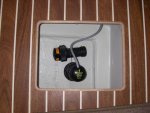
Mine's in a shallow bilge compartment under the forecabin floor. Just lift out the hatch, and there it is. I stuff an old towel around it before removing it, but only about a cupful of water gets in as the flaps in the tube seal fairly well.

impeller.jpg
 
We inherited one on a boat in the late 70s. It read very differently in frothy water to calm water and in shallow water compared to deep water. They didn’t catch on then with all those flaws so interesting to see if better transducers (and I suspect programmed data interpreters ) allow them to catch on this time. I see them like 3D movies - they burst onto the scene for a few years then vanish again.
 
Mine's in a shallow bilge compartment under the forecabin floor. Just lift out the hatch, and there it is. I stuff an old towel around it before removing it, but only about a cupful of water gets in as the flaps in the tube seal fairly well.

View attachment 118453
oooooo...

showing off your nice, clean, dry, posh bilges.]


Well done! Worthy of a Boat Show vessel
(written with envy and admiration)

Incidentally, is yours a "paddle" or a "paddle-less" airmar?
 
oooooo...

showing off your nice, clean, dry, posh bilges.]


Well done! Worthy of a Boat Show vessel
(written with envy and admiration)

Incidentally, is yours a "paddle" or a "paddle-less" airmar?

Thanks! I posted the photo to show that sensibly easy access to a transducer is possible. The boat's 7 years old now, and only has a bit of dust and fluff in the bilges. I don't clean the bilges. The transducer is the paddlewheel type, and I antifoul it a couple of times a year with Trilux.
 
Thanks! I posted the photo to show that sensibly easy access to a transducer is possible. The boat's 7 years old now, and only has a bit of dust and fluff in the bilges. I don't clean the bilges. The transducer is the paddlewheel type, and I antifoul it a couple of times a year with Trilux.
and you don't have any issues with AF build-up?
 
and you don't have any issues with AF build-up?

No, I use wet-and-dry sandpaper to clean off the old antifoul from the impeller and the housing. It's easiest to do by pulling the impeller axle out, cleaning the bits separately, painting them separately, then re-assembling when the paint's dry.
 
Top