Lofrans Kobra windlass installation problem

ashanta

Well-Known Member
Joined
28 Apr 2003
Messages
1,192
Visit site
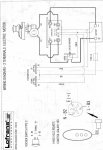
Sorry to be long winded on a technical problem but any help would be very welcome. I have just replaced an old windlass for a new Lofrans Kobra 1000w windlass on a recently acquired yacht. I Have used the already installed (good condition) heavy cable from the battery, which has an inline fuse. I have fitted the control box close to the windlass motor and I have fitted a circuit breaker also. I have installed a control handset that plugs into a socket in the anchor well. The problem I have is that when I tried (tested the windlass without load) it worked initially. as long as I kept my finger on the up or down control button. Once I take my finger off the control button I cannot get it work again and I hear the solenoid clicking below in the compartment where it is installed. . When i check the circuit breaker (hydrolic magnetic) it appears to be in the same switch position but if I switch it off and back on again he windlass will work once more but only for the one press of the control. I have gone over the wiring diagrams and I cannot see that I have deviated in any way. The main install wiring diagram shows the windlass motor, control box, circuit breaker and anchor controls (either foot or hand) and I have wired the installation to this drawing.
Many thanks
 
Firstly, I would get rid of the fuse, it can cause real problems if it blows at a critical time and the circuit breaker is all that's needed. I have a Kobra and have installed a couple of others as well, all with foot switches (mine with radio control as well) which have worked OK. Your fault is strange and I suspect a faulty controller.

Process of elimination - If you disconnect your remote control and bridge the switch terminals on the control box with a bit of wire (very low current) and it works OK, then the remote is the problem. If the fault is still there, bridge the windlass power terminals on the controller with a heftier bit of wire and see if it works OK in forward and reverse. If it works OK then, it appears the controller is faulty.
 
Last edited:
Can't help with main problem but you might want to reconsider the plug in connection in the anchor well. Not a good place as damp and worse the cable is too near the chain and windlass gypsy. Makes an awful mess when it gets caught - guess how I know. Better to hve the lead coming out of the forehatch or use a radio control.
 
Can't help with main problem but you might want to reconsider the plug in connection in the anchor well. Not a good place as damp and worse the cable is too near the chain and windlass gypsy. Makes an awful mess when it gets caught - guess how I know. Better to hve the lead coming out of the forehatch or use a radio control.

I changed ours to buttons on the deck. They have little covers on them so you can't tread on them accidentally and run the windlass if the breaker is left on. An additional advantage is that you can use your foot to operate them this encourages you to keep your fingers well away from chains and windlasses.
 
Downside of foot switches is that you have to operate them from a fixed point. Handheld control on. Wander lead coming forward through the forehatch much more convenient and flexible. Likewise hand held radio. Foot switches also have a reputation for fragility, particularly when used two or three times a day 25 weeks a year by charter holidaymakers!
 
When i check the circuit breaker (hydrolic magnetic) it appears to be in the same switch position but if I switch it off and back on again he windlass will work once more but only for the one press of the control.

Is the circuit breaker correctly rated?

The purpose of a fuse or circuit breaker is to protect wiring primarily, so your fuse or circuit breaker should be mounted as close to your battery as possible. You don't need both a fuse and a circuit breaker, so if the circuit breaker is giving problems you could remove it.
 
You don't need both a fuse and a circuit breaker, so if the circuit breaker is giving problems you could remove it.
I don't think the OP made it clear where these were located: I would expect a fuse or breaker in the low current feed to the control box, and also in the high current feed to the windlass. My windlass is a Lofrans Tigres [sic] and has a 120A fuse in the high current feed.
 
img080.jpgThanks for all the feedback and advice. I will be working on the job on Wednesday so hopefully I will know more then. Just to clarify to those who referred to the fuse. I did point out that the original main power supply cable already had a fuse fitted. Well installed and enclosed in a sealed box. This is located close to the instrument panel. I have attached this main PS cable to the new Lofrans control box which is situated in the forward cabin close to the anchor well and well protected. The anchor control switch and the 80 Amp circuit breaker (Hydraulic Magnetic) are connected to the control box. I do not see any point in removing the fuse from the main PS cable as I don't think it is a problem.
I will carry out the fault finding suggestions made and hopefully pinpoint the problem.
Many thanks.
 
Thanks for all the feedback and advice. I will be working on the job on Wednesday so hopefully I will know more then. Just to clarify to those who referred to the fuse. I did point out that the original main power supply cable already had a fuse fitted. Well installed and enclosed in a sealed box. This is located close to the instrument panel. I have attached this main PS cable to the new Lofrans control box which is situated in the forward cabin close to the anchor well and well protected. The anchor control switch and the 80 Amp circuit breaker (Hydraulic Magnetic) are connected to the control box. I do not see any point in removing the fuse from the main PS cable as I don't think it is a problem.
I will carry out the fault finding suggestions made and hopefully pinpoint the problem.

The purpose of the fuse is to protect the cable to the windlass - in order to do this it needs to be located close to the battery, as you have done. You mustn't remove it.

The 80A breaker you've fitted is, I suspect, under-rated for a 1000W load. These circuit breakers trip at very low levels of overload, in contrast to heavy duty fuses, which generally have a slow-blow characteristic. As you already have a fuse in the circuit from the battery, you don't need the circuit breaker. I'd simply remove it.

You should, of course, still have a small inline fuse in the thinner wiring for the control handset.
 
Was the circuitbreaker supplied with the windlass and control relay? Mine (with Kobra) was, and it will trip if the motor is still in overrun when the current is supplied in reverse, but not when it's grunting breaking out the anchor, so back-EMF can be a problem. If you are not aware of doing this, could the points be bouncing in the control relay - unlikely I think. Possibly a faulty CB - they can be a PITA.
 
As an aside. I installed a Lofrans Kobra windlass 3 years ago on my boat as per the diagram shown.
The chain will run down, alongside the vertically mounted motor which can damage the black rubber boot, allow water ingress into the motor, and corrode the brushes and brush holders. This is what happened to me, and as a result I have just had to fork out £325 for a new motor. In my case it is impossible to stop some water entering via the hole in the deck.
I have now put a modified hawse pipe upside down to guide the chain away from the motor, as well as adapting an upside down flower pot to protect the motor from any splashes.
I believe the recommended size circuit breaker for a 1000w motor is 100A
 
... as well as adapting an upside down flower pot to protect the motor from any splashes.
I believe the recommended size circuit breaker for a 1000w motor is 100A

Ah, the true spirit of Practical Boat Owner! And I agree that an 80A breaker could be undersized.
 
The 80A breaker you've fitted is, I suspect, under-rated for a 1000W load ... As you already have a fuse in the circuit from the battery, you don't need the circuit breaker...
Agree with the first part, depending on your cable I would expect about a 120A breaker. The fuse protects the low current control wires, the breaker the high current to M1/M2. Both are required.
 
Last edited:
Agree with the first part, depending on your cable I would expect about a 120A breaker. The fuse protects the low current control wires, the breaker the high current to M1/M2. Both are required.

I don't think you've fully understood the information the OP has provided. His cables from the main batteries to the windlass are fuse-protected, at the battery end. Therefore, there's no need for a breaker. But there should be a small fuse protecting the control wires.
 
Thanks for your advice. One other point is that I didn't test the windlass under load. I tested it without the chain. Would that have made a difference?
 
I bought the control box, as shown in the diagram with the windlass. As I have just replied to other forumite, I only tested the windlass without load. e.g. without chain and tension. Would this be the reason?
 
I don't think you've fully understood the information the OP has provided. His cables from the main batteries to the windlass are fuse-protected, at the battery end. Therefore, there's no need for a breaker. But there should be a small fuse protecting the control wires.
You are right, I didn't pick that up. I assumed it was wired as per the diagram.
 
I don't think you've fully understood the information the OP has provided. His cables from the main batteries to the windlass are fuse-protected, at the battery end. Therefore, there's no need for a breaker. But there should be a small fuse protecting the control wires.

Now, I don't know much about electrics but, can you put an inline fuse on 2AGW cable?
Which the OP seems to imply, or his he referring to the the fuse on the live feed to the foot switches.
 
Top