Locktite

Do you know I can't answer that. I presumed it was to avoid chain twist when circling at anchor.
My set up is exactly like Vyv's on his.
I bought the Kong quite a while back to replace my existing swivel which on comparing is rather light on contruction.
What's your views on them?

I have seen no evidence that a swivel actually untwists chain. The bearing is very crude and it seems most unlikely that a few twists in 30m or more of chain will be sufficient to allow a swivel to rotate. I cannot think of many places where you would develop lots of twists, or you would need to sit at anchor for a long time, only turning one way. The idea that a swivel will allow an anchor to arrive at the bow roller the right way round looks a weak argument. The anchor should rotate as it is lifted and their are simpler and safer ways to ensure the anchor arrives 'right way round' - without any human intervention.

I hear of swivel failure, a few shackle failures and almost no chain failures. Swivels appear to be a weak link.

They fail because of incorrect attachment. The fork being attached directly to the anchor shank. This results in the fork being forced open the end result of which is that the little locking bolt inside the clevis pin can be ripped off. But the clevis pins, being sex bolts (and inherently weak) also fail. Finally the joint in the bearing itself is simply a pin with a retain cap welded on. These are prone to corrosion and simple failure of the pin.

One mystery is why so many people use them, no-one has even heavily promoted swivels but they are almost ubiquitous.

If you must have a swivel then Kong is the best and I have never heard of a bad report.

I am very willing to be shown they, swivels, are essential but have seen no evidence at all.

Jonathan
 
jerrytug,

sounds great but I'm not familiar with 242 grade, is that ' undo in future ' or ' that's it for life ' stuff ?! :)

Recommended by Vyv Cox on his website (thanks Vyv!) for anchor swivels. Designated 'medium strength', yes you can undo it, immersing in boiling water softens it, warming up with a blow lamp really softens it.
Only undo it without warming up, if you have the right spanner and no rounded-off nuts etc...
 
I have seen no evidence that a swivel actually untwists chain. The bearing is very crude and it seems most unlikely that a few twists in 30m or more of chain will be sufficient to allow a swivel to rotate. I cannot think of many places where you would develop lots of twists, or you would need to sit at anchor for a long time, only turning one way.


Swivels are certainly not essential, but without one have I had some rare problems where the chain has developed enough twists to make chain retrieval difficult.

The twists in the chain are not noticeable when distributed over the total length of the rode, but when retrieved the gypsy will only pass untwisted chain so the twists become compressed into the last bit of chain. If the chain has more than a certain number of twists per unit length it starts to bunch up and jam. Once the anchor breaks free from the bottom the problem is solved. The anchor will rotate (at a quite alarming speed) to untwist the chain.

However, to break the anchor out you need to shorten the rode to a very short scope. You cannot break the anchor out until you have retrieved enough chain.

It is a rare problem and despite having had this difficulty on a couple of occasions, I still do not use a swivel, but it's hard to fix if it occurs so it is something to be aware of. The torque from the twisted chain becomes very high and a swivel even with the crudest bearing would rotate in these circumstances.

This was a mild case I managed to photograph underwater. Here you can see chain at 1:1 as the anchor is retrieved . Notice how the chain has become twisted enough to just start to bunch up. The chain is under quite a bit of tension, but some links are lying sideways.

(The yellow line is a just a bit of old fishing net the chain has managed to ensnare)

image.jpg1_zps0bjpgzn0.jpg
 
To be honest I followed what vyv cox adopted to his anchor as he is a font of knowledge with excellent practical skills to boot. It wasnt until I read an article by him regarding the swivels on the market that I decided to buy the kong.
It's beautifully engineered and would look great with a stainless anchor and chain.
 
To be honest I followed what vyv cox adopted to his anchor as he is a font of knowledge with excellent practical skills to boot. It wasnt until I read an article by him regarding the swivels on the market that I decided to buy the kong.
It's beautifully engineered and would look great with a stainless anchor and chain.

+1.
 
Swivels are certainly not essential, but without one have I had some rare problems where the chain has developed enough twists to make chain retrieval difficult.

The twists in the chain are not noticeable when distributed over the total length of the rode, but when retrieved the gypsy will only pass untwisted chain so the twists become compressed into the last bit of chain. If the chain has more than a certain number of twists per unit length it starts to bunch up and jam. Once the anchor breaks free from the bottom the problem is solved. The anchor will rotate (at a quite alarming speed) to untwist the chain.

However, to break the anchor out you need to shorten the rode to a very short scope. You cannot break the anchor out until you have retrieved enough chain.

It is a rare problem and despite having had this difficulty on a couple of occasions, I still do not use a swivel, but it's hard to fix if it occurs so it is something to be aware of. The torque from the twisted chain becomes very high and a swivel even with the crudest bearing would rotate in these circumstances.

This was a mild case I managed to photograph underwater. Here you can see chain at 1:1 as the anchor is retrieved . Notice how the chain has become twisted enough to just start to bunch up. The chain is under quite a bit of tension, but some links are lying sideways.

(The yellow line is a just a bit of old fishing net the chain has managed to ensnare)

image.jpg1_zps0bjpgzn0.jpg

I think I'd risk the very rare occurrence of twists than risk the security, or otherwise, of a swivel.

Jonathan
 
Last season, after similar comments to those above from Jonathan and noelex, we dispensed with the swivel. In general we managed OK without it but there were occasions when the anchor came up the wrong way up, for reasons that I cannot explain. This was a problem for us because Jill normally works the foredeck when we haul but she could not turn the anchor to set it the right way up. She also found that there were occasions when the windlass could not cope with the twisting between the windlass and roller. She is convinced that the windlass was more noisy and showed signs of being less happy without the swivel.

So, for the coming season i have bought a cranked Osculati swivel to try. It doesn't have the jaws of the Kong so should hopefully not be subject to the lateral forces that it can suffer. Plus, it should also roll the anchor to always be the right way up. This was the strongest design that I tested, with a UTS nearly 1.5 times that of the chain. We will see and I will report back.
 
We have also gone part way down the same route as Vyv. We have introduced a cranked bar into the rode, which self rights the anchor. So its like Vyv's cranked unit, without a swivel. Ours is made from gal Bis 80 made by Anchor Right and originally named a Boomerang.

I like the idea it has no moving parts :)

The big question mark, still unanswered, is why the chain twists at all. Noelex has posted an image of an excessively twisted chain - it would take a very long time at anchor, with tides all turning the yacht in one direction only and/or lots of wind changes to develop a hockle like that (and it would be most useful if Noelex actually can fill in any information). Vyv also had an image of his anchor - with the chain twisted (but Vyv remains puzzled as to why chains twist).
 
Can they develop twists as they go down the navel pipe and then lay themselves round and round the pile of chain in the chain locker?
Seems to me, that process could develop twists, in the same way that wrongly flaking down a line on deck, in a pile, can develop twists?

I agree it is hard to visualise bad twists being made by a few tides.
 
In some anchorages in the Med where wind can be very fluky the boat does rotate quite a lot but nowhere near enough to cause the chain twisting we see. One cause that we know of is that with a fast windlass like ours the anchor rotates as it is pulled through the water. This does not explain why the chain twists beyond the bow roller, which in our case is grooved to accept the vertical links. Even more, it doesn't explain why the chain twists in the locker, beyond the windlass. In the worst case we experienced we had to take the boat into deep water and lower the anchor gradually while manually untwisting the chain in the locker. This was when we had a swivel!
 
Seajet, you have mentioned the physical securement to give a positive lock, pins, peening etc

Volvo assemble, or secure, their 3 bladed props (probably the same with the 4 bladed) with a large nut that is torqued onto the main part of the shaft (of a sail drive). a tab washer and another bolt that is torqued into a thread within the main shaft. The bolt and nut are locked together by the tab washer. Other than the tab washer and the torqueing there is no securement. Oddly there is a hole drilled through the shaft that would take a pin but neither the big nut nor smaller bolt have matching holes (maybe the hole is for a non folding prop assembly).

Volvo do not suggest using an adhesive on the large nut nor smaller bolt - though they do direct use of their, blue, adhesive for the alan bolts that effectively secure the blades.

To me (and you?) I'm guessing this is not a belt and braces assembly but presumably it works or, otherwise, there would be lots of threads here.

Jonathan
 
Personally I would not uphold Volvo as a guiding light when it comes to bolt tightening techniques. Last year I investigated the failure of a Volvo D2-4 engine whose big-end had punched a hole through the crankcase. The cause was clearly that one of the conrod bolt nuts had loosened. In the course of the investigation I found that the nuts are not locked in any way, no tab washers, loctite or split pins. The torque figures were surprisingly low, 22 lb.ft from memory, don't recall the metric figure. It astonishes me that they get away with this situation, except for this owner. Volvo replaced the low hours engine, presumable acknowledging that the fault was theirs.
 
When I had a boat with a Volvo saildrive, a stainless castellated nut was £18.00 and the simple cast nasty zinc propeller boss ( which all the fancy welding departments at BAe Kingston couldn't do anything with as it was such rubbish material ) was £480, in 1988...
 
The big question mark, still unanswered, is why the chain twists at all. Noelex has posted an image of an excessively twisted chain - it would take a very long time at anchor, with tides all turning the yacht in one direction only and/or lots of wind changes to develop a hockle like that (and it would be most useful if Noelex actually can fill in any information).


Every 360° rotation of the boat causes a twist in the chain. Note that the boat does not have to drag all the chain to the other side of swing circle it only has to spin through 360°.

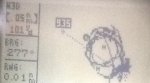
Last night at our anchorage is a simple, mild example. The wind was very light and flukey and we did several 360° rotations as you can see from the GPS trace. The anchor is at Waypoint 935 so we are not rotating around the swing circle, but the rotations nevertheless put a twist in the chain. The wind is light enough that the chain is holding the bow in position and the boat is rotating about this point.

While having breakfast in the cockpit we have spun around another couple times. In most cases the clockwise and anticlockwise rotations almost cancel, but in some situations the boat seems to like rotating the same way.

The most common time is seems to occur is where there are two different competing forces on the anchored boat. So current opposing the wind direction or even two opposing wind patterns with a sea breeze in almost the opposite direction to the prevailing wind. In the wrong situation it can see the boat doing 360° spins as the separate forces compete for dominance.

It can also occur with reversing currents although in most cases these produce a 180° rotation followed by a rotation back the opposite way.

It is quite rare for these twists to reach the stage where the chain is very difficult to retrieve with the windless, but it can be a very frustrating problem if it does happen so it something you need to aware of if you do not have a swivel.
 

Attachments

  • image.jpg
    image.jpg
    41.4 KB · Views: 0
Last edited:
+1, I have found my boat does a few 360 degree turns in light wind over tide conditions - so an angel weight on the anchor warp or a drogue streamed behind is a good idea ( the latter only if one has the space and swinging room for it ).

Swivels are not 100% perfect in engineering terms, even if they had ball bearings there'd be some friction, so one shouldn't be too surprised by moorings twisted tight like a Spanish Windlass...

Even if not sailing I go on my boat regularly to release the twists on the mooring chain, so it doesn't either sink her by the bow or winch up the mooring sinker and go walkabout !
 
Top