Locking flush pin shackles

I mention that Omega links come in all shapes and sizes. I also forgot to mention hammerlocks, as a replacement for shackles.

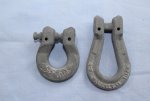
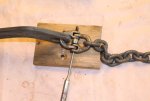
The picture above shows one design of an Omega link, there is another here, without the clevis pin, bottom right. The restriction to Omegas is that the mouth and clevis is designed to only accept the chain size for which they are designed. They thus don't accept your chain and your anchor shank - which is why I have an omega and shackle in the photo above. The same restrictions apply to hooks from the lifting industry - the hook it self and the slot and clevis pin will only accept the chain for which they are designed. If its an 8mm hook - it will only accept an 8mm chain. As an aside - that's a state of the art hook - the links in the hook are fully supported, the crown by those little dimples and the length of the lanky the sloping base of the slot in the hook itself.

None of this stuff is expensive.

IMG_4799.jpeg

On the right another variation for Omega shape, a pear link. The clevis pin has little slots at each end to secure with hammer in pins that are hammered through the small holes. They are inconveneoint, very, to release and I have taken to using cotter pins. The pear link also has an oval cotter pin, rather than a round cotter pin.

IMG_4999.jpeg

Hammerlocks are different. They will usually accept, say, your anchor shank and the chain size for which they are intended. I illustrate above a 6mm, 10mm conventional hammerlock and an elongated one (for which I have not yet found a sensible use). I have stripped the paint off preparatory to grit blasting and Armorgalv (galvanising) coating.

They are called hammerlocks because you hammer in the connector pin through a central locking device. Relatively easy to secure but slightly more fiddly to de-couple -IMG_4682.jpeg

you really need a punch to take them apart

The big advantage is they are relatively low profile, unlike a shackle with its protruding lug, and they are bit more versatile as you may need only one device (the hammerlock) to join chain (particularly high tensile G70 chain) to your anchor. The disadvantage is they usually are retailed only painted (but I have seen galvanised ones in marine applications - but don't know who supplies) and a bit of a faff to disengage.

We have used them long term and cannot fault them. Some members here have or do use them, without negative comment. The latter use them painted and simply dump them when they become grotty. You can source them in a G100 strength and Ketten and Waelder make them in Duplex stainless (I suspect at some cost :( ) to a G60 strength.

There are lots of choices, outside the marine industry, you just need to search and think laterally.

Jonathan
 
Last edited:
I mention that Omega links come in all shapes and sizes. I also forgot to mention hammerlocks, as a replacement for shackles.

The picture above shows one design of an Omega link, there is another here, without the clevis pin, bottom right. The restriction to Omegas is that the mouth and clevis is designed to only accept the chain size for which they are designed. They thus don't accept your chain and your anchor shank - which is why I have an omega and shackle in the photo above. The same restrictions apply to hooks from the lifting industry - the hook it self and the slot and clevis pin will only accept the chain for which they are designed. If its an 8mm hook - it will only accept an 8mm chain. As an aside - that's a state of the art hook - the links in the hook are fully supported, the crown by those little dimples and the length of the lanky the sloping base of the slot in the hook itself.

None of this stuff is expensive.

View attachment 143827

On the right another variation for Omega shape, a pear link. The clevis pin has little slots at each end to secure with hammer in pins that are hammered through the small holes. They are inconveneoint, very, to release and I have taken to using cotter pins. The pear link also has an oval cotter pin, rather than a round cotter pin.

View attachment 143829

Hammerlocks are different. They will usually accept, say, your anchor shank and the chain size for which they are intended. I illustrate above a 6mm, 10mm conventional hammerlock and an elongated one (for which I have not yet found a sensible use). I have stripped the paint off preparatory to grit blasting and Armorgalv (galvanising) coating.

They are called hammerlocks because you hammer in the connector pin through a central locking device. Relatively easy to secure but slightly more fiddly to de-couple -View attachment 143828

you really need a punch to take them apart

The big advantage is they are relatively low profile, unlike a shackle with its protruding lug, and they are bit more versatile as you may need only one device (the hammerlock) to join chain (particularly high tensile G70 chain) to your anchor. The disadvantage is they usually are retailed only painted (but I have seen galvanised ones in marine applications - but don't know who supplies) and a bit of a faff to disengage.

We have used them long term and cannot fault them. Some members here have or do use them, without negative comment. The latter use them painted and simply dump them when they become grotty. You can source them in a G100 strength and Ketten and Waelder make them in Duplex stainless (I suspect at some cost :( ) to a G60 strength.

There are lots of choices, outside the marine industry, you just need to search and think laterally.

Jonathan

Was it not traditional to secure the clevis pins with dowels made of Lignum Vitae or Teak which would just be broken through when the clevis pins were drifted out but nonetheless held the pin very securely while in use .....
But moving on, its a pity that no one reputable makes a Kenter type shackle for small chain as they do for stud link. The smallest I've found being for 14mm . They look that in proportion they would be quite a useful item.
 
I understood Jimmy Green were selling a gal shackle with no protuberance on the pin made by a French supplier (whose name I forgot) but who are owned by one of Europe's major lifting companies. Chaineries Limoger - or something similar.

Jonathan

Thanks Neeves for the heads up re Jimmy Green. You are correct about Chaineries Limousines. JG sell a grade 70 shackle with breaking strain to match the G70 chain.

Force 7 Grade 70 Anchor Chain Shackle Link Connector

I have just ordered one. At £54 it is reassuringly expensive! It’s not exactly a flush pin configuration, but looks encouraging. I’ll report back in due course.
 
Last edited:
SS rated shackle
one I bought is stronger than my chain and way stronger than the holding power of my anchor
red loctite in the thread, needs heat and muscle to undo

For some reason there is no mention of a safety factor nor quantification of WWL. Stainless is strong, stronger than we sometimes give credit for (and in this case the 10mm shackle seems strong enough for a 8mm G30 chain). However 316 stainless has a notoriously low yield (it bends easily) and I'd worry about the clevis pin bending and then not being as easy to disengage as anticipated. I'd also prefer a bow shackle, rather than a 'D' shackle as the bow better aligns with the tension. If I wanted to use a stainless shackle I'd check out Kettern and Waelders offerings in their Cromox range before investing. K&W's UK distributor (or one of them) is Andersen in Newcastle who also have a range of stainless shackles that I would throw into the mix. Tecni from whom I buy my Crosby shackles do offer a stainless, recessed head (Alan key) bow shackle - which is absolutely rubbish.

If at all possible I would not move from my current choice - Crosby G209a bow shackles, galvanised and alloy - not as pretty as 316 stainless. The 3/8th" shackle fits 8mm chain has a 10t MBS and a WLL of 2t. However we have a, very, wide bow roller and the issues of shackles being too wide simply does not occur (thank goodness!)

Thanks Neeves for the heads up re Jimmy Green. You are correct about Chaineries Limoges. JG sell a grade 70 shackle with breaking strain to match the G70 chain.

Force 7 Grade 70 Anchor Chain Shackle Link Connector

I have just ordered one. At £54 it is reassuringly expensive! It’s not exactly a flush pin configuration, but looks encouraging. I’ll report back in due course.

That's extortionate. My wallet went into hiding at the thought. :(. However as you appear to have a narrow bow roller and G70 chain - then you don't have much choice.


Just looking at the prices of appropriate shackles (some stainless or alloy) - someone appears to be making a lot of money. Crosby are good - but not THAT expensive. If I were an anchor or chain maker/distributor - I'd sell Crosby shackles (or equivalent - Yoke, Peerless, Campbell) as part of my package.

Jonathan
 
Last edited:
That's extortionate. My wallet went into hiding at the thought. :(. However as you appear to have a narrow bow roller and G70 chain - then you don't have much choice.

Jonathan

Agreed - it is. However in comparison to the cost of chain & anchor, the premium is hopefully worth it, given the limitations of my bow roller!
 
SS rated shackle
one I bought is stronger than my chain and way stronger than the holding power of my anchor
red loctite in the thread, needs heat and muscle to undo
Small point - but that isn't a "rated" shackle, in rigging accessories "rated" generally means it has had some test procedure & documentation regarding the datasheet wwl & mbl.

Very rare to find a rated component in stainless accessories, maillon rapid quicklinks are available rated in stainless but can't think of any other commonly available. No use really for an anchor chain.

What this means is it says ***Kg max break load but you don't know how reliable that figure is...
 
Small point - but that isn't a "rated" shackle, in rigging accessories "rated" generally means it has had some test procedure & documentation regarding the datasheet wwl & mbl.

Very rare to find a rated component in stainless accessories, maillon rapid quicklinks are available rated in stainless but can't think of any other commonly available. No use really for an anchor chain.

Ketten and Wälder, Cromox range and their G60 duplex stainless components, hammer locks, chain hooks, omega links, shackles.

Jonathan
 
Top