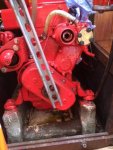
Locked solid lump

No mention yet of decompressing the engine using the convenient lever on the rocker cover or using the starting handle.

Standing on the latter (properly engaged) whilst operating the former might achieve some movement.

Wasn't hand-starting mentioned in post #1?

As was removing the injectors thereby fully decompressing the engine. :)

Richard
 
Maybe a more useful thought. Will the engine turn over easily if the water pump is removed again? There's a slot in the end of its shift which has to engage with a pin inside the hand-starting assembly cover and it's possible to jam up against it instead.
 
Before removing the head, if the injector hole allows try to look inside the cylinders with an endoscope camera, avialable from £10 on fleabay (connects to USB to strore pics and vids on a pc).
 
Provided that the engine has been de-anganged from the transmission; can only be a sticky valve or corrosion between bore and piston rings. The valves do not stick due to corrosion, only if they bent or the valve guide is cracked. By far the most likely cause is rust on the bores.

If so, you need to persist with trying to shock-turn the engine by hand; rusty bores will make it almost impossible to rotate the engine; or if you remove the cylinder head, tap the top of the pistons gently with a wooden mallet. It appears that salt moisture has gone in to the engine; common problem with aero engines out in the field by the sea.
 
Sundays report. Two sessions of rugby is too much for someone my age, perhaps I could find a gentle sport - sailing??
However back to the job in hand. Got a few hours, but long enough to bolt a 2ft length bit of U shaped uni-strut to the front of the engine, will post a photo tomorrow. Swinging on that gave me nothing. Stuffing a crowbar into the U, giving me a 4 ft lever and leaning on it was enough to get a few degrees of movement, or was it the bolts slipping. The marks on the flywheel told me that I had rotation.
I worked it back and forwards with only 5 degrees of movement. An hour later I had the engine vaguely free. Put the flywheel back on to use it to turn the engine, manually. The hand start was still too stiff to turn the engine over. I worked this for a further 30 mins until I had proper movement.
I had enough time to change out the oil, diesel floats on oil, to answer my previous question, as the cold oil took a lot to siphon it out of the sump until the last few pints that were mostly diesel.
New oil, all the valves opening,, rocker box on, decompression lever just touching the tops of the valves when closed, injectors and their washers back in and connected up, flywheel on.
The starter spun the engine easily, but despite bleeding the system I have been unable to get the engine started. Ran out of time so will try again one evening with a fully charged battery and some easy start.
The main snag is sorted, just a small matter of getting the engine started and back in the water, then clearing the mess in the cabin, wiping the diesel off the deckhead lining and trying to get the smell of diesel out of the boat!!! Anyone have any ideas, or I expect that there is already a thread to read...
Thanks for all of the advice, it has helped me to bounce ideas around and get some other experienced minds on the case, and writing it down helps to sort the activities and next moves..
Richard W
 
When you crank the engine with the starter motor does it have that characteristic sound of compression resistance. It is good to know what a good engine sounds like being cranked but not running. If the bores are shot or valve stuck open or even decompressed you get a much freer turning engine on starter. A sure indication that it is lacking compression. good luck olewill
 
Please do not use easy start

+1
Its OK for 4 stroke spark ignition petrol engines because the spark determines the ignition timing but with a compression ignition engine you have no control over the ignition timing. If it occurs too early on the compression stroke you can do mechanical damage to the engine.

Not so good fro 2 stroke petrol engines because it contains no oil.
 
When you crank the engine with the starter motor does it have that characteristic sound of compression resistance. It is good to know what a good engine sounds like being cranked but not running. If the bores are shot or valve stuck open or even decompressed you get a much freer turning engine on starter. A sure indication that it is lacking compression. good luck olewill

That's great news Richard.

I'm assuming that the diesel which came out with the oil is the diesel that you poured in through the injectors? If there was a lot more coming out than you poured in then I would be concerned, of course.

Did any water come out with the oil? Your seizure had all the classic symptoms of rusted rings but it would be very bad luck for this time happen over the space of one winter unless some water had got into the combustion chamber. The most obvious space is past the head gasket although other ways such as turning over the engine for a long time without it firing and the seacock open are possible but much less likely.

If you get the engine started keep a very close eye on the coolant level or for steam in the exhaust and water in the oil.

I've quoted Olewill as he is right about listening to the engine on turnover. Does in sound like it did before? Does it perhaps spin even more freely than it used to?

Once you've checked the fuel supply to the injectors if it still doesn't start (don't turn it with the seacock open) and particularly if it is spinning a bit too freely then you might indeed have a compression problem. That could be caused by a blown gasket or could be something worse. I won't say what as others will accuse me of being a Jonah but from my previous posts it's clear what I'm referring to.

If you have any doubts about the compression ask a mechanic do perform a compression test. It's a quick job and could save you a lot of time and give you a clear diagnosis of bores, valves or worse.

Richard
 
I'm pretty sure that with a fully charged battery and fuel getting to the injectors, it'll go now it's free. A simple diesel engine only needs fuel, compression, and sufficient cranking speed to run.
 
Olewill - the compression is as before, I can hardly crank the engine when it is de-compressed let alone when not engaged. A very definite cycle of pressure then free for each pot - seems healthy to me.

Richard - Diesel in the oil was a combination of from the pots, as well as topping up the sump to try to get the big end bearings a little lubrication in the event that they were rusted. No sign of water or milkiness in the oil other than that created by the oil aerating when siphoned.

Sailorman and VicS - The Easystart comment concerns me, as I was led to believe that it was designed for diesels. The Navy even installed a system on to some of their smaller craft for operating in cold weather, and I grew up feeding an old BMC Captain the stuff on a regular basis on board Dads Waterwitch in the 80s. Having had a quick look on line, I might go for an electric paint stripper on the intake to give the engine a bit of encouragement. I tried the gas lighter for the stove yesterday, shoved up the air intake, but not enough heat from it and it now needs a top up.

The photo of the "Crank Persuader." I have missed off the top section that includes a 2ft crowbar, but you get the drift....

Bukh DV20.jpg
 
This thread reminds me of a similar experience that I had 3 years ago. I have an 80hp ford on my motorsailor which was wintered in Sicily at the time. I returned from the UK in the spring to find the engine locked solid. After advice from a mechanic friend I left parafin in the chambers for 4 days then removed the starter motor and was able to get a crowbar behind the teeth of the flywheel starter ring and yanked it back and forth. I eventually freed the engine and got it running again. the following winter I was able to return mid winter and run the engine but the next winter I had the same trouble but was unable to free it. When I tool the head off No. 4 piston was rusted solid to the cylinder wall. The whole lot was removed and taken to a local workshop and rebuilt. The problem was caused by internal corrosion of the water cooled exhaust manifold which had been allowing raw water into the exhaust port. During the summer it never settled for long enough in the chamber to do any harm but over the winter it did. I ended up with a complete new cooling system and a refubished block and a hole in the bank account.
 
Nearly there - engine re-assembled and bled, a fully re-charged battery and partially re-charged owner. Engine turning happily but not firing. Hung a gas torch in front of the air intake with the flame pointing inside the air intake, to give me some "pre-heat", this time the engine fired but did not pick up. Change CAV filter - more diesel over the cabin - what a pig they are to change!! Re-bleed through CAV, pump, engine filter and injectors and turnover on the starter. The engine was firing and trying to run, but as soon as I stopped running the electric start, the engine died. I could taste the fuel in the air, so what was going on...
I bled injector 1, while trying to start the engine. The engine did not fire.
I bled injector 2, while trying to start the engine. the engine fired, but did not run...
Getting a bit late, took both injectors out and have dropped them in for servicing and spray pattern checks.

What am I missing?
And as an aside, how often should you have your injectors serviced?
 
Did you turn over the engine with one injector out at a time? You would be able to see the spray very clearly. I'm just wondering if the high pressure pump is functioning. Also you really should check the compression. If the rings have been rusting there may be a significant drop.
 
Top