Load Bearing Question

Little Dorrit

Well-Known Member
Joined
27 Jan 2010
Messages
1,295
Location
South Coast
Visit site
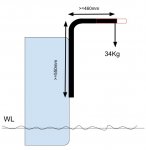
I am looking for some help with structural load bearings. I want to put davits on the transom to support an older ‘lift up’ Aries wind vane which weighs 34Kg. Newer (and I assume) lighter models are attached using davits made from two lengths of 38.1 x 6.35mm aluminium tubing clamped to the transom with 4 x 38mm pipe clamps and 8 x 316 M8 bolts. These are attached to the transom and a 90-degree bend allows them to support the wind vane. The weight will hang about 350mm from the bend and 450mm from the transom. On the newer Airies models, this is an acceptable method of installation but I wondered if this would support my 34Kg version?
Copy of Davits.jpg
 
surely it's not only the static weight that should bother you. Assuming this wind vane is in operation (and from my understanding of the concept), wont you have more lateral or whatnot forces exerted to these davits?
at a guess the sketch above will work, but it may flex a bit, and will that affect what you want to achieve?
 
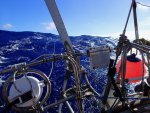
My Aries dates from about 1988. I am quite sure it is not a LW version. It appears to be mounted exactly as your diagram except the transom slopes somewhat so the tubes are angled. It has been totally reliable. See attached, taken when the Aries was doing brilliantly in big seas.
P1050040 (1).jpeg
 
You could also add a triangulation strut to brace the pipe or gusset plate inside the bend to share the load on the bend. Triangulated structures are much more rigid and can therefore use smaller diameter tubing. Imagine what would happen to a bicycle if you removed the crossbar.
 
, wont you have more lateral or whatnot forces exerted to these davits?
The "rudder" blade on this type is like a pendulum in the water so hardly any lateral forces compared to a hydrovane which uses its blade as a full rudder, requiring substantial mounts
 
when I installed my Servo Pendulum I mocked up some plastic pipe to get the lengths and bends right.
I then noticed that the stern deck was more or less, the right height for my 2 horizontal tubes,
So I mounted the tube fixings on the stern deck instead of the transom and did away with the bends.
Its neater, stronger, and works fine.
 
My Aries dates from about 1988. I am quite sure it is not a LW version. It appears to be mounted exactly as your diagram except the transom slopes somewhat so the tubes are angled. It has been totally reliable. See attached, taken when the Aries was doing brilliantly in big seas.
View attachment 136655
That's good to know. The only problems I envisage are that the lift up unit I have is quite a bit older than the current versions including yours and very heavy, although I don't think the working forces are that great. The only other potential issue is that the manual says not the have the height above 1050mm above waterline, I think I'll be about 1075 but I can't see why an extra 25mm would make that much difference. The manual mentions forces on the servo rudder are reduced, perhaps that's another question for another time.
 
I have a 1980's Nick Franklin lift-up, similar or the same. 12 ton boat.

I would not trust those mounting tubes. Are they from the Danish guy in Holland who is supplying and servicing metric Aries now? Approach with caution.
The 35Kg approx will be flung and twisted about in all directions with a violent motion, and that's whether it is steering the boat, or not.
The loads are heavier than you think. In my opinion your brackets need triangulation, not bends.
Also, at some point in the future, someone is very likely to use those brackets for towing, or clambering out of a dinghy, or simply crash into them with another vessel.

If you can, use the bolts, brackets and tubing which Franklin supplied. They are excellent quality and design.
(They come up 2nd hand, and if you go that route, I have some in storage as I couldn't use them on my oddly shaped boat, so give us a shout.)
 
Last edited:
The "rudder" blade on this type is like a pendulum in the water so hardly any lateral forces compared to a hydrovane which uses its blade as a full rudder, requiring substantial mounts
The lateral forces can be larger than you might be imagining. 'Hardly any' would be a mistaken estimate..
 
A photo of the mock up might help

But in general , there are plenty photos of Aries on the internet mounted with 2 additional struts coming up from the transom lower, outer area and meeting the main mounts at or near the vane .
The unit is now braced ‘4 ways’
like a Monitor w/vane to resist twist and abuse!
So long as you have the right diameter tube stubs that attach to the Aries, then these stubs can be welded to any size tube that you are happy with .
 
I have a 1980's Nick Franklin lift-up, similar or the same. 12 ton boat.

I would not trust those mounting tubes. Are they from the Danish guy in Holland who is supplying and servicing metric Aries now? Approach with caution.
The 35Kg approx will be flung and twisted about in all directions with a violent motion, and that's whether it is steering the boat, or not.
The loads are heavier than you think. In my opinion your brackets need triangulation, not bends.
Also, at some point in the future, someone is very likely to use those brackets for towing, or clambering out of a dinghy, or simply crash into them with another vessel.

If you can, use the bolts, brackets and tubing which Franklin supplied. They are of excellent quality and design.
(They come up 2nd hand, and if you go that route, I have some in storage as I couldn't use them on my oddly shaped boat, so give us a shout.)
Hi, yes it sounds as if you have the same model. The frames I am going to construct will be identical to the ones supplied by Airies. Theirs are constructed using 38.1 x 6.35mm Aluminium Tube. I will be using the same. My design is exactly the same as those currently used although, as you say, perhaps the additional weight of the older lift up models is not suitable for this set-up? It certainly is a very heavy lump. I have not been able to find any information on the weight of the newer models, perhaps they are much lighter? I have been pondering this problem for a while and also have designed an option for a triangulation style set-up but can't see why that would be any stronger, which is why I have posted the question here. I think it depends really on the lateral forces that the wind vane will be subject to, which I have no idea on. Thank you for your input, it may still be the way I decide to go although that would not be the simplest and easiest option as I will still need to put small bends in the tubing.
 
I'm intrigues, why aluminium and not stainless.

I concur with what R.Ems has posted. In big seas the 35kg becomes something considerably of more importance - when stuck on top of a, flimsy, pylon.

I have a similar bracket, 50mm SS tube, braced down to the attachment point on the transom the whole secured with 2 x 15mm 'U' bolts (the 'U' is the same size as the tube). The original bracket - unbraced - failed.

Jonathan
 
I'm intrigues, why aluminium and not stainless.

I concur with what R.Ems has posted. In big seas the 35kg becomes something considerably of more importance - when stuck on top of a, flimsy, pylon.

I have a similar bracket, 50mm SS tube, braced down to the attachment point on the transom the whole secured with 2 x 15mm 'U' bolts (the 'U' is the same size as the tube). The original bracket - unbraced - failed.

Jonathan
The vane gear is cast aluminium so unless I used bush to isolate the stainless it would suffer from catalytic corrosion. You are right stainless might be better although a more complicated approach so using aluminium makes the job simpler.
 
The vane gear is cast aluminium so unless I used bush to isolate the stainless it would suffer from catalytic corrosion. You are right stainless might be better although a more complicated approach so using aluminium makes the job simpler.
I think you have to take the catalytic corrosion on the chin, and use the best material for the job.
 
Top