Liquid level indicator

Spuddy

Well-Known Member
Joined
8 Jul 2003
Messages
1,958
Location
Kent
Visit site
My fuel tank has two rt angle bends in it so can't dip it, also a blighter to get out so neither do I want to install a meter thingie.
So fuel left is always guesswork on engine hours and consumption rates.
Then I remembered a mention of liquid level hand held device used for calor bottles. Any one have experience of using such or can say yea or nay that it will work?
 
The gas bottle device relies on the temperature of the gas changing between its liquid and gaseous states, so wouldn't work on a fuel tank.

If access is poor, you could consider a pneumatic gauge, where you have a weighted tube going to the bottom of the tank, then pump air into it and measure the pressure (which corresponds to the height of liquid in the tank). Sterling sell one, but it's about £300. Or you could make one, with a simple rubber bulb to apply pressure, and a cheap pressure gauge. You'd need a low pressure gauge; a 4ft depth of diesel would only give a pressure of about 1.65 PSI. You can get a 2 PSI digital gauge for about £20, eg https://www.ebay.co.uk/itm/LCD-Digi...ressure-Meter-Gauge-2Psi-D-B3Q8-/282772888258
 
The gas bottle device relies on the temperature of the gas changing between its liquid and gaseous states, so wouldn't work on a fuel tank.

If access is poor, you could consider a pneumatic gauge, where you have a weighted tube going to the bottom of the tank, then pump air into it and measure the pressure (which corresponds to the height of liquid in the tank). Sterling sell one, but it's about £300. Or you could make one, with a simple rubber bulb to apply pressure, and a cheap pressure gauge. You'd need a low pressure gauge; a 4ft depth of diesel would only give a pressure of about 1.65 PSI. You can get a 2 PSI digital gauge for about £20, eg https://www.ebay.co.uk/itm/LCD-Digi...ressure-Meter-Gauge-2Psi-D-B3Q8-/282772888258

I have a "Tank Tender" on my boat. It works as pvb says. Seems quite reliable.
http://www.thetanktender.com/about.html

TS
 
My tanks have flexible transparent tubes for draining off any dirt or water. When using them, I can hold them up against a board with a mark for every 20 litres. I appreciate that not everyone's tanks are suitably equipped, or accessible. The tubes are, of course, left empty and shut off.
 
That sounds very interesting pvb but I can't quite visualise how it would fit together. Might you be willing to do a sketch?

The principle is very simple - a tube going to the bottom of the tank, some way to pump air into it, and a method of measuring the pressure the air reaches. If something like the digital gauge I linked to is used, one connection would be to the pipe, the other connection would be left open to atmospheric pressure.
 

You could simplify that by replacing the pressure gauge with a U tube manometer. That's a U shaped tube, about half filled with a liquid, one arm open to atmosphere and the other attached where the "pressure level gauge" is shown.

If the liquid is the same as the liquid in the tank, the difference in levels will be the same as the distance from the bubbler exit to the tank surface. Using water in the U tube might be preferred to Diesel, in which case the the difference in levels will be about 80% of the depth. This would probably be more useful (definitely cheaper) than an electronic or mechanical gauge for shallow tanks,

Derek
 
My fuel tank has two rt angle bends in it so can't dip it, also a blighter to get out so neither do I want to install a meter thingie.
So fuel left is always guesswork on engine hours and consumption rates.
Then I remembered a mention of liquid level hand held device used for calor bottles. Any one have experience of using such or can say yea or nay that it will work?
My tank was fitted with a meter from new. I treat the indication as a VERY "rough guide".

Over the years a close watch on consumption has given me an average use per hour that I now rely on as leaving fuel in a tank for more than six months is no longer a good idea as modern diesel has a shelf life.
 
The principle is very simple - a tube going to the bottom of the tank, some way to pump air into it, and a method of measuring the pressure the air reaches. If something like the digital gauge I linked to is used, one connection would be to the pipe, the other connection would be left open to atmospheric pressure.

Got it ... thanks.
 
Is your outlet pipe at the bottom of the tank and if so can you get at it?

There exist sensors which work by sensing the head of pressure on the fuel. They're usually shown mounted to a dedicated boss on the tank but I don't see why one shouldn't be tee-d off the outlet pipe right next to the tank. Any reduction in pressure due to the action of the lift pump is probably minimal with a yacht size engine and in any case only applies while it's running.

There are also submersible pressure sensors which only need to be dropped into the fuel on the end of their attached wire - perhaps you could wangle one of these in without removing the tank? Must admit I'm not sure how you'd prevent it rolling noisily around the bottom as the boat moves...

Pete
 
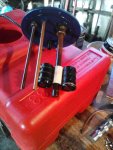
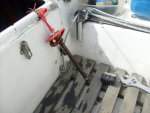
My fuel gauge consists of a row of 5 miniature reed switches attached to a piece of plastic strip and pushed into the top of a vertical tube in my fuel tank. The tube is sealed closed at the bottom.
Around the tube is a short length of loose fitting tube with two 35mm film canisters (floats) cable tied to it. One of these canisters has a magnet in it.
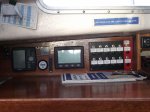
fuel1.jpgfuel2.jpgfuel3.jpg

Each reed switch is connected to it's own LED on the dashboard. There are 4 green LEDs and 1 red one at the bottom.

This simple system has worked reliably for many years. But a few years ago the new blend of diesel has started to affect the copper pipe. So a change to all plastic pipe is on my list of things to do.

John
 
The gas bottle device relies on the temperature of the gas changing between its liquid and gaseous states, so wouldn't work on a fuel tank.

If access is poor, you could consider a pneumatic gauge, where you have a weighted tube going to the bottom of the tank, then pump air into it and measure the pressure (which corresponds to the height of liquid in the tank). Sterling sell one, but it's about £300. Or you could make one, with a simple rubber bulb to apply pressure, and a cheap pressure gauge. You'd need a low pressure gauge; a 4ft depth of diesel would only give a pressure of about 1.65 PSI. You can get a 2 PSI digital gauge for about £20, eg https://www.ebay.co.uk/itm/LCD-Digi...ressure-Meter-Gauge-2Psi-D-B3Q8-/282772888258

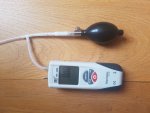
20181107_101112.jpeg

Thanks pvb. I haven't tried it on the diesel tank yet but very good at distinguishing different depths of my morning coffee.

Hoses and connectors from Advanced Fluid Solutions (AFS)
Bulb (for blood pressure) from Ebay.
Total cost (including manometer) £40 including postage.
 
Last edited:
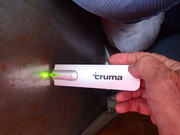
The gas level indicator needed is the Truma one that works on ultrasonic principles. It detects the presence of butane or propane in a steel bottle, provided it is relatively large. It will not work on my Campingaz bottles. However, it will detect diesel levels in a stainless steel tank and I assume it would do the same with a relatively thin-walled mild steel one. My motorsailer has immensely thick-walled fuel tanks, something like 5 mm, and it will not work with them.

These photos show it in action on my stainless tank. Of course, you need access to the side of the tank.

 
The gas level indicator needed is the Truma one that works on ultrasonic principles. It detects the presence of butane or propane in a steel bottle, provided it is relatively large. It will not work on my Campingaz bottles. However, it will detect diesel levels in a stainless steel tank and I assume it would do the same with a relatively thin-walled mild steel one. My motorsailer has immensely thick-walled fuel tanks, something like 5 mm, and it will not work with them.

These photos show it in action on my stainless tank. Of course, you need access to the side of the tank.


Would this device work to determine the level in my black water holding tank, I guess there is probably some methane in there?
 
Top