Lining hull with cedar strips

armchairsailor

Well-Known Member
Joined
17 Sep 2009
Messages
1,144
Location
back aground in Blighty
Visit site
Just thinking aloud here...

Saw a nice plastic classic the other day that I'm possibly interested in. She's solid but not pretty inside and needs an update/ fettle. Got me to thinking about those nice interiors where people have, say, lined the forecabin with 1-2" wide strips of varnished or oiled cedar or similar.

Has anyone got advice or suggestions for doing this? I assume it would be relatively simple. I'd imagine you apply bilge paint, make up vertical ply strips (glued to hull?) and screw down the strips. Does this sound about right?
 
I owned a boat where this was done from new. varnished teak strips screwed to glassed-in hollow vertical GRP stringers. Looked nice, much like traditional way with wooden hulls, and kept bedding away from bare white GRP hull sides. Snag was you had to unscrew lots of strips to clean behind strips - looked awful once dusty/mildewey white visible behind strips. That was with small gaps between strips to allow ventilation, not fully lined as in some boats.
 
There is a guy on You Tube called Sail Life he fitted out a boat and describes in detail how he did it, he has loads of videos including his current project but it was on his previous boat refit, do a search of his videos.
 
There is no need to leave any gaps between the strips for 'ventilation'. On my boat the strips have a half lap along their length (to allow for any movement) and they are around 25mm away from the hull. Since the top and the bottom are open there is ample scope for ventilation... as well as space for passing cables.

IMG_0055.jpg
 
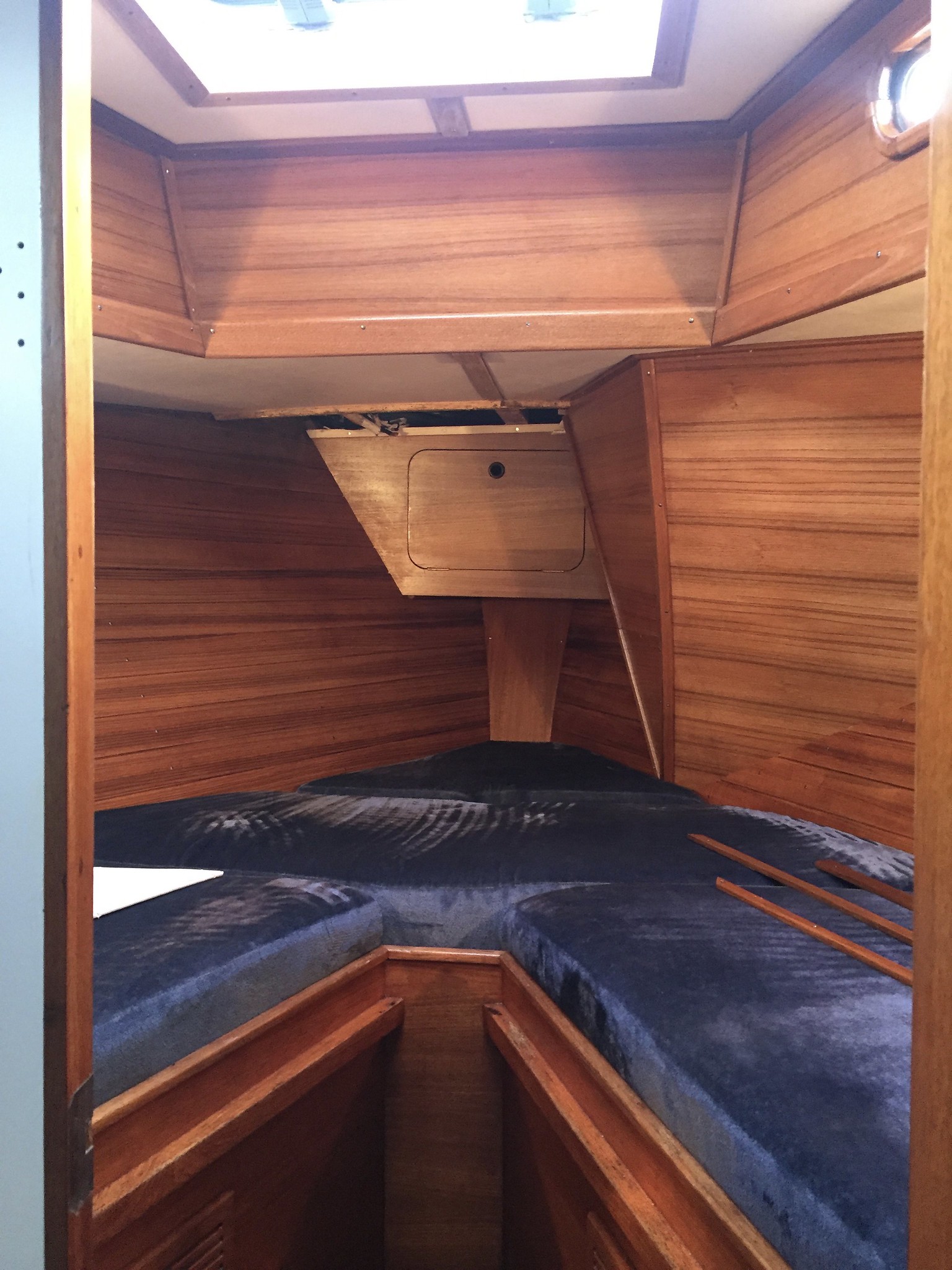
I converted the vinyl lining to strips of teak last winter on my own boat.

Although not needed, I left the original ply backing sheets in place. Behind these were blocks glued to the hull that the ply was secured to which subsequently was used to hold the new strips in place. The point is, if there is nothing to screw the new strips too, you will need to add that first to the hull. The strips are secured with stainless screws, do not use brass. On my renovation a lot of old brass screws had lost zinc and just crumbled. The time consuming bit is the trim to hide any edges. To starboard in the fore cabin is an anchor stowage locker and I just used a sheet to line that as it was too fiddly to follow with plank strips. The strips have an L shaped lip to over lap on the edge, butted up close before drilling and screwing in place.

IMG_6969 by Rival Sailor, on Flickr
 
The time consuming bit is the trim to hide any edges.

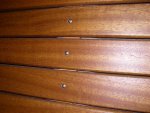
If you do the wide, spaced-out ceiling strips that the OP is thinking of then there is no trim. The ceiling is simply made with neat rounded-off corners and the gaps are part of the style:

4570674823.jpg


(That's the same type of boat as I used to have, but a better photo of someone else's.)

Mine was made the same way as jwilson's in post #2, with some soft material placed against the hull and then glassed over to make a raised ridge that could be screwed into. But I don't see why your idea of white-painted wooden stringers glued to the hull with sikaflex or polyurethane or something shouldn't work just as well.

Pete
 
I did mine in a similar way to Puff, using cedar tongue and groove to vertical battens - mainly because I had some left over from a household job. Not so easy to follow a curves as the individual slat method but gives a more "built in" look for not a lot of effort. Same problem of finishing the edges where it sits against other trim, though.
 
Last edited:
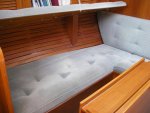
On my old HR352, the cabins were lined with strips screwed to wooden battens secured to moulded ribs. The inside of the hull was painted with floodcoat. Gaps between the strips allowed good ventilation. The strips had radiussed edges, see pic.

IMGP0567.jpg

IMGP0324.jpg
 
Last edited:
Top