Line sizes and low-friction rings

That's useful, Bilbo. What would you say about splicing a small loop in the end of the dyneema, putting the bight through the loop and holding the LFR in that? Say if the tapered end inside the dyneema line extended all the way round the LFR and past the join, how would the strength of that compare?

Dyneema has a huge breakload, and we tend to use it as if it was braid on braid polyester. Consequently it would be very rare for dyneema to reach the types of stresses on a cruising boat unless well under specified but even 5mm dyneema has a break load approaching 2 tonnes.

For instance 3mm Dyneema has a breaking load of well over 900 kg. The sheet winches on my Sadler have a max working load of 850kg

So it's quite possible my winches would give up before the 3mm Dyneema.
 
There seems to be a great deal more to the question(s) of 'bend radius' on breaking load, and much of it is in here.....

We already know from the knot testing that a tight bend radius with constricting force on the line gives about a 50% loss

http://forums.sailinganarchy.com/index.php?showtopic=154025&hl=+amsteel%20+eyesplices

In this continuing conversation, the 'bend radius' discussion seems to start around #44 and continues.... I am certainly no authority in this, but those guys are.
 
They do, but as their diagram shows they're referring to the fixing strop that you lash around the U-shaped perimeter - not to the rope size you run through the centre.

I believe this is also what the Barton ones are saying (thanks Snooks) - the chandlery's pricing label is meant to be read as one line: 'for up to 10mm fixing strop'.

Clearly you can run any line up to the internal diameter through it, but presumably there'll be more friction when more of its circumference is in contact with the ring?

The smaller the line, the lower the friction.

All tests I've seen show rings as having significantly higher friction than blocks, especially for large deflections. Used normally on high load, small adjustment situations: vang, early in a back stay cascade, or with small deflections - jib I haul etc.
 
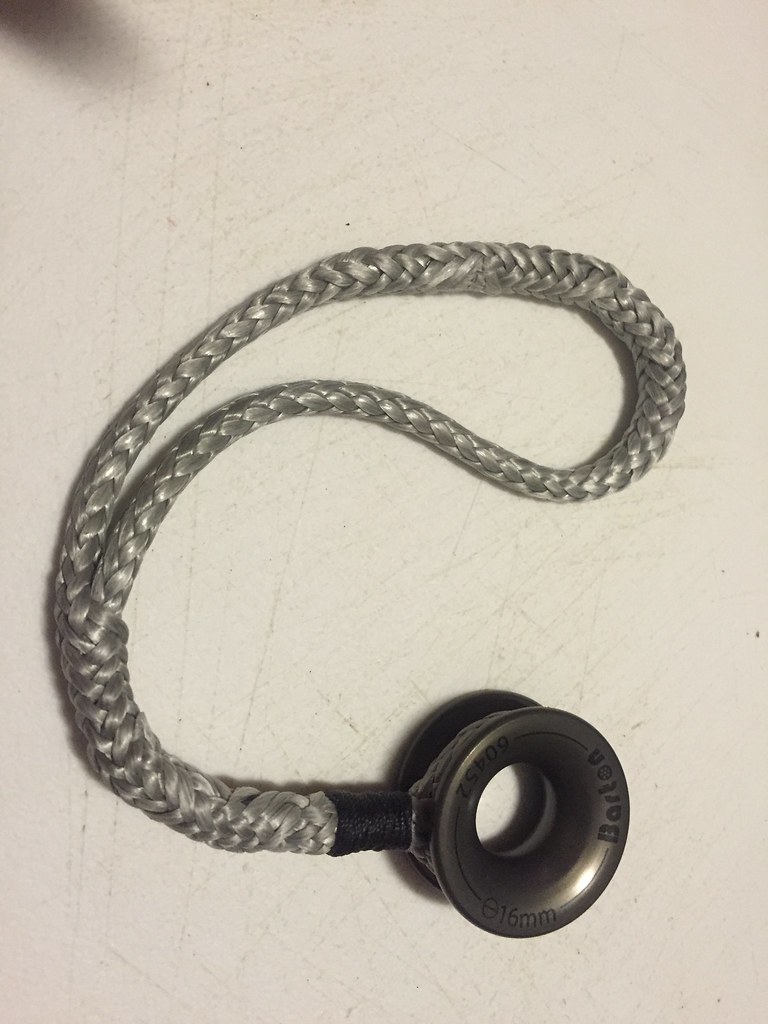
I know this is fred drift but having read this thread and some others on LFR I sat down last night whilst SWMBO operated the cooker and knocked this up - mainly as I couldnt believe the £30 tax placed on the components individual cost.

IMG_0378 by Owen Lees, on Flickr
 
This is my LF ring set up for adjusting the sheeting angle from my cockpit.

LF-ring_zpsnwll97x5.jpg

That's such a good idea, Snooks. Does your sheet run through another car block at the aft end of the track to set the ultimate vertical angle? On my boat the next thing is the block mounted on the side deck at 90 degrees.

(Alternatively I could use the existing car-mounted block at the aft end of the track, and find another way of bolting the dyneema eye to the forward end of the track.)
 
Snooks that's cool.
I am so copying that idea as going out to alter the car is such a pain in the posterior on mine and I was trying to get away from yet more blocks.
 
That's such a good idea, Snooks. Does your sheet run through another car block at the aft end of the track to set the ultimate vertical angle? On my boat the next thing is the block mounted on the side deck at 90 degrees.

(Alternatively I could use the existing car-mounted block at the aft end of the track, and find another way of bolting the dyneema eye to the forward end of the track.)

Yup, the existing car is far aft so it takes give a good sheet lead to a turning block, and as a bonus keeps the line away from my sprayhood webbing :0)

I thought about using the car forward, but needed to double the down line for purchase, and needed a fair lead into the aft turning block :0)
 
Yup, the existing car is far aft so it takes give a good sheet lead to a turning block, and as a bonus keeps the line away from my sprayhood webbing :0)

I thought about using the car forward, but needed to double the down line for purchase, and needed a fair lead into the aft turning block :0)

Thanks! Then the bit I'm missing is the equivalent of your slider with ring at the forward end of the traveller, to lash the LFR assembly to. Alternatively, I could replace one track bolt with an eye bolt, but that would put a more localised force on the traveller.

I guess the whole arrangement creates a narrower wind slot than using the traveller as intended? Because the further up the LFRs are set (the equivalent of pulling the car back for sailing upwind), the more of an inboard component there'll be in the purchase line between the two LFRs. Have you noticed such an effect while sailing - or has your boat performed upwind as you'd come to expect before you made the mod?
 
This is my LF ring set up for adjusting the sheeting angle from my cockpit.

LF-ring_zpsnwll97x5.jpg

Snooks, a small word of caution about those rings and windows...

Race boats have been using those rings for ages, but we use them as inhaulers - already having movable cars.

At the 2011 IRCs a competitor discovered a small problem with them, in a setup that looks pretty similar to yours in terms of the relative position of the ring and the windows (and to ours at the time). Basically, as they tacked the flogging jib sheet was whipping the ring against a window, and on the breezy day the whole window imploded in a pre-start tack. Your set-up looks like it would be more than possible for that ring to get whipped against the porthole in a tack, especially with the ring pulled down a bit and a reefed jib.

When we heard that we added some light bungee to the shrouds to prevent the ring from ever hitting the cabin windows.
 
Snooks, a small word of caution about those rings and windows...

Race boats have been using those rings for ages, but we use them as inhaulers - already having movable cars.

At the 2011 IRCs a competitor discovered a small problem with them, in a setup that looks pretty similar to yours in terms of the relative position of the ring and the windows (and to ours at the time). Basically, as they tacked the flogging jib sheet was whipping the ring against a window, and on the breezy day the whole window imploded in a pre-start tack. Your set-up looks like it would be more than possible for that ring to get whipped against the porthole in a tack, especially with the ring pulled down a bit and a reefed jib.

When we heard that we added some light bungee to the shrouds to prevent the ring from ever hitting the cabin windows.

Thanks for the heads up, I've been out in light and heavy ish weather but at the moment the rings just fall to the deck. I'm still trying to decide whether to use in-tweakers or just bungee to keep them up out of the way. Or a bit of light bungee to pull the smaller LF back so the big ring is kept close to deck.

I was going to give them the once over with self-almalgumating tape, because I could see that if a sheet jammed slack it would flog about. But ai also haven't heard them hit the coach roof yet.
 
Thanks! Then the bit I'm missing is the equivalent of your slider with ring at the forward end of the traveller, to lash the LFR assembly to. Alternatively, I could replace one track bolt with an eye bolt, but that would put a more localised force on the traveller.

I guess the whole arrangement creates a narrower wind slot than using the traveller as intended? Because the further up the LFRs are set (the equivalent of pulling the car back for sailing upwind), the more of an inboard component there'll be in the purchase line between the two LFRs. Have you noticed such an effect while sailing - or has your boat performed upwind as you'd come to expect before you made the mod?

The mod came about because I wanted to adjust my sheeting angle from the cockpit. In a money free world I could have got new towable cars and track etc. But Sadlers have a GRP headlining so that was out of the question for both cost and practicality :0)

I was thinking about an eye bolt through the deck, one hole in the headlining I could live with. But then I found these cars from Barton £35 each, and I thought for the sake of removing the end screw it was worth it.

At present her bottom is still keeping the local mullet fully fed, but I'll know more about her pointing ability in a week or two.
 
Thanks! I saw the Barton Genoa Slide 32mm for that price as well - I understand it'll fit my Lewmar size 2 track. I flinch at spending 2*£35 on a fixing (this is supposed to be an ingenious and inexpensive mod, not approaching the price for ball bearing cars with 4*purchase blocks!) - but I suspect I'll go the same way as you.

Would be very interested in your expert view on how or whether the inboard component of the force from the sheet gives you a narrower slot and whether it makes any difference to sailing upwind.
 
This is my LF ring set up for adjusting the sheeting angle from my cockpit.

LF-ring_zpsnwll97x5.jpg

Thanks Snooks. You inspired me to do the same. I replaced the forward through-deck bolt of my Genoa track with an eye bolt, and soft-shackled two LFRs to it for a 3:1 purchase. I used the same 2:1 cascade as you. I fashioned a teak top for the cheek block on the side deck, and bolted the cam cleat to that. The line is all 4mm dyneema, but I sheathed the cascade line with a red cover I stripped off an old polyester braided rope, for the clutch and fingers to grip. I'll shorten the cover so that only unsheathed dyneema goes through the LFR.

On thinking about it in use, I think you had the better plan to use a second car instead of my eye bolt at the forward end of the track, because the car spreads the upward force between several through-deck bolts whereas with my design a single through-deck bolt bears all the force. It's on a wide washer under the deck, but still... I just couldn't find an inexpensive car for my Lewmar Ocean size 2 track.

View attachment 58750
 
Last edited:
Thanks Snooks. You inspired me to do the same. I replaced the forward through-deck bolt of my Genoa track with an eye bolt, and soft-shackled two LFRs to it for a 3:1 purchase. I used the same 2:1 cascade as you. I fashioned a teak top for the cheek block on the side deck, and bolted the cam cleat to that. The line is all 4mm dyneema, but I sheathed the cascade line with a red cover I stripped off an old polyester braided rope, for the clutch and fingers to grip. I'll shorten the cover so that only unsheathed dyneema goes through the LFR.

On thinking about it in use, I think you had the better plan to use a second car instead of my eye bolt at the forward end of the track, because the car spreads the upward force between several through-deck bolts whereas with my design a single through-deck bolt bears all the force. It's on a wide washer under the deck, but still... I just couldn't find an inexpensive car for my Lewmar Ocean size 2 track.

View attachment 58750

Looks good. I've found in stronger weather conditions with a bit too much genoa out it's not as easy to pull in, but not too much load to let out (if that makes sense?) so before I set off I'll just keep them tweaked in until I know where I'll be going and the sheeting angle I need....Or just reef :0)
 
Looks good. I've found in stronger weather conditions with a bit too much genoa out it's not as easy to pull in, but not too much load to let out (if that makes sense?) so before I set off I'll just keep them tweaked in until I know where I'll be going and the sheeting angle I need....Or just reef :0)

I've just found to my great disappointment that on re-furling the genoa in a heavy breeze the LFRs thrash around and have caused several dings in the gelcoat around the angular coachroof corner pictured above.

Snooks, have you had this problem? I guess two ways to solve it would be (a) to sheathe the larger LFR that carries the sheet in some rubber or leather cover, and/or to use a heavy-duty bungee to hold the thing down to the eye bolt when the genoa sheet wasn't pulling it upwards.

I would be grateful for all ideas!
 
Go the other way (assuming non-overlapping jib). Bungy up to the shrouds, holding the ring up & away from the coachroof.
 
Top