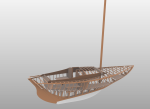
Likely displacement weight folkboat

GeoffNZ

New Member
Joined
14 May 2020
Messages
15
Visit site
Hi,
Could anyone shed light on likely displacement weight of my folkboat. She is a 26 ft 1964 English built carvel planked, cast iron keel folkboat. (G.J Farharm built).
She has Reg Tons 3 and 4 tenths carved into her deck beams. From what I can glean from the forum this is probably a gross metric tonnage and relates historically to how many barrels she would hold. This would translate to approx 7500 pounds but I suspect this isn't the displacement figure as such that I seek - seems a bit high.

Why I want to know is below 6000 pound displacement a 5 kW motor should get her up to hull speed . Over that would need a 10 kw.
Generally they a powered by an 8 - 10 hp diesel which would coincide with the smaller electric.
 
Folkboats commonly use 1GM or 1GM10 yanmars, so 5KW seems about right. (Yanmar hp figures are a bit optamistic, the 1GM is about 6hp, the 10, 8 ish.
 
Thanks guys. So the GRP international folkboat on Saiboatdata.com would weigh in the ballpark of my wooden one? Generally think of plastic as lighter but suppose GRP isn't a polyboat and is probably as heavy or a heavier build than wood.

In correction. I believe she was actually built by J.G.Parnham of Hants. Copied the other off a survey that was done on her. Just one of the errors in that report!
 
Don't take the published displacements too literally. The original Folkboat was very lightly built and the GRP boats aim to keep close to the original. English Folkboats were much heavier and did not meet FB class rules. Add large coachroofs fully fitted interiors, water and fuel tanks, inboard engine etc and I expect many will be closer to 3000kgs (still nothing to do with registered tonnage). You can get a better estimate of the weight of your boat by lifting it with a crane in slings.

Having said all that a 5KW electric will be more than enough power to achieve hull speed, although of course you will likely only be able to have enough battery capacity for a few hours running.
 
I have the specs of a 1964 long-coachroof Folkboat built on the IoW as 2 and 3/4 imperial tons displacement - ie about 2,800 Kg without engine - engines were optional.
 
Hmm - looks as if she could be over 6000 lbs then.
Might need to see if travel hoist can weigh her or just go for the larger unit.
 
...

Why I want to know is below 6000 pound displacement a 5 kW motor should get her up to hull speed . Over that would need a 10 kw.
Generally they a powered by an 8 - 10 hp diesel which would coincide with the smaller electric.
The power you need won't suddenly change from 5 to 10kW if it's slightly over 6000lb.
Hull speed is not a precise figure, it's a guide to an area of the power/speed curve where adding more power is of decreasing speed benefit.
You may need to consider prop efficiency, the Folkboat prop operates in a small cutout behind a big keel. The props you can use for electric might be more or less efficient than those which come with a Yanmar, depending on size, rpm etc.
The Folkboat is a pretty slippery shape and I think, historically, many have done OK with really small engines. It's not a shape that will be fast under motor, for the LOA of the boat.
You may also want to consider what the prop will do to the sailing performance.
 
Hmm - looks as if she could be over 6000 lbs then.
Might need to see if travel hoist can weigh her or just go for the larger unit.
No, really would be a waste. As already noted a Yanmar 1GM has a maximum power of 8.5hp or a little over 6kw and a cruising speed of 4.5 knots can be achieved at about 2700rpm when the engine produces about 3.5kw. Easily achieves hull speed of just under 6 knots at full power.

With an electric motor you will never use full power for any length of time, simply because energy consumption rises rapidly (far more than with a diesel) and range plummets. Those who have gone electric accept that speeds of anything more than 4 knots on a small boat like yours are just not achievable if you want any sort of cruising range - and even then only achievable with large and expensive battery capacity.

What kind of propulsion system are you planning on fitting?
 
I crewed on a Contessa 26 that had a Petter Mini 6, basically the same hull and it drove it readily at hull speed in favourable conditions; probably developing 3.5kW on a good day. 5kW is ample motor power, the problem with more is that you can't get it into the water, the prop aperture is barely large enough to accommodate a prop for a 1GM or similar. More power is going to be wasted unless you start hacking lumps out of the sternpost to make a bigger hole.
 
My experience was with Folkboats built in East Germany in the early 1960s. They were carvel built, weighed in at over 2.5 tons with their doghouse, and were all fitted with 4hp Stuart Turner petrol engines which gave them a speed of about 4 knots in calm conditions.
 
Or just have the boat lifted ....
Only costs a few hundred quid.

A Folkboat will have similar volume/draught/waterline beam/wll relationships as other boats of similar style.
All comes down to 'how accurately do you need to know?'

The proper thing to do is to build some estimates of drag vs speed, which you can get by putting limits on the displacement and taking data from 'similar' hulls, then consider the thrust vs speed from whatever prop with whatever power behind it.

I suppose instead of using a load cell to get the weight, one could simply measure the drag at various speeds as Bethwaite did.
 
How do you calculate the volume of the water displaced without complex drawings and calcuations?
The load cells on a boat lift are far more accurate.

Easy - fill a swimming pool to the brim & turn off the pumps. Crane the boat in so it displaces the water out off the pool and into the run-off drains.
lift boat out again then measure the drop in pool water. Easy Peasy ;)
 
Top