
Lightning Protaction Design

Willower

New Member
Joined
14 Dec 2010
Messages
4
Visit site
We have a Dufour 24 which has an apparently original lightning protection system based on a strap to one of the keel bolts.

I have just discovered that the strap is disconnected where it passes under the forward berths at a point where an apparent fuse holder had been connected. I'm a little surprised to find such a thing there - is it normal?

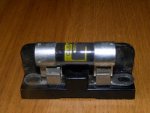
The "thing" may not be a fuse but it looks like one. Its about 10mm diameter and 50mm long formed from a glass cylinder with substantial metal ends. It has two wires internally at each end. I cannot see the centre for sintered metal. There is no apparent lightning damage however.

I've attached a photo which might clarify things

Thanks for any interest

Robert
 

Attachments

  • fuse.jpg
    fuse.jpg
    68.8 KB · Views: 0
It looks like a fuse, but putting a fuse into a lightning conductor appears counter productive to me. There is a thread on the subject of lightning strikes and protection here http://www.ybw.com/forums/showthread.php?38545-Yachts-and-lightning-strikes
There seems to be no clear cut advice about what to fit, or not. Boats in places like Croatia where lighting storms are frequent are often fitted with a device consisting of a number of metal rods pointing outwards at the masthead.
 
We have a Dufour 24 which has an apparently original lightning protection system based on a strap to one of the keel bolts.

I have just discovered that the strap is disconnected where it passes under the forward berths at a point where an apparent fuse holder had been connected. I'm a little surprised to find such a thing there - is it normal?

The "thing" may not be a fuse but it looks like one. Its about 10mm diameter and 50mm long formed from a glass cylinder with substantial metal ends. It has two wires internally at each end. I cannot see the centre for sintered metal. There is no apparent lightning damage however.

I've attached a photo which might clarify things

Thanks for any interest

Robert

The lightning strap on my Dufour does not have any fuse,a tinned copper strap connects the rigging to one keel bolt terminated with a jubilee clip attachment.Some interaction between the dissimilar metals is apparent and needs watching.Are you the first owner of this vessel?Could it have been modded?Sorry Norman E our posts were simultaneous!
 
Doesn't seem much sense having a fuse in a lightning conductor, but maybe it's actually some other device intended to prevent stray current corrosion by blocking small currents while allowing big ones?

Just a guess.

Pete
 
It could be a gas arrester that is normally used in telephone circuits to short lightening to ground. I have a number of mains plugs with then fitted.Dont know why it would be used in a boat lightening strap could be fitted in between 12v and earth or mains and earth
 
Probably a Gas discharge surge protector.
When the voltage surges above a level, the electrical power is strong enough to ionize the gas, making it a conductor. It passes on current to the ground until the voltage reaches the normal level, then becomes high resistance again.
 
Thanks for the prompt replies. I had not heard of the Gas Discharge Surge Protector, but that sounds more sensible then a fuse. It might explain why there are two wires at each end rather than one. Would the sintering imply that it needs replacing?

The spreading rods, or equivalent wire brush devices on the mast or on roofs are, I think, to provide protection from a strike happening. If the ground is negatively charged wrt the clouds then electrons will tend to flow away from the most pointed areas of the boat creating a non lethal current from the masthead to ground. I think the idea is that the negatively charged volume created makes it less likely for a positively charged leader to find an attractive path. It does not work if the clouds are negative wrt ground, but I suspect this is an unusual occurrence.

Please ignore the para above if you know it to be rubbish.

Thanks again

Robert
 
Very interesting LadyInBed,
Any idea if it would survive the lightning strike?
Would it help in preventing stray currents?
That is,when in passive mode, there would not be any current possible between the rig and the keel?
Willower, thanks for asking the question!
 
Last edited:
As said it is lmost certainly a gas discharge or perhaps solid state device that conducts with any largish voltage. Hence providing electrical isolation until you need it. A bit like galvanic isolator for lower voltages. It will do as well as the cables for carrying lightning current.

The concept of pointed or brush like devices on the extremities of high points is to intensify the voltage tension at that point. This can have the effect of dissipating static build up at a lower voltage hence less dramatically. I think it is to reduce static electricity build up which can contribute to atracting a lightning strike. In the case of an actual strike they will not take any further part in the process or damage.
They are often found on higher speed aircraft on the trailing edges of wing and tail and are designed to dissipate static electricity build up produced by friction with the air. The Idea is to dissipate earlier to reduce radio interference. good luck olewill
 
can I ask about the practicality of linking the lightning protector to a keel bolt please ?

Having seen what happens when a protection system was earthed to a large (15" by 15") radio ground plate (it blew a hole in the hull), what happens if you send gazillion volts to a keel bolt in, for example, a keel that is painted and anti-fouled and therefore (possibly ?) non-conducting ?
 
can I ask about the practicality of linking the lightning protector to a keel bolt please ?

Having seen what happens when a protection system was earthed to a large (15" by 15") radio ground plate (it blew a hole in the hull), what happens if you send gazillion volts to a keel bolt in, for example, a keel that is painted and anti-fouled and therefore (possibly ?) non-conducting ?

A very profound question and really not easily answered. (nobody knows) It is all a case of very high current hence overheating of any resistance in the circuit along with the ability of the voltage to jump over any discontinuities so maintaining the current through plasma arc.
I am at a loss to understand why a 15inch square ground plate should by being in the conductive path blow a hole in the hull. Quite likely the bolts were melted (fused) in carrying the current. The plate itself could also melt (fuse) although less likely. It is also conceivable that when the plate had gone in vapour, the hull was melted or even that the moisture in the GRP conducted some current and overheated exploding the GRP. All very horrible.
In a similar way the keel bolts carrying the current could melt (vaporise). I don't think the mass of a cast iron keel (or even lead) would melt in itself. I think the antifiouling paint and coatiungs will be insignificant in the current path.
Grounding the keel to the mast seems like the most accepted method of protection. Connecting all bolts may spread the current but on the other hand may mean all bolts are destroyed. (ie those not connected and hence not destroyed may hold the keel on) We are talking huge destructive currents here so all we can do is hope to minimise damage.
good luck olewill
 
Top