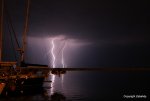
Lightning forecast - unplug or not unplug shore power???

tudorsailor

Well-Known Member
Joined
12 Jun 2005
Messages
2,756
Location
London
zebahdy.blogspot.co.uk
So I'm sitting in a little marina in the northern aegean. Lightning is forecast. Should I unplug the shore power or it is better to be grounded via the shore power?

Obviously I would not do this during the thunderstorm.

I ask because we once had lightning strike nearby and the was a click as the shore power tripped/blew.

TudorSailor
 
I'd unplug, but not for the reason you suggest. If the t'storm carries strong winds from a bad direction, you may want to leave that quay quickly. (Writes a man who once discovered that a security-conscious Turkish marinero had helpfully padlocked his power lead into the shoreside box in just such circumstances...)

Boats on quays are far more likely to suffer damage in thunderstorms through boffing the quay or each other than they are to suffer direct strikes. Pace...last autumn's shenanigans in Greece, and many others. In a particularly sheltered harbour/marina, of course, this may not be an issue.
 
Last edited:
I don't think a shorepower lead is going to make any difference in the likelihood of getting struck by lightening. The path to earth it provides is small and indirect (it goes via a long wire to the shore side earth points), so it won't make the chances of a strike much greater.
My major concern when moored in a thunderstorm is the associated high speed gusts of wind which can do more damage than a strike. I'd therefore tend to unplug the shore power lead as it's one less thing to get damaged if the boat gets thrown around a lot by the wind rather than because I was seeking to isolate the boat from a potential lightening strike.
 
Drifting the thread but slightly...

-A lightning strike is preceded by a discharge from the ground to the cloud, which 'opens up' a pathway for the main strike from the cloud to earth.
-Pointy things tend to discharge electricity well.
-If the mast has no good route to earth, can it gain charge to initiate that precursive discharge more or less easily than if it has a good electrical connection to earth?
Discuss.

P.S. Never ever hide from a thunderstorm in a cave:

French Advice: "If, unfortunately, we are surprised by the storm, we must avoid standing near the peaks and summits and descend as low as possible. Never shelter under a tree or cave unless the ceilings are very high, get away from any metal objects, avoid getting wet, do not stand close to a vertical wall or anything that is prominent and to put oneself at a distance from the precipices because when one is touched by the lightning one is jostled, even displaced. To avoid ground currents, one must move away from each other.
The best thing is to squat, sit on a backpack and, if possible, on a slab that has little contact with the ground. And, never protect yourself with a survival blanket that attracts lightning."

Well that's us stuffed then!
 
I carry an old pair of jump leads which I can clip to the standing rigging and dangle in the water.

That may help by discharging the pre-strike potential, making a strike less likely but, in the event of a strike, I would think it pretty much guarantees failure of the rigging at the pint where the jump lead is attached, as that will be the pint of highest resistance and will therefore get hottest. Sybarite's chain will have a similar problem, but multiple points of contact with the mast will mitigate the problem to some extent, provided the oxide layer on the mast doesn't prevent a good contact.

My very limited experience suggests that if a bolt's got your name on it, you're toast. Whether any sort of system a yottie can use really helps, I don't know. Maybe it's like cancer, where some people can do everything right and still get it, others can smoke and booze, eating nothing but fry-ups and still die Roger McGough's Youngman's Death, but we can improve the odds.

If I were to put together a system, I think it would be lengths of rigging wire long enough to go at least a metre into the water and clamped to each shroud and stay over a length of maybe 15cm, using several clamps so as to reduce the resistance to a minimum. I haven't bothered because 1. I'm not sure whether such a system wouldn't attract strikes that would otherwise miss me, and 2. I've never thought of it as a high risk.
 
I used to run the Army's communications site in the mountains of Troodos, Cyprus, and lightening was a real problem and you have a point both about the contact and the chances of being hit.

I'll take my chances with the standing rigging, though, because I've seen the effects of lightening in a confined space; fortunately the strike which came in on the waveguide and leapt across to the cable distribution frame missed one of my Corporals by a couple of feet. I've never seen anyone so white. (We normally had advance warning and used to sit in the NAAFI during high lightening states).

I used to have a rogues gallery of cables and other equipment that had been hit by lightening to show those who were sceptical about why we stayed out of the comms rooms during lightening state 2 or 1. It was a sobering experience and I have a very health fear of it.
 
Drifting the thread but slightly...

-A lightning strike is preceded by a discharge from the ground to the cloud, which 'opens up' a pathway for the main strike from the cloud to earth.
-Pointy things tend to discharge electricity well.
-If the mast has no good route to earth, can it gain charge to initiate that precursive discharge more or less easily than if it has a good electrical connection to earth?
Discuss.

P.S. Never ever hide from a thunderstorm in a cave:

French Advice: "If, unfortunately, we are surprised by the storm, we must avoid standing near the peaks and summits and descend as low as possible. Never shelter under a tree or cave unless the ceilings are very high, get away from any metal objects, avoid getting wet, do not stand close to a vertical wall or anything that is prominent and to put oneself at a distance from the precipices because when one is touched by the lightning one is jostled, even displaced. To avoid ground currents, one must move away from each other.
The best thing is to squat, sit on a backpack and, if possible, on a slab that has little contact with the ground. And, never protect yourself with a survival blanket that attracts lightning."

Well that's us stuffed then!

Why not hide in a cave?

Safer than out in the open?
 
the strike which came in on the waveguide and leapt across to the cable distribution frame missed one of my Corporals by a couple of feet. I've never seen anyone so white.

I had a similar experience as a teenager. I was at home between A level exams with a mate when the house was struck by lightning. A huge flame shot out of the boiler he'd been leaning on a few seconds before.

When we gathered our scrambled wits, the telephone was smouldering gently and when we went outside, we could see a 6 foot hole in the roof. The strike had also gone down the
aerial lead to next door's TV, which exploded and gone on to fry all the mains wiring.

I've never enjoyed thunderstorms since
 
If another boat gets hit by lightening and is connected to shore power there is a risk that you boat will get a power surge if you are connected to shore power (I do not claim to know how much of a risk).

For me I do not think the risk is worth taking as it could prove expensive, unless it is covered by the insurance then maybe a free rewire and other bits.
 
Our mains charger was fried by a lightning strike in Southsea marina. I'm not sure which strike it was but there were none in the immediate area so there was clearly a mains surge. I'd always suggest disconnecting.
 
Drifting the thread but slightly...

-A lightning strike is preceded by a discharge from the ground to the cloud, which 'opens up' a pathway for the main strike from the cloud to earth.
-Pointy things tend to discharge electricity well.
-If the mast has no good route to earth, can it gain charge to initiate that precursive discharge more or less easily than if it has a good electrical connection to earth?
Discuss.

Not the way I understand lightening to work... I think that the ground is positively charged and the clouds negative. When a strike occurs there is a slow moving charge going up that meets a faster charge coming down. The suddenly created conductive path presents an opportunity to discharge a wider volume of cloud.

There are 2 types of lightening protection, both confusingly called conductors. One has pointy bits at the top, the other dosent. The pointy one works by corona discharge enabling a safe discharge of the ground around the building. The non pointy one works by providing a preferred route for the zap.
since the oggin is vastly more conductive than ground, pointy ones wont work very well at all since it would have to dissipate the entire charge of the whole storm.
 
A lightning conductor is exactly that: in the event of a strike it is specifically designed to carry the charge down a heavy conductor where it will do least damage. It is also designed with a point at the highest part o f the building so that it will produce the strongest rising leader. ( the weak low voltage positive charge reaching up to contact the corresponding negative charge leader descending from the cloud). As such a lightning conductor is actually intended to attract lightningaway from more vulnerable parts.

Lightning protection is intended to prevent the positive charge leader from forming in the first place, I don't want to discourage you from what you feel safe doing, but I suspect that by earthing the rig during lightning the known physics suggests you may actually be increasing the chance of a direct strike. If earthing the rig works, why do boats on moorings get struck?

The other effect a big lightning bolt nearby can have is to create a heavy magnetic impulse, inducing an electrical charge in nearby metal objects. I have read accounts of people getting quite severe electric shock from pushpits, guardrail, or metal rigging during nearby strikes. A near miss can still fry electronics anyway from an induction pulse generated in the boats wiring.. The wiring itself may or may not be damaged. I was videoing a specacular storm recently. Each time there is a big nearby stroke, the video picture is momenrtarily scrambled.

Many years ago a moored boat was struck. The old style rotating Seafarer echo sounder was damaged, so the owner returned it to Seafarer but didn't say what had happened to it. It came back with new internals, and a sharp note reminding the owner NOT to connect it to the mains again!

Disconnecting the shore power is a good idea to prevent lightning surges reaching the boat. Overhead telephone cables are vulnerable too. There have been a number of people killed over the years by lightning using landlines that have been struck
 
Last edited:
Top