To measure inrush current accurately you really need an oscilloscope to measure voltage drop accross a shunt as the duration of max current is so short.
(and others by the same guy) may be of value in the discussion. Essentially he uses a lead acid battery as a "surge protector" for both discharging and charging LiFPO4 cells. I will not attempt to summarize what he seems to explain quite clearly.
I don't think leaving the batteries in parallel will result in much charging, the LFP batteries would have a lower voltage than LA float, but i haven't tested that.
There has been some talk of a delay in the BMS shutting down if the current draw exceeds the rating of the BMS, that hasn't been my experience. I have found that if the BMS current is exceeded the BMS shuts down instantly.
Jump packs etc do work, but you have to keep them charged and bigger engines need bigger jump packs, which don't come cheap. Plus, they don't help if the engine batteries are knackered.
I've found that as long as the starter current does not exceed the BMS, or fuse rating the engine will start fine, as a few of you have said.
My setup is 280AH of LFP @ 24V and a 200A JK BMS, from grade A EVE cells, assembled by myself. The fuse is a 250A NH fuse, protecting the wiring. The engines are 7 litre Volvo diesels, 350HP each. The battery isolators are key operated from the electrical panel next to the lower helm.
From the previous setup of LA batteries there was a manual parallel switch, connected between the load terminals of the main isolators. Turning this on and the engine battery isolator off, then pressing a starter switch the BMS instantly shut down, leaving the boat with no power at all until the BMS reset. Clearly no good.
So i fitted two heavy duty solenoids in the battery compartment, activated by a pair of key switches in the electrical panel next to the lower helm. One solenoid replaced the manual parallel switch, the other bypassed the BMS. With the parallel switch on, then the BMS bypass switch on, pressing the starter switch resulted in the engines starting straight away without the BMS shutting down.
I had to switch the engine battery isolator off, as the engine batteries are actually fully charged, but this shows that i can start the engines with completely flat/knackerd batteries and if need be leave them isolated and run everything from the LFP bank to get home. With slightly flat batteries it wouldn't be neccesary to isolated the engine batteries.
It would also be possible to use the parallel switch to run everything from the engine batteries if there was an issue with the LFPs or the BMS, isolating them with the domestic isolator if needs be.
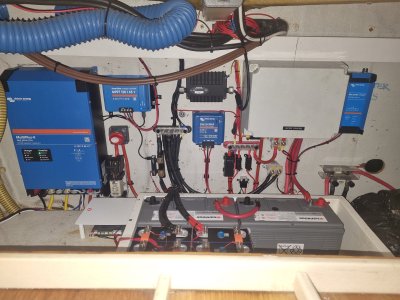
This is the layout of everything in the battery compartment :
There is a moulded GRP cover that goes over the batteries, the the blue ducting above connected to it for ventilation. The battery temperature is circa 20 degrees C.