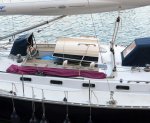
Life raft, inflatable or wooden tender?

In a way you are asking the wrong question. Its not a choice between a tender and a life raft. Sailing without a tender really limits your options. And one will not do the job of the other.

It’s your choice, Do you feel more comfortable with a raft. If so get one. The chance you will need it is very small. But if you do it’s the best option.

As it happens I bought a life raft before I bought a tender. My decision was based on my sailing my newly purchased old boat home involving a couple of hundred miles of a very lonely coastline.
It provided piece of mind to my wife who was worried about my crew her son.
Today it just takes up space in the locker. I think it serves as a placebo.

Sailing the rest of the summer without a tender really limited our options. Nice anchorages we couldn’t go ashore. I missed the tender.

I now have a nice new inflatable tender. I tow it. But it’s a roll up so for longer trips I can stow it. It also rolls up and goes in the trunk of the car.

I used to have a hard tender. Nice to row, pain to tow, heavy to lift, required a trailer to take home, and was stolen. From the dock even though it was chained
 
With your boat it would almost be sacrilege to tow a modern rubber boat; Maybe an old round-tail Avon, but who wants to row one of them? Make or buy a wooden tender with ample built-in buoyancy. You could even get a gunter rig and a tent made up...

My two pence:

- Using the inflatable tender when we were in Croatia was scary because the karstic limestone is really sharp. A big tear was a real possibility when landing on one of the uninhabited islands.
- Inflating the tender in a rush may not be possible.
- May be easy to get it hung up in the rigging in a high stress situation.
- I once had a dive cylinder setup which would permit rapid inflation of the dinghy. Something more dedicated would be a good idea.

- A life raft may or may not work.
- A life raft inside the boat may not be reachable when needed, though your keel is presumably pretty secure.
- A life raft outside the boat may no longer be there when needed, maybe even if properly mounted.

- Despite some inbuilt buoyancy we had an occupied GRP tender, which was too tender, sunk by a clumsy crew member climbing aboard. After salvaging it, it later disappeared from the tow line one night. Maybe it made a good lure for a great white?
- I would not like to bounce even a GRP boat off the rocks in Croatia.


We now use a hired liferaft or the inflatable on the foredeck for lads' cross channel stuff but tow a Rigiflex 360 for family cruises. The Jeanneau is big and heavy, but tows well and is a superb easily driven rowing/motor tender for four people, enabling significant trips up rivers, snorkeling adventures and the safe carriage of the huge piles of stuff that families seem to require for any trip. They are practically indestructible, if you remove the bung they self bail under tow, they don't blow about in anything under a F8 at least.

I would prefer a tender that could be sailed too, but these are built as club safety boats... It was also painless to breast-tow the mother ship across Hurst Narrows after ingesting a load of seaweed into the water intake and burning out the exhaust...
 
Depends how much value you place on the lives of your family at the end of the day . hope you never have to use one.

Shame on anyone who goes to sea without hiring a a fully crewed offshore lifeboat to follow them everywhere.... after all, what price is your family's safety? :-)

I prefer to think it's a matter of using common sense to balance risk over practicality, rather than making people feel bad for not spending more than they can afford on probably/hopefully unnecessary safety equipment.
 
Put the fire out with the extinguishers you have on board - don't burn
Fix the plank with the tools you have on board - don't sink
Get seen by the ship with the radar reflector or active AIS - don't have a collision you can't survive
Call the coast guard with the PLB you have on your lifejacket or the handheld DSC VHF in the cockpit - get rescued

Once you have all of the above covered, then start to contemplate a life raft because it is the absolute last resort. The cost of all of the above is much more reasonable than a life raft and servicing, and you can expect a much better outcome than floating about in a paddling pool with a tent on top...
 
Having had a solid tender land in the cockpit after it was picked up by a folowing sea, I'd never tow one for any worthwhile distance.

On the liferaft question. There is a distinct difference between safety and emergency equipment. Safety stuff you use all the time, lifejackets and the like. Emergency equipment may be the only thing standing between you and your god. When you need it, are you going to regret spending the money?
 
Put the fire out with the extinguishers you have on board - don't burn
Fix the plank with the tools you have on board - don't sink
Get seen by the ship with the radar reflector or active AIS - don't have a collision you can't survive
Call the coast guard with the PLB you have on your lifejacket or the handheld DSC VHF in the cockpit - get rescued

.

Unless you industrial grade fire extinguishers and training in fire fighting, then the fire extinguishers on board will do little more that give you some additional time to escape a serious fire. They will probably cope with a small galley fire, but once a fire has spread to wood work, you are going to have to get off. In your house they will little more than suppress the fire until you get out.
 
On the liferaft question. There is a distinct difference between safety and emergency equipment. Safety stuff you use all the time, lifejackets and the like. Emergency equipment may be the only thing standing between you and your god. When you need it, are you going to regret spending the money?

Safety equipment is what prevents you from having to use emergency equipment. As lustyd says, it's about spending money sensibly, not splurging on every possible worst-case situation. Do you only carry one life raft?
 
Why the assumption that "an inflatable or a dinghy are unlikely to be any use in the sort of conditions that would result in your boat sinking"? For day sailing, even cross-channel, there is absolutely no need to be out there in weather so bad that a dinghy would be useless. Fire or getting holed (typically by a failed sea-cock), in good weather, are the more significant risks.

Nor am I in sympathy with the retailers' punch-line "You owe it to your family". Take that to its logical conclusion and you'd only go sailing in a lifeboat. And never take them to your yacht by car, since far more accidents occur on the road.

The level of protection should be commensurate with the risk. With help rarely more than an hour away, a good inflatable dinghy ought to provide a sufficient backup for the sort of sailing the OP proposes and would be useful for other purposes. Use the money saved to equip with top-quality life jackets, preferably with hoods.
 
Last edited:
Since invariably it is best to stay with the boat rather than ditch to the raft perhaps it would be better focusing in keeping the boat from sinking. At what stage does the boat become a better raft than the raft? There are two situations I can think of where you would need to abandon a boat no matter what, 1) significant fire, 2) catastrophic failure of hull (run over by tanker, gas explosion).

Fire can be resolved by having good detection and firefighting measures as well as spec-ing fire resistant wiring etc. Catastrophic hull failure can be reduced in likelihood by a good watch and gas safety etc. So, if you do these things and make a boat with positive buoyancy have you not made your boat into a better life raft than a proper raft? The risk must then be very low and might be below the threshold for reasonable expenditure in all but the most extreme journeys.
 
The advantage that a liferaft has over an inflatable dinghy is that unless you keep the dinghy inflated at all times then a raft is much quicker to deploy. Some might not think that a problem but emergencies are usually a result of the unexpected happening unexpectedly.
 
As said both of you do a sea survival course if going offshore. Never tow a dinghy offshore, keep the dinghy on the foredeck deflated enough to fit, get a life raft for peace of mind and attach it to the stern rail. We had fire extinguishers in the saloon, fore and aft cabins. Always turn the gas off when not using the cooker.
 
Thanks for all the replies. Here is where I think I am:

Try not to sink or burn:

Well maintained wooden hull.
New standing rigging 2013.
Meths stove (no gas onboard)
New batteries (2) 2012, complete re-wire 2013
New engine 2013 with all new pipes and sea cocks.
One sink with 2013 new seacock.
Sea heads with S&L old fashioned seacocks - serviced annually.
All seacocks have bungs attached or close by.
Log with cap and bung close by

Try not to get run down:

Radar reflector
Fixed VHF DSC with AIS receiver

Call for help:

Fixed VHF (as above)
EPIRB
Hand Held VHF
Coastal Flare pack (just out of date so will be replaced over the winter)
Numerous phones and ipad plotter

Try to survive:

Life jackets always worn - with personal dan bouy, light and most have spray hoods (winter job to sort out who has what on each belt and test as the LJ's are 4 years old now)
Inflatable - but its to large for the foredeck so is stowed

I think what the thread is telling me is not to rely on the inflatable as a way of getting off in a hurry, towing a hard tender isn't a great solution and life raft is going to be very much a last resort.

I guess in the end I'm going to end up with a life raft , but for now, just rent one for longer trips. The economics will make the decision for me. if renting becomes more expensive than owning, then that will be the decision made.
 
Would not be without the inflatabe tender, being without is too limiting.
We don't tow it more than a few miles.
I'm happy to sail in the english channel without a liferaft.
However, in real terms he are cheaper now so next boat might have one.

Years ago I sailed on a boat with an Avon dinghy fitted with CO2 bottles.
Could be an option?
 
Before we set out for the Med I gave this whole debate a good deal of thought and read round the topic a bit. Given that we were going to be doing a Biscay crossing as well as several longish hops once we got to the Med, it was clear we needed a refuge should the boat become untenable.

So, what could go wrong that would cause us to abandon the boat? Fire is the most obvious followed by holing the hull such that we could not prevent the boat sinking. That's the obvious ones and ones that I've actually heard of happening. In the first instance, fire, there is likely to be very little time to organise inflating a dinghy: indeed, it's possible that we wouldn't even be able to launch one from the foredeck should we be carrying one there. So that dictated a liferaft as the last resort.

I have heard of the idea of using a CO2 cylinder to inflate a dinghy but having looked at it, the practical difficulties of having to make up a pipe network and trigger mechanism were such that I dismissed it. In addition, a dinghy has no overhead cover and, whilst we tend to avoid high winds if we can, the thought of getting into a fairly unstable dinghy has killed any desire to rely on the dinghy as a last resort.

Anyhow, that's my thinking and why we have this lump strapped on to the coachouse. If we were in UK I suspect that we wouldn't have a raft, as we'd likely be sailing fairly close inshore and it easy and cheap to hire a raft for the odd longer trip.
 
Last edited:
Thanks for all the replies. Here is where I think I am:

Try not to sink or burn:

Well maintained wooden hull.
New standing rigging 2013.
Meths stove (no gas onboard)...

Oddly enough the only time I have had a afire on board at sea was when meths leaked down the back of the stove... Although to be fair the fire extinguishers did get it out. :)
 
>Life jackets always worn - with personal dan bouy, light and most have spray hoods (winter job to sort out who has what on each belt and test as the LJ's are 4 years old now)

One thing I forgot to mention is the key thing is not to go overboard. The only way to do that is to fix a U bolt in to cockpit to clip onto and jackstays. Use a harness with one short and one long tether, the long one is for attaching around the mast if reefing or dropping the sail in strong winds keeping the short tether on the jackstay. In bad weather move about the deck on your knees. We always clipped on at night and in bad weather and viewed life jackets as what you put on when getting into a life raft.
 
I tow an inflatable, which we use for when we get to the destination, and I also have an old inflatable deflated and folded as a plan B escape route. If I ever do blue water sailing, I will buy a life-raft too.
 
The 1979 Fastnet wasn't the only time crews abandoned to the life raft yet failed to survive, while the boat they left did. Rather than a life raft, would inboard flotation bags not be a better solution? While not local, these chaps seems to think so: http://www.turtlepac.com/products/underwater-lift-bags-a-yacht-floatation.html.

I'd rather be on a wallowing yacht that could sail than a life raft.

Holing of the hull would be covered, though if they melted in a fire......
 
Top