
Lewmar Evo, ejecting Tailer off the top

IanR

Well-Known Member
Joined
28 Oct 2001
Messages
415
Location
Onboard
seascape2016.blogspot.com
Anyone else had a problem with Lewmar winches squeezing the tailer off the top of the drum?

The plastic retaining disc appears too frail to retain the force of the tailer, the line and the spring and the tailer jumps off with shock and possible severe consequences for the poor crew. I have now had this issue on three winches. Once the threads on the ring are deformed its curtains for the ring. I would have expected the ring to be metal to maintain the thread.I would hesitate to describe is as a design fault if I am the only one enjoying this feature.


Line size and load all within specs for an EVO 48ST, Ring was tightened reasonably sensibly.
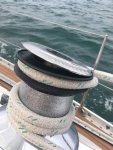
winch.jpg
 
This from cruisers forum. Does it offer any insights?
Dear sailing friends,
I have mounted a LEWMAR EVO 45 ST winch to handle the main sheet of my Privilege 435 catamaran.
The main sheet is a 2 part purchase affair at the end of the boom. So the pull is reasonable on this size of winch and indeed only normal effort is required on the winch handle, even when sailing upwind in 25 knots of wind

As can be seen on the photo, a black plastic nut cum washer is screwed on top of the winch and locks its assembly, notably the circular self tailer.

I discovered that if the sheet is turned only twice around the drum of the winch (a common mistake with amateur crews), the sheet not only slips but breaks the black plastic nut cum washer, allowing the top crown of the circular self tailer to escape.
Have you experienced similar failures ?

To worsen this case, LEWMAR sells the plastic nut cum washer (a few grams of plastic 2" in diameters) sells this spare part for ....53 € French retail price
Attached Thumbnails
 
This from cruisers forum. Does it offer any insights?
Dear sailing friends,
I have mounted a LEWMAR EVO 45 ST winch to handle the main sheet of my Privilege 435 catamaran.
The main sheet is a 2 part purchase affair at the end of the boom. So the pull is reasonable on this size of winch and indeed only normal effort is required on the winch handle, even when sailing upwind in 25 knots of wind

As can be seen on the photo, a black plastic nut cum washer is screwed on top of the winch and locks its assembly, notably the circular self tailer.

I discovered that if the sheet is turned only twice around the drum of the winch (a common mistake with amateur crews), the sheet not only slips but breaks the black plastic nut cum washer, allowing the top crown of the circular self tailer to escape.
Have you experienced similar failures ?

To worsen this case, LEWMAR sells the plastic nut cum washer (a few grams of plastic 2" in diameters) sells this spare part for ....53 € French retail price
Attached Thumbnails
Thanks for the link which I followed.

I have now been contacted by other unhappy customers and have written to Lewmar for a third Time seeking advice and solutions . The last time to their CEO.
I think I might start a business making the rings for the winches. It could turn out to be lucrative.
 
Anyone else had a problem with Lewmar winches squeezing the tailer off the top of the drum?

The plastic retaining disc appears too frail to retain the force of the tailer, the line and the spring and the tailer jumps off with shock and possible severe consequences for the poor crew. I have now had this issue on three winches. Once the threads on the ring are deformed its curtains for the ring. I would have expected the ring to be metal to maintain the thread.I would hesitate to describe is as a design fault if I am the only one enjoying this feature.


Line size and load all within specs for an EVO 48ST, Ring was tightened reasonably sensibly.

View attachment 129859

The Evo's have been around for quite a few years now (8 or 9 maybe?), I worked at the company for many years, but left equally many years ago for pastures new and the comments and advice below are therefore entirely my own. However, thousands were sold to OEM and private customers during my time there, it must be tens of thousands by now if not more, and if there was a fundamental design flaw, it would have been most apparent very quickly!

The lower jaw is the part that springs downwards to accept the line, the upper plastic jaw is locked in place on top of the drum with fixing screws. Therefore the feeder arm (the stainless bit) doesn't take any of the force of the thickness of the line, or the spring pressure of the jaws. Really, all it takes is some compression force (on the arm part), which is mainly taken up by the 2 brass collets into which the feeder arm should lock, this transfers the load into the main centre stem and spindle of the winch. Equally, there is a bit of support from the "stripper ring" which should be locked into the recess at the back of the feeder arm.

If a feeder arm has been overloaded, by using too few wraps on the winch drum, normally the stripper ring would be crushed, or the stainless bent, causing the winch to become stiff. It's very rare for the plastic top cap to pop off like this, I'm not sure I saw even one instance of this.

Some things to check :

- Are you using a minimum of 3 wraps on the drum, then onto the self-tailer? This minimises force on the feeder arm, and is as per Lewmar guidance.
- Is the metal feeder arm locking into the 2 brass collets at the top of the centre stem properly? The teeth on the inner diameter of the feeder arm should be located into these and be a relatively snug fit.
- Is the plastic stripper ring that sits in-between the 2 rope jaws present? Is it "OK", i.e. not crushed or broken? Is the protruding part of this stripper ring situated so it is locked in place at the back of the metal feeder arm?

I can imagine that if this has happened once, for whatever root cause, that the plastic top cap would be ruined at that point, and attempting to re-use it would mean reoccurence of the same issue again and again (even if the root cause was fixed or not repeated).

However, if you've replaced the top cap 3 times, and have had the issue repeat 3 times, something's not right in the set-up or operation of the winch IMO....or you have some extreme, rare, tolerance stack-up on the relevant parts, that means the feeder arm isn't supported as it should be.
 
Sailor Benji

Thank you for taking the time to provide such detail I do appreciate it. I am sorry for the delay but I have been away from the web for a week

I take all your points in order

Normally yes we use three or more wraps on the winch
Yes the collets are properly in place
Yes the stripper ring is properly in place

I hear what you say but there are enough unhappy customers out there to contradict the view that these winches are reliable and have no problems. I have been contacted by quite a few sailors who have had their Evos let them down

Reports of
bent tailers,
caps coming off
drums disconnecting have been reported by a selection of them

These faults might well reinforce the view that the Evo was definitely not an upgrade from the earlier series of trusty Lewmar winches, quite the contrary.

The fact that Lewmar initially agreed to machine metal rings to replace the plastic ones implies that this solution was acceptable to Lewmar and certainly fixed the problem for some. It could be that the plastic rings soften over time but the implication of user error may be erroneous considering many had previous winches from Lewmar that worked sufficiently well for years for them to invest thousands on new Evos. The fact remains that Evos appear to be lightly engineered in comparison. Our local distributor concurs and will no longer stock them as he has had far too many problems. The salt in the wound is that the "consumable rings" are just as poor as the originals and yet cost in excess of 50 euros a pop.

The sad fact now though is that despite me contacting the technical department and the CEO of Lewmar in person I have had no interest from Lewmar in attempting to either discuss or resolve this sad state of affairs.

Best
Ian
 
I installed an Lewmar EVO 40 on m boat last year basically to use on my jib and main halyards. It has given me problems since then. Clearly, it is a design flaw that may have been rectified, but I'm not aware of any information to that end. The plastic cap that holds down the metal self-tailer arm is inadequate for the job. Any line in the self tailer puts enough pressure on the arm that it pries the screw-down plastic cap to rip through it threads and pop off. The first time this happened I ordered a replacement ring for about fifty bucks and the same thing happened again. The only way to use this winch is to avoid using the self-tailer (this is not what I paid for!). The other issue is that putting the winch back together is a real bear of a job. Getting the the brass collets back in place is tricky and time consuming until the next time it happens. I've bought many Lewmar products over the years and never had a problem with any of them. This is a major issue that needs a fix. Any suggestions?

Thanks,

Steve
 
Top