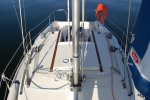
Leisure 18 - How many shrouds?

Jaguar 25

Well-Known Member
Joined
14 Nov 2012
Messages
466
Location
Liverpool
Visit site
Bought a 1997 Leisure 18 in July and very happy with it.
However, looking at some YouTube videos of Leisure 18s sailing, I noticed they (seem) to have three shrouds each side holding the mast up whereas mine has only two and no backstay (no backstays in the ones in the videos either).

Is mine missing something?
 
Bought a 1997 Leisure 18 in July and very happy with it.
However, looking at some YouTube videos of Leisure 18s sailing, I noticed they (seem) to have three shrouds each side holding the mast up whereas mine has only two and no backstay (no backstays in the ones in the videos either).

Is mine missing something?

When you say "only two"" presumably you mean two each side? If so I imagine that's a pair of cap shrouds over swept back spreaders and a pair of lowers?

Similat to my Sea Wych although that does also have a pair of backstays.

Fairly common sort of set up on small boats at one time.

Many people will have modified the rig adding an additional pair of lowers. The rig will almost certainly be changed if a new mast is fitted.

With the Sea Wych some people square off the spreaders and fit fore and aft lowers but I guess with no backstays you have to keep the swept back spreaders and cap shrouds

You should be able to get loadsa info and advice from the Leisure Owners Association
 
Last edited:
I just found the videos on Youtube, and, yes, both boats seem to have forward and aft lowers. This may be a later modification of an earlier rig, or perhaps your boat, with only caps and aft lowers could be a later, simpler version.
The explanation could also be that the boats in the videos had rigs of a different manufacture to that on your boat.
I would offer the same advice as above;contact the Owners Association.
 
Thanks, posted the query on the Leisure Owner's website so I will see if that brings any explanation. There were only about 12 to 15 built and all by Simon Cory as far as I can tell.
 
I think you must have been looking at my Youtube videos of the Leisure 18.
As VicS said, the Leisure 18 has a pair of cap shrouds over swept back spreaders and a pair of lowers, a forestay and no backstay.
Don't worry, the extra "shrouds" that you have seen on my boat are not actually shrouds, but wires that steady the mast when putting it up and taking it down, in conjunction with a gin pole.
I hope you enjoy your Leisure 18, they are great little boats.
 
With any small yacht rig you have the problem of supporting the middle of the mast in the fore and aft direction. You can have intermediate stays from chain plates aft of abeam the mast and a baby forestay running from the foredeck to the middle of the mast. Or you can have 2 more intermediate side stays running to points near the gunwhale forward of the mast. (hence 3 side stays per side). The problem with one baby fore-stay is that the jib must be dragged around the front of it each time you tack. The problem with 2 forward intermediate side stays is that they limit the amount of jib overlap as the leach of the jib will foul the stays when jib is tight.
The last option is the aft swept spreaders. Here both the cap and intermediate side stays come from chain plate aft of abeam the mast. The intermediate side stays pull the middle of the mast aft. The spreaders are mounted rigidly at an angle aft so they meet the cap shroud. (with some push of the cap shroud away from straight when looking from side). Thus the spreaders will push the middle of the mast forward to counteract the pull back of the intermediate stays. So adjustment of tension of the stays is all interrelated. This arrangement of stays aft of abeam the mast also mean that you can do without a back stay. Although commonly with aft swept spreaders the cap stays don't go to the top. (fractional rig) and the back stay can be used to tension the forestay and bend the mast for strong winds.
We have one odd 34fter at our club with no back stay. It means you can have a huge roach on the main sail. Outward curve from straight of the back of the mainsail. So more area. It does have a huge displacement of side stays aft of the mast so chafe of sail on side stays becomes a real problem when running.
I think I would always have a back stay because it is so easy to add good support to the mast and forestay. However most dinghies do no have a back stay. (relying on the fore and aft dimension of the mast to keep it straight. My little boat has the fractional rig with side stays aft of the mast and aft swept spreaders. One day the back stay parted flogging along under spinnaker. Fortunately the main sail and aft mounted side stays meant mast did not come down. But long ago one spreader attachment failed so it so its aft sweep and that resulted in the mast crumpling up under pressure.
Lastly one boat that I know of (MacGreggor 26 trailer sailer) has permanently mounted additional side stays mounted on chain plates on the cabin top precisely in line with the hinge of the mast (to the middle of the mast) so that when raising or lowering the mast these side stays keep the mast central from vertical to horizontal. Useful when mast is raised often. olewill
 
I think you must have been looking at my Youtube videos of the Leisure 18.
As VicS said, the Leisure 18 has a pair of cap shrouds over swept back spreaders and a pair of lowers, a forestay and no backstay.
Don't worry, the extra "shrouds" that you have seen on my boat are not actually shrouds, but wires that steady the mast when putting it up and taking it down, in conjunction with a gin pole.
I hope you enjoy your Leisure 18, they are great little boats.

Thanks for the info Mark,
I feared it was some subsequent mod to keep the mast from falling down following in use problems occurring!
 
With any small yacht rig you have the problem of supporting the middle of the mast in the fore and aft direction. You can have intermediate stays from chain plates aft of abeam the mast and a baby forestay running from the foredeck to the middle of the mast. Or you can have 2 more intermediate side stays running to points near the gunwhale forward of the mast. (hence 3 side stays per side). The problem with one baby fore-stay is that the jib must be dragged around the front of it each time you tack. The problem with 2 forward intermediate side stays is that they limit the amount of jib overlap as the leach of the jib will foul the stays when jib is tight.
The last option is the aft swept spreaders. Here both the cap and intermediate side stays come from chain plate aft of abeam the mast. The intermediate side stays pull the middle of the mast aft. The spreaders are mounted rigidly at an angle aft so they meet the cap shroud. (with some push of the cap shroud away from straight when looking from side). Thus the spreaders will push the middle of the mast forward to counteract the pull back of the intermediate stays. So adjustment of tension of the stays is all interrelated. This arrangement of stays aft of abeam the mast also mean that you can do without a back stay. Although commonly with aft swept spreaders the cap stays don't go to the top. (fractional rig) and the back stay can be used to tension the forestay and bend the mast for strong winds.
We have one odd 34fter at our club with no back stay. It means you can have a huge roach on the main sail. Outward curve from straight of the back of the mainsail. So more area. It does have a huge displacement of side stays aft of the mast so chafe of sail on side stays becomes a real problem when running.
I think I would always have a back stay because it is so easy to add good support to the mast and forestay. However most dinghies do no have a back stay. (relying on the fore and aft dimension of the mast to keep it straight. My little boat has the fractional rig with side stays aft of the mast and aft swept spreaders. One day the back stay parted flogging along under spinnaker. Fortunately the main sail and aft mounted side stays meant mast did not come down. But long ago one spreader attachment failed so it so its aft sweep and that resulted in the mast crumpling up under pressure.
Lastly one boat that I know of (MacGreggor 26 trailer sailer) has permanently mounted additional side stays mounted on chain plates on the cabin top precisely in line with the hinge of the mast (to the middle of the mast) so that when raising or lowering the mast these side stays keep the mast central from vertical to horizontal. Useful when mast is raised often. olewill

This is exactly right and what I saw but didn't recognise. See Mark's response. It was his Leisure 18 in the video.
 
For those who are interested, here is a photo showing the set up of the mast steadying wires and gin pole;
 

Attachments

  • DSC_0600.jpg
    DSC_0600.jpg
    495.3 KB · Views: 1
Top