Lee Cloths

What about lee cloths on the "V" berths? Would "Y " shaped lee cloths be OK?

Remember someone has to be sailing the boat, so not all the bunks will be in use under way. Quite likely whoever sleeps in the forepeak in port or at anchor, will doss down in the saloon instead when on passage, for a more comfortable motion.

Pete
 
Remember someone has to be sailing the boat, so not all the bunks will be in use under way. Quite likely whoever sleeps in the forepeak in port or at anchor, will doss down in the saloon instead when on passage, for a more comfortable motion.

Pete
Thanks for that. I've got a lot to learn!

I learn a lot from you blokes because I've only done social sailing. As soon as I put the yacht in the water I'll get an old sea dog to skipper the yacht for me.

Your comment regarding a more smooth motion in the saloon interests me as I have just about completed my berth beside the center cockpit (and motor). So that should have a fairly easy motion? (From what you guys say, a berth that is ideal at anchor is no good at sea......):unsure:

Screenshot_2020-07-04 roberts mauritius 43 specifications - Google Search.png

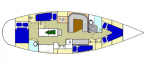
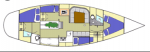
I'm not sure I've done the right thing because I've extended the berth through the bulkhead like the design below. (If I didn't extend it the berth would have only been 5'10") But because I didn't want a transverse double berth in the aft cabin I built it for and aft. That meant I had to raise the double berth to about waist high. (Of course by going higher I get a wide berth). One way or another I have to raise the floor to clear the quadrant anyway so maybe it is not a problem.

Screenshot_2020-07-04 Bruce Roberts Mauritius Norfolk 43 Boat Plan - Fine Line Boat Plans Desi...png
 
If you want to use netting use a fine mesh. The rope in a large mesh and or knots to make the net will dig into flesh and be uncomfortable.
 
I assumed he was thinking more of someone standing in the saloon falling against the leecloth. The same reason saloon tables need to be very strong against sideways shoving.
Ah yes, good point. Luckily I have a narrow cabin too, so little room to get up speed.
 
For a brief moment I thought this thread might be about the resurgence of the textile ondustry in Cork?
I considered making the lee cloths just a foot high, but then realised that they need to be high enough to retain the user in the event of a 90°+ knockdown.
The discussion of the use of netting has prompted me to look at the idea of using the debris/safety netting that is normally attached to scaffolding.
https://scaffold-safety.com
The fire retardant type with reinforced edge and galvanised eyelets seems to be the way to go.
 
I've made one last year. It's attached to the bulkheads like the one you circled in red. What's different is that I've used netting instead of cloth, as it's much better for air circulation and also you can look around from in there.

Top and bottom has a 5mm line through the netting. The bottom line is attached to stainless fittings under the seat (the forward edge, not under the cushion) in five points. The top line is on each end routed through a stainless hoop mounted on the bulkhead and from there to a small stainless rope jammer, tied off with a stopper knot. That allows me to reach up and release the lee cloth with one swift move when the crew is screaming for help from up in the cockpit (or anything else happens). Also obviously easy to close and pull tight.

There's also some small velcro straps at the bottom fittings (under the overhanging seat cushion) so the thing can be stored in a bundle there when not in use. I didn't want it stuffed under the cushions, as it would wear away from friction there.

Used it in a bunch of rough passages to sleep behind now and can confirm it's working well. The crew prefers rolling around in the wide aft cabin bed though and just piles up cushions around her :)

No photos, as it's far too hot to get up and snap some, sorry. ?
 
Yngmar

Greece eh?

What you've done seems like a good idea. I'll certainly keep those points in mind. I think I'll use webbing (probably something like the safety webbing they use on construction sites)
 
We have a lee cloth for our saloon: not normally used as a berth but when we’re on passage it provides a comfortable, safe place for the off watch person. It’s a commercial product, made by the folks who do those net bags for the cockpit for you to stuff ropes into. It attaches to the forward bulkhead and the front of the chart table by means of snap shackles on a length of doubled up cord. It‘s fastened to the frame of the “bunk“ with a series of screws. Never had a problem with it. When not in use, lift the cushion and the cloth goes underneath: that’s how it spends most of its life!
If I were fitting one now, I’d make myself but to a very similar pattern. I’d use acrylic canvas and polyester webbing but I’d stick to the same basic idea of a piece of cloth retained under the bunk by screws and fixed fore and aft to the bulkheads by snap shackles. It’s easy, flat canvas work, no curves or seams, looped webbing for the tension strap and brass eyelets for the screws.
 
One of the key uses of lee cloths is for putting junk in so that it does not end up in a pile on the floor during a trip.

So I would make at least one, easy to rig and not laced like a corset at the top.
 
Ours is basically guardrail netting. Strong enough - I've bounced my not perfectly slim self off it many times without it complaining. Sometimes I need a cushion against it for comfort, especially on the port tack where I'm resting against it.
 
I think it is important that the underside of the lee cloth extends at least to the center line of the berth. In use, the lee cloth will curl the mattress and help hold the occupant securely across their hips and shoulders. They will be as one with the boat and not be rolled backwards and forwards like a bit of pastry.
I think this is an important point. When the boat is heeling, it lets you adjust the mattress so that the sleeper is more level and comfortable as well.
 
Top