LED Nav lights

Makes sense to me.

Some years ago, I wandered across to Baltimore, Co Cork, and back again, and had THREE different wired sets of nav lights fail, for one reason or another. .... ad another.
I ended up with D-cell battery-driven jobs which lasted - just - long enough to get me back.

I still believe in multiple-redundancy in nav lights... and I now have some battery-driven LED clip-on nav lights. They will last a darn sight longer than the old incandescents I had before.

I carry my bike lights aboard for that reason (plus LED tri and filament sidelights). At the speed our craft moves, most big ships regard us as stationary so any light is better than none - if they mistake us for a buoy it might still save our lives
 
i had good nav lights but if i was fishing in the solent at night---- if anything was on a converging course i would put my deck lights on for 30 seconds----kept me safe
 
That would be my logic save for the fact that the lenses in my ancient port and stbd lights are so crazed and misted up they’re limiting the light transmission. I suppose I could try and source new lenses....
When I looked into that for my stern light, a new lens would have cost me more than replacing the whole unit with one the same.
 
This thread is a timely reminder for me. My mast is currently down. Last time I had it down I wanted to fit LED bulbs. Due to cost and fitting hassle I was prepared to live with the less sharp cut-off between sectors and fit a LED bulb into the tri-colour of the existing tri/white light fitting, a well-known brand (can't remember which just now) and designed for filament bulbs.

I bought the relevant third-party LED bulb specifically labelled for that particular make of fitting, with the three different coloured sector LEDs. I fitted it, and fortunately checked it while the mast was down. I found the bulb had been incorrectly assembled, and the LEDs were 180 degrees out from the fitting, so that the red and green LEDs shone through the white lens, and vice versa (the bulb and bayonet socket have offset pins, so can't be rotated). Due to shortage of time I ended up re-fitting the filament bulb in the tri, but I did fit an LED in the all-round-white (though I know filament bulbs do look more scenic in anchorages!).

I returned the faulty LED bulb to the well known marina-based East Coast chandlery, who didn't quibble and told me that several other people had also returned this brand of LED bulbs. :eek: I wonder how many boats are wandering around with completely mad colour sectors in their mast head 'tri' lights, or have only discovered it once their masts are up.
 
This thread is a timely reminder for me. My mast is currently down. Last time I had it down I wanted to fit LED bulbs. Due to cost and fitting hassle I was prepared to live with the less sharp cut-off between sectors and fit a LED bulb into the tri-colour of the existing tri/white light fitting, a well-known brand (can't remember which just now) and designed for filament bulbs.

I bought the relevant third-party LED bulb specifically labelled for that particular make of fitting, with the three different coloured sector LEDs. I fitted it, and fortunately checked it while the mast was down. I found the bulb had been incorrectly assembled, and the LEDs were 180 degrees out from the fitting, so that the red and green LEDs shone through the white lens, and vice versa (the bulb and bayonet socket have offset pins, so can't be rotated). Due to shortage of time I ended up re-fitting the filament bulb in the tri, but I did fit an LED in the all-round-white (though I know filament bulbs do look more scenic in anchorages!).

I returned the faulty LED bulb to the well known marina-based East Coast chandlery, who didn't quibble and told me that several other people had also returned this brand of LED bulbs. :eek: I wonder how many boats are wandering around with completely mad colour sectors in their mast head 'tri' lights, or have only discovered it once their masts are up.
If you were changing from incandescent to led bulb, then the housing must have had coloured lenses, from what you say, you bought a bulb with coloured led's! Why?
The bulb you took out was all round white so the replacement bulb should have been an all round soft white led.
 
If you were changing from incandescent to led bulb, then the housing must have had coloured lenses, from what you say, you bought a bulb with coloured led's! Why?

Because if you have just a plain white LED inside the colours do not show correctly - the green looks blue (or at lest blue-ish), and the red is relatively dim. This is because while 'white' is theoretically all colours, in practice there's a different spread of colours shown by 'LED bulbs' (less red and green/yellow, more blue IIRC) and 'filament bulbs' (more red and yellow). The lens of a conventional tri-colour fitting is designed for filament bulb colouring.

To show the colours correctly, there are specially designed LED replacement bulbs. These have three banks of specific coloured LEDs - red, green and white, aligned (or should be!) with the relevant sectors of the lens.

That arrangement gets the correct colours to show, but because the light fitting is designed to have a filament - akin to a 'point' source of light - and the LED light source is an area rather than a point, you lose the sharp definition of the cut-off between the sectors. For this reason a fitting designed for a filament bulb will not strictly meet the ColRegs requirements if fitted with an LED bulb.

The bulb you took out was all round white so the replacement bulb should have been an all round soft white led.

It was an all round rather hard white!
 
I recall that one time there were colour issues with LED units as nav lamps. Are LEDs now approved for nav lamps?

Sorry for [post - just saw that my question has a;lready been answered in the thread.
 
Because if you have just a plain white LED inside the colours do not show correctly - the green looks blue (or at lest blue-ish), and the red is relatively dim. This is because while 'white' is theoretically all colours, in practice there's a different spread of colours shown by 'LED bulbs' (less red and green/yellow, more blue IIRC) and 'filament bulbs' (more red and yellow). The lens of a conventional tri-colour fitting is designed for filament bulb colouring.

To show the colours correctly, there are specially designed LED replacement bulbs. These have three banks of specific coloured LEDs - red, green and white, aligned (or should be!) with the relevant sectors of the lens.

That arrangement gets the correct colours to show, but because the light fitting is designed to have a filament - akin to a 'point' source of light - and the LED light source is an area rather than a point, you lose the sharp definition of the cut-off between the sectors. For this reason a fitting designed for a filament bulb will not strictly meet the ColRegs requirements if fitted with an LED bulb.

It was an all round rather hard white!
You dont fit the hard white in existing tricolour you fit warm white. The colour comes out fine then or at least so close that no observer can tell the difference and I doubt anyone could tell the difference in cut off. Do you think our boats and particularly the old sailing boats with oil lamps were set up with mathematical precision? If you can see red and green together its on a collision course with you, those few degrees blur mean if you cant tell if it will strike your port bow or your starboard, but do nothing and strike it will.

However I agree that the OP couldnt use a 3 colour LED in an incadescent housing
 
You dont fit the hard white in existing tricolour you fit warm white. The colour comes out fine then or at least so close that no observer can tell the difference and I doubt anyone could tell the difference in cut off.....
A very sweeping statement based on what?

LEDs do not put out a full spectrum of white light.
They put out a few spectral lines which are enough to satisfy the human eye's cone receptors, so we perceive as 'white'.
Navlight lenses filter the spectrum that goes through them, to give satisfactory colours when full spectrum white light from an incandescent bulb shines on them. The dyes in the plastic will have absorption characteristics across the spectrum which work well enough with white light that our eyes perceive the desired result. But shine the few spectral lines of a white LED on them, all bets are off.
As LEDs have improved, white LEDs have more spectral lines and colour rendering is much better than it used to be. But it can still be quite hit or miss with plastic filters.
You have to be sure that the result looks 'green' to everyone, not just you. Some people see colours differently without being anywhere near 'colour blind'.

This is why LED nav lights are not cheap, you have to do a lot of testing and QA to ensure the colours hit the proper standards.
 
A very sweeping statement based on what?

LEDs do not put out a full spectrum of white light.
They put out a few spectral lines which are enough to satisfy the human eye's cone receptors, so we perceive as 'white'.
Navlight lenses filter the spectrum that goes through them, to give satisfactory colours when full spectrum white light from an incandescent bulb shines on them. The dyes in the plastic will have absorption characteristics across the spectrum which work well enough with white light that our eyes perceive the desired result. But shine the few spectral lines of a white LED on them, all bets are off.
As LEDs have improved, white LEDs have more spectral lines and colour rendering is much better than it used to be. But it can still be quite hit or miss with plastic filters.
You have to be sure that the result looks 'green' to everyone, not just you. Some people see colours differently without being anywhere near 'colour blind'.

This is why LED nav lights are not cheap, you have to do a lot of testing and QA to ensure the colours hit the proper standards.
Did I suggest one should use ancient cheap LEDs? It was only really tricolours I was talking and and as it is quite legal to have merely one all round red over a green on sailing boats sectorisation is clearly not regarded as vital for our slow craft
 
First of all apologies to John for triggering a seemingly terminal thread drift.

I recall that one time there were colour issues with LED units as nav lamps. Are LEDs now approved for nav lamps?

It is obvious there is a lot of confusion out there about this.

There are purpose designed and made LED nav lamps which are certified to meet the ColRegs specifications. I believe Lopolight and Nasa are among these.

If you put an LED bulb in a nav light fitting designed for filament bulbs it will almost certainly not meet the requirements (except perhaps with an all-round white). The sector cut-offs will not be correct, and the colours may well not show correctly.

With care and attention to the factors involved you may find a solution which, while not strictly meeting the ColRegs requirements, you are satisfied is a practical approximation. The danger to this approach is that (i) clearly many people do not understand the factors involved and their effects, and (ii) the ColRegs help keep us all safe, and if we were all to pick and choose which bits we didn't want to bother to obey then chaos would reign.
 
The first, the most important thing here, is that you get SEEN early enough for avoidance.

Let's not lose sight of that.
 
The cover is usually designed with the assumption that the light will be coming from essentially a single central point, as with traditional lamps. With most replacement led lamps, the light comes from several leds usually further from the central point and closer to the coloured cover. This will blur the sectors to some degree.

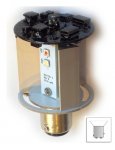
There are however exceptions, for example this, where the sectors are created by the lamp itself, with a single led in each sector.
462AD976-86CA-4B6E-99DB-A2585621571A.jpeg
 
In the days of oil lamp navigation lights they had baffles that would provide a better cut off angle.

Simply gluing dividers in to the outside of the plastic lens would solve that problem.
 
Top