LED masthead lights interfere with the AIS reception

I am hoping to have my investigation sorted in 1-2 wks and I will post my findings on here as soon as complete.
Hi Paul,
are you anywhere near completing your investigations? I am waiting with bated breath as I am hoping to fit masthead LED lights before my mast goes up next week.
 
Hi Ashman, this is Paul from Digital Yacht and I have just read this interesting thread. I must admit that we have not had any direct contact from other customers about interference with LED Nav Lights, so I hope that it is not too common an occurrence. That said, I wanted to jump on this straight away and see if there was anything that can be done to fix the problem.

I have called Boat Lamps and spoke to Adrian the owner, who is also very interested in investigating and solving this problem. We have planned for him to send me a lamp with voltage regulator and then I will test it with our receivers and transponders. The goal is to try and recreate the problem and see if a fix can be found.

I am hoping to have my investigation sorted in 1-2 wks and I will post my findings on here as soon as complete.

The right way to do this is with an RF frequency spectrum analyser. An expensive piece of kit unfortunately.
 
Its ridiculous not to mention potentially dangerous having to switch off lights to get an AIS signal or having to fit another antenna.

Surely the CE regs prohibit the sale of led lights that cause rf interference whether directly or indirectly (by allowing it to get in to the supply wiring)?

i would ask Ofcom for their opinion?
 
Last edited:
Its ridiculous not to mention potentially dangerous having to switch off lights to get an AIS signal or having to fit another antenna.

Surely the CE regs prohibit the sale of led lights that cause rf interference whether directly or indirectly (by allowing it to get in to the supply wiring)?

i would ask Ofcom for their opinion?

I suspect that the problem may be the long runs of cable parallel in the mast.
The switchers will be running at most a few MHz, AIS is over 160MHz, it's unlikely to be 160MHz RF coming from the LEDs.
I would not be surprised if the mechanism was actually switching pulses at a few MHz coupling into the aerial line from the light wiring.
Some filtering (of the light wires) at the masthead might well work.
A choke/inductor good for a few MHz and some small capacitors would be a starting point.
It can also help to have the light wiring twisted together.
Also, it might be worth making sure the AIS receiver has good rejection of low frequency blocking, maybe put a high pass filter in the aerial line to cut off everything below say 50MHz.
Unfortunately, if it's a transceiver, that filter will need to be rated for 25 Watts, hence expensive.
A ferrite ring around the coax might help, by stopping 'common mode' current flowing in the outer.
Also looking at the grounding of the AIS set relative to the lights. Big earth loops can be a nuisance.

I don't think OFCOM or CE will help, it's probably as much to do with installation practice as product design.
 
Would an oscilloscope be of any use?

With a USB scopeI I can just see a blip which seems to coincide with a target coming in but see no change turning on and off the lopo light.
Look on the light wiring.
A good scope might see switcher noise at 250kHz to a few MHz. There are scopes that work above VHF but ££££....
If you can see the low MHz noise and cut it down with filtering, you'd be very unlucky if you weren't cutting its harmonics too.
The signal that actually gets to the receiver only needs to be microvolts to block the channel. That's not easy to see.
 
Won't pass any CE conformity tests* and are they affecting your neighbours radio reception? If you had the spots onboard, would they jam your VHF?

*These basically state that electrical/electronic equipment must neither cause interference to other equipment nor be susceptible to it.

The problem is that CE is a self certification process so I suspect that many products are never actually tested: the manufacturers just stick on the CE label.
 
I suspect that the problem may be the long runs of cable parallel in the mast.
The switchers will be running at most a few MHz, AIS is over 160MHz, it's unlikely to be 160MHz RF coming from the LEDs.
I would not be surprised if the mechanism was actually switching pulses at a few MHz coupling into the aerial line from the light wiring.
Some filtering (of the light wires) at the masthead might well work.
A choke/inductor good for a few MHz and some small capacitors would be a starting point.
It can also help to have the light wiring twisted together.
Also, it might be worth making sure the AIS receiver has good rejection of low frequency blocking, maybe put a high pass filter in the aerial line to cut off everything below say 50MHz.
Unfortunately, if it's a transceiver, that filter will need to be rated for 25 Watts, hence expensive.
A ferrite ring around the coax might help, by stopping 'common mode' current flowing in the outer.
Also looking at the grounding of the AIS set relative to the lights. Big earth loops can be a nuisance.

I don't think OFCOM or CE will help, it's probably as much to do with installation practice as product design.

The point is: the light should NOT be allowing any interference to get back into the wiring. Its not acceptable that you should have to poke about with a scope or spectrum analyser or start adding ferrite rings to existing wiring whether DC or RF or even to the existing wiring to the light.
If you had paid a marine electrical engineer to install the light and then had AIS problems, you'd not be impressed if you were told you then had to pay extra to cure the interference from said light or even worse, switch it off when you wanted to check for AIS targets.

You should fit a properly CE certified light and get a refund on the original.

I'm sure Ofcom would certainly be interested if anyone was selling any product that interfered with reception in the marine VHF band and would recommend you remove it immediately.
I
 
Interference from buck regulators (even at 150 MHz) is well documented - see my link above for one of many examples. The responsible manufacturers of these regulators warn about this problem and advise methods to control it and also advise where a particular product is not suitable because of the probability of radio interference.

The problem is mis-application of particular types of buck regulator when they have to operate close to vhf equipment. I suspect all the main LED nav light suppliers are aware of this problem, but those that make LEDs for general use may not have planned for this issue.

If you put LED nav lights in close proximity to vhf antennae, check for interference. Simple.
 
The point is: the light should NOT be allowing any interference to get back into the wiring. Its not acceptable that you should have to poke about with a scope or spectrum analyser or start adding ferrite rings to existing wiring whether DC or RF or even to the existing wiring to the light.
If you had paid a marine electrical engineer to install the light and then had AIS problems, you'd not be impressed if you were told you then had to pay extra to cure the interference from said light or even worse, switch it off when you wanted to check for AIS targets.

You should fit a properly CE certified light and get a refund on the original.

I'm sure Ofcom would certainly be interested if anyone was selling any product that interfered with reception in the marine VHF band and would recommend you remove it immediately.
I
I agree with your sentiment, but the allowed emissions are not zero.
Radio receivers are by their nature sensitive.
Couple the two too closely and the blame is split.
EMC (electromagnetic compatibility)radiated testing tends to be done at a range of a few metres, not a few millimetres as might be the case inside a mast.
Also, I've seen plenty of instances of things like switching power suppliers working quite cleanly when powered directly from a good 12V supply, but very dirty when on long leads.

Unfortunately, just because a bunch of products like a light and a radio pass CE individually does not mean they will be OK together, particularly if the installation is done in an 'RF unaware' way.

I do have access to spectrum analysers and so forth, it might be interesting to measure emissions from some of these lamps.
Also maybe the front end of the AIS receiver might be more susceptible to out of band than is desireable.
It's a long way from proven that the light is emitting directly on the AIS channel.

Unfortunately, most of this stuff is designed down to a price, and sticking in a quid's worth of extra components to improve EMC in 'real life' installations falls by the wayside.
 
I agree with your sentiment, but the allowed emissions are not zero.
Radio receivers are by their nature sensitive.
Couple the two too closely and the blame is split.
EMC (electromagnetic compatibility)radiated testing tends to be done at a range of a few metres, not a few millimetres as might be the case inside a mast.
Also, I've seen plenty of instances of things like switching power suppliers working quite cleanly when powered directly from a good 12V supply, but very dirty when on long leads.

Unfortunately, just because a bunch of products like a light and a radio pass CE individually does not mean they will be OK together, particularly if the installation is done in an 'RF unaware' way.

I do have access to spectrum analysers and so forth, it might be interesting to measure emissions from some of these lamps.
Also maybe the front end of the AIS receiver might be more susceptible to out of band than is desireable.
It's a long way from proven that the light is emitting directly on the AIS channel.

Unfortunately, most of this stuff is designed down to a price, and sticking in a quid's worth of extra components to improve EMC in 'real life' installations falls by the wayside.

I agree that the CE regs also imposed a duty on manufacturers to make their equipment as immune from interference as possible as well as not causing it.
Until some independent tests are carried out we'll never know what's going on.
 
Sounds like they should since its not imho a minor issue and indicates poor design and inadequate CE testing.

Perhaps some of the 'poor design' blame needs to be pointed at those deciding that all this stuff needs to be co-located at the masthead, and at the yacht level rather than the sub-system level?
It all seems very similar to a project I worked on, lots of stuff that worked fine in itself, not so good when installed on the same vehicle....

The danger is you will need a ce approved or whatever bloke to wire your mast.
 
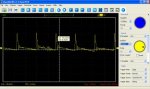
Some scope images....
With a bedazzled LED and lopolight tricolour

Worth noting I can tell no difference in ais reception with lopo being on or off, though there are reports of people who have.
Also using a SSB reciever the bedazzled LED's are noticable with the antenna a almost touching the LED but silent further away. Unlike a previous fluorescent tube which was extremely RF noisy. The fridge is noisy in the ham bands, haven't tried it further up, think it's OK.

So this all tells us........ almost nothing :)
..
Sharing feed with a usb charger and LED not connected..
sharednoled-1_zps45ffa300.jpg
..

Shared USB with LED
sharedwithled-1_zps697a9464.jpg

Almost direct to battery with no LED
directnoled-1_zpsc6a2c7e7.jpg

Almost direct to battery with LED
dierctwithled-1_zpsb2ec3ca9.jpg

To Lopo inside swith turned off
tricolouroff-1_zpsd9422cf4.jpg

To lopo turned on
tricolouron-1_zpsb2bc7270.jpg
 
Some scope images....
With a bedazzled LED and lopolight tricolour

Worth noting I can tell no difference in ais reception with lopo being on or off, though there are reports of people who have.
Also using a SSB reciever the bedazzled LED's are noticable with the antenna a almost touching the LED but silent further away. Unlike a previous fluorescent tube which was extremely RF noisy. The fridge is noisy in the ham bands, haven't tried it further up, think it's OK.

So this all tells us........ almost nothing :)
..

Well it tells me that the lopolight is not nearly as bad as the usb charger.
You can see why things like phone chargers often ruin Navtex reception, which is around 500kHz.
In my view, I would hope a VHF/AIS receiver would be fairly well immune to noise under a MHz, otherwise it might have a hard time on a boat with an HF or MF transmitter.
Alternators, solar panel regulators and so forth will also create noise, and with a lot more power behind it.

The traces also suggest that the 12V system is quite high impedance at a few 100kHz, a lower impedance might turn those voltage spikes into current spikes, the trick is to absorb some of the energy in the process...

Thanks for posting useful pictures!
 
Hi this is Paul from Digital Yacht again. Sorry for the time it took me to complete the investigation but this is a really busy time for us and I have only been able to work on this in the evenings.

I have now completed my testing of a number of different LED lights/bulbs from various manufacturers and in my tests a small number of LED Navigation Light systems were found to potentially cause interference with AIS reception, if the cable to the light was run directly alongside the VHF antenna cable.

The electrical noise was generated by the switch mode regulator in the LED Navigation Light and we would recommend to all manufacturers of these lights to look closely at using lower frequency switch mode regulators and fitting suppression filters.

The noise was pre-dominantly radiated (through the air between the cables), rather than conducted (through the wiring) and routing the LED Navigation Light cable away from the VHF Antenna cable had the biggest positive affect on reception.

Differences were found between manufacturers and even between different LED Light models in the same manufacturer's range, so we would recommend checking an LED light before fitting them on a boat with an AIS system installed. This can be done by placing a coil of LED Light power cable alongside the AIS VHF antenna cable and checking if the RSSI figure increases or checking the number of AIS targets with the LED Light ON and then when you turn the LED Light OFF.

Below is an oscilloscope image of the noise created by one light that caused total loss of AIS reception and was the worst of the lights tested. You will note that the actual voltage of the noise is not great (<100mV) but it is the frequency of the signal and the sharpness of the leading spike that causes the problem. In fact we found lights that created larger amounts of noise (in terms of voltage) but the frequency and smoother waveform resulted in no affect on the AIS reception.

Severe Interference.jpg
 
It did occur to me that it may be possible to vary or even fix the interference without going up to the nav light. If a variable resistor or variable voltage linear regulator were connected in the power supply to the LED then at lower supply voltages some buck regulators will increse the mark space (on off ) ratio to the point where they are on almost all the time. This should vary the interference or possibly stop it or move it's frequency out of band.
So something like an LM 317 regulator with a potentiometer on the output such that you can vary the voltage supplied to the LED. Reduce the voltage supply to the point where the LED loses brightness. Check for interference. Check for interference at various supply voltages to the LED. The different voltages may cause the LED oscilator to run at different frequencies so different degrees of interference. Depending on the current drain of the LED and the voltage you reduce to, it may overheat the LM 317 so you may need an LM317K metal IC with a heat sink. Check the specs for the regulator and the LED. good luck olewill
This would be a very crude fix but having the advantage that you can do it from below. good lcuk olewill
 
Top