LED Anchor Light?

Lights

I do a bit of sailing at night on the Swan River surrounded by suburbs and fairly congested. Frequently I will see a boat a say " He has no nav lights" only to notice later that he has but on mast top. When sailing as I think most boat operators I am looking at the water ahead not the sky. So IMHO mast head lights are less noticeable than low level lights. olewill
 
I do a bit of sailing at night on the Swan River surrounded by suburbs and fairly congested. Frequently I will see a boat a say " He has no nav lights" only to notice later that he has but on mast top. When sailing as I think most boat operators I am looking at the water ahead not the sky. So IMHO mast head lights are less noticeable than low level lights. olewill

So if a cargo ship were to be travelling on the river at night with his navigation lights on, you would collide with him and tell him it was his fault because his lights were too high up?

There is such a thing as keeping a good watch, which involves looking everywhere as well as up higher than sea level.

In my experience most hull shapes at close quarters in a well lit suburban area will stand out against the back drop of lights if not be illuminated by them. It is better to spot them early which a high up light will allow you to do and then you can plot your course with plenty of time before getting to close quarters.
 
lights

Hello Vonasi Yes I was referring to a specific location where big ships can be heard from a mile away (Heavy rock) and no you can't see the nav lights for the party strobe lights and coloured lights. Not easil;;y missed. However without trying to bring anyone to any conclusions I still claim high lights in some cases are not as noticeable as low lights. In my experience. olewill
 
In the last five years we've spent over 80 nights at sea and over 700 nights at anchor, we've seen at least three thousand yachts with lights turned on.

In anybody is thinking of fitting LED's please spend some nights in anchorages where there are at least fifty boats. Hopeully there will be some LED lights around and you will see what we have seen.

You can immediately spot the LED anchor lights. They have a blue tinge, incandescent a yellow tinge. You can compare boats close to each other and you will notice that LED's are half as bright or less than incandescent.

If LED lit boats come in at night, again you willl spot them, but only when they are close (around half a mile). The nav LED's are even worse plus have two wrong colours,not white and not green.
 
In the last five years we've spent over 80 nights at sea and over 700 nights at anchor, we've seen at least three thousand yachts with lights turned on.

In anybody is thinking of fitting LED's please spend some nights in anchorages where there are at least fifty boats. Hopeully there will be some LED lights around and you will see what we have seen.

You can immediately spot the LED anchor lights. They have a blue tinge, incandescent a yellow tinge. You can compare boats close to each other and you will notice that LED's are half as bright or less than incandescent.

If LED lit boats come in at night, again you willl spot them, but only when they are close (around half a mile). The nav LED's are even worse plus have two wrong colours,not white and not green.

That's a very broad statement! If you are talking about garden lights and similar LED anchor lights then I agree with you. If you are talking about a proper marine item such as the Triton anchor light or a Lopolioght, or no doubt various others, then you are quite incorrect. Neither of the two I mention above looks blue, is dim or in any way inferior to tungsten filament bulbs. Another area of superiority of these two (apart from their low consumption) is their reliability. I have lost count of the number of times I have climbed my mast, cleaned all the bulb contacts, left everything working, only for it all to fail again very soon after. I replaced my masthead light but only a very small improvement was made.

One other drawback with plastic coloured lenses, on nav lights and tricolours. Over a few years, less than five in our case, the sun will bleach out the colours. My nav green was almost completely white when I realised this. Last season we went through the Khalkhis bridge at around midnight in company with about ten other yachts. At least half of these had white greens and several had white reds.
 
That's a very broad statement! If you are talking about garden lights and similar LED anchor lights then I agree with you. If you are talking about a proper marine item such as the Triton anchor light or a Lopolioght, or no doubt various others, then you are quite incorrect. Neither of the two I mention above looks blue, is dim or in any way inferior to tungsten filament bulbs. Another area of superiority of these two (apart from their low consumption) is their reliability. I have lost count of the number of times I have climbed my mast, cleaned all the bulb contacts, left everything working, only for it all to fail again very soon after. I replaced my masthead light but only a very small improvement was made.

One other drawback with plastic coloured lenses, on nav lights and tricolours. Over a few years, less than five in our case, the sun will bleach out the colours. My nav green was almost completely white when I realised this. Last season we went through the Khalkhis bridge at around midnight in company with about ten other yachts. At least half of these had white greens and several had white reds.

I agree with everything that you have written.

We too ran the Khalkis bridge gauntlet a couple of years ago but to be honest as first boat through after it had been stuck closed for ten days, with a 28 year old engine against a 6 knot current (they got the timing wrong), and an engine that had just mysteriously cut out the day before requiring me to clean out the injection pump, other peoples lights being faded was quite low on my priority list! Creeping through at less than one knot SOG against the swirling current the last thing I wanted to do was look behind me to see all the other boats lights approaching much faster!

Anyway a bit off topic there but I will add that a good quality LED anchor light to me is a good safety feature. As you say standard bulbs are unreliable, as are the owners at switching them on. An awful lot of people with standard anchor bulbs just don't use them because they can't afford the electricity consumption. You don't get that problem with an LED bulb so there is always an incentive to switch it on.

As I have said before I am guilty of previously being a garden light as anchor light user. But now when I row ashore and look back at the anchorage I can't believe I ever trusted one. My LED top of mast bulb is brighter and whiter than any normal bulb in the anchorage, and as for the garden lights, well you just can't see them.
 
There seems to be a group of people who have LED's and won't hear anything said against them. The only way for people who don't have LED's to find out whether that group is correct or those of us who stick with incandescents are correct is to go and see a few anchorages. Surely that's not asking too much on what is a major safety issue. Time well spent I would say.

>the sun will bleach out the colours...we went through the Khalkhis bridge at around midnight in company with about ten other yachts. At least half of these had white greens and several had white reds.

That's just bad seamanship not a reason not to have incandescent. We change ours when they begin to fade.

Vonasi said: standard bulbs are unreliable.

Not in my experience. They either work or they fail catastrophically. LED's on the other hand lose brightness as single diodes fail and you won't notice.
 
Last edited:
Vonasi said: standard bulbs are unreliable.

Not in my experience. They either work or they fail catastrophically. LED's on the other hand lose brightness as single diodes fail and you won't notice.

I feel that there is a lot of bad press given (particularly on this forum) against LED's. Most of this is quite correct but only when applied to the older style diodes which were horribly voltage sensitive. This meant that when installed on a boat they suffered early and untimely death. They are also the culprits of the 'LED's are blue' school of thought because they were.

Technology has moved on though and I'm pretty sure that none of the posters here who are praising their own LED bulbs (myself included) have the older type. The new ones are normally SMD type diodes which are reliable, very bright and very white. They also use far fewer LED's (mine only has 6) so if one or two failed you would certainly notice. Personally I don't like the idea that I could switch a (filament) anchor light on, leave the boat and that light could fail to blackness while I'm not there at any moment. Far better to be left with some light on than none at all.

So yes many people won't have moved on at the same pace as technology and will sit at home saying how terrible LED's are based upon their experiences with a chinese torch that they once upon a time bought in a pound shop! Eventually though everyone will have to accept LED bulbs in their boats just as they are having to accept that filament bulbs are obsolete for their houses. Time, tide and technology wait for no-one.
 
Yes technology has moved on but for most people cruising budgets haven't - most people have limited budgets. I can see why, with a limited budget, people don't add to their charging facilities or battery bank sizes. It would also imply they will go for the cheapest LED's. Which leads to the problems I've pointed out.

If you are right about new LED's (which means I haven't seen any amongst thousands of yachts) then there should be a campaign to stop the sale of cheaper ones.
 
Yes technology has moved on but for most people cruising budgets haven't - most people have limited budgets. I can see why, with a limited budget, people don't add to their charging facilities or battery bank sizes. It would also imply they will go for the cheapest LED's. Which leads to the problems I've pointed out.

If you are right about new LED's (which means I haven't seen any amongst thousands of yachts) then there should be a campaign to stop the sale of cheaper ones.

The Triton anchor light, championed by several in this thread alone, is/was a long way from being expensive. Somewhere around £30 if I remember correctly. Easily viewable from 2 miles and extremely bright in the anchorage. We also use ours as a cockpit light for eating under the bimini. It took a 25 watt tungsten bulb to produce similar levels of light. £30 doesn't seem a lot to pay for not being run down by a fishing boat while consuming fractions of an ampere.
 
Another very satisfied user of the Triton anchor light (hoisted about half way up the topping lift). Invariably we have the brightest light in the anchorage, and have had numerous people comment on its visibility and some have asked for details of what it is and the cost (was approx £35 three years ago)
 
No 100% correct answer

I remember on my first night arrival coming into Studlands to anchor and nearly ramming a boat at anchor. It had a mast head light on which was lost to me in the stars. I then decided that the way to go was a light in the fore triangle. However this has the problem of not being visible all round, except when the boat is rolling and the light is swaying. This is even more apparent in the Med where you have lots of flat calm nights with no rolling. I have a Triton anchor light which is brill, very low consumption with a really good light. But in the fore triangle there are arcs where it is not fully visible. Forget about the 6 degrees I want to be seen all round. So for this next season I am going to get another Triton and hang one aft also. Then I will be visible through 360 degrees and at a level where the natural line of sight should spot me no prob.
 
I remember on my first night arrival coming into Studlands to anchor and nearly ramming a boat at anchor. It had a mast head light on which was lost to me in the stars. I then decided that the way to go was a light in the fore triangle. However this has the problem of not being visible all round, except when the boat is rolling and the light is swaying. This is even more apparent in the Med where you have lots of flat calm nights with no rolling. I have a Triton anchor light which is brill, very low consumption with a really good light. But in the fore triangle there are arcs where it is not fully visible. Forget about the 6 degrees I want to be seen all round. So for this next season I am going to get another Triton and hang one aft also. Then I will be visible through 360 degrees and at a level where the natural line of sight should spot me no prob.


That sounds like a good solution. I hang my Triton off the end of the boom, where not only is it seen from almost all round, it also lights up the cockpit, and boarding ladder.
 
£30 - £35! You lot were ripped off. My 6 SMD bulb cost only a tenner and as said before is stunningly bright and stunningly white!
 
Yes technology has moved on but for most people cruising budgets haven't - most people have limited budgets. I can see why, with a limited budget, people don't add to their charging facilities or battery bank sizes. It would also imply they will go for the cheapest LED's. Which leads to the problems I've pointed out.

If you are right about new LED's (which means I haven't seen any amongst thousands of yachts) then there should be a campaign to stop the sale of cheaper ones.

See my last post reference budget.

As for 'I haven't seen any amongst thousands of yachts' that's probably because they are so good now that you can't tell the difference!
 
I have

I have been using LED anchor lights for a few years.

One thing to note, at least on this side of the pond, is that very few after market bulbs are "certified" in the fixture you are installing them into. In the US they need to be USCG approved/certified if installed by a new boat builder and this is the law for builders. While you as a boat owner are not "technically" required to use certified lights it is probably a decent idea to do so.

The concern becomes your insurance company and the lawyers in the event of a nigh time accident. A guy on the forum I moderate here in the US was just denied a coverage of his 10k hull deductible when another boater hit his docked boat. The insurance company claimed his boat stuck out further than the finger pier!! Yeah and so does every boat in the marina!

Insurance companies are going to great lengths to deny claims these days. I find it doubtful that they would be running over with the check book if you got hit while using a non-certified bulb if they investigated and found you're bulb was not in compliance with intensity, vertical and horizontal sectors etc. etc. .. Just food for thought..

I have an anchor light mounted to my radar pole on the stern. I have at least 358 degrees, or more, of visibility with it as I have circled in my dinghy, from about 30 feet away, at night, and can hardly find a break in the light.
113437965.jpg


The coast guard (on this side of the pond anyway) is most likely only looking to see that you are displaying lights and the proper ones and you may likely never even be asked. However in the event of a night time accident the lawyers may bring nav lights to the forefront of the case.

Just weigh your options and make the right choices for you. If non-approved/certified makes you comfortable go for it..

LED bulbs are the snake oils of 2009 so be very careful who you buy from as all LED's are NOT created equal. The question of matter comes into play here in the US with our sleazy legal system. If you are involved in a night time accident it will likely become your job, and your expense, to prove in court that your fixture/light met the color, beam, horizontal, vertical and distance standards. Any good maritime lawyer could attempt to make his entire case based on your use of non-certified LED lights especially when there are now plenty of "certified" options.

In the US the specificity for nav lights is well defined in the CFR. The specs are a LOT more in depth than just, can you see it 2 miles away? Below is the criteria nav lights must meet to be USCG certified. Don;t know if you guys have something similar or not.

From US 33 Code of Federal Regulations 84:

Colors

� 84.13 Color specification of lights
(a) The chromaticity of all navigation lights shall conform to the following standards, which lie within the boundaries of the area of the diagram specified for each color by the International Commission on Illumination (CIE), in the "Colors of Light Signals", which is incorporated by reference. It is Publication CIE No. 2.2. (TC-1.6), 1975, and is available from the Illumination Engineering Society, 345 East 47th Street, New York, NY 10017. It is also available for inspection at the Office of the Federal Register, Room 8401, 1100 L Street N.W., Washington, D.C. 20408. This incorporation by reference was approved by the Director of the Federal Register.
(b) The boundaries of the area for each color are given by indicating the corner coordinates, which are as follows:
(1) White:
x 0.525 0.525 0.452 0.310 0.310 0.443
y 0.382 0.440 0.440 0.348 0.283 0.382
(2) Green:
x 0.028 0.009 0.300 0.203
y 0.385 0.723 0.511 0.356
(3) Red:
x 0.680 0.660 0.735 0.721
y 0.320 0.320 0.265 0.259
(4) Yellow:
x 0.612 0.618 0.575 0.575
y 0.382 0.382 0.425 0.406

Intensity

� 84.15 Intensity of lights
(a) The minimum luminous intensity of lights shall be calculated by using the formula:
l = 3.43 x 10⁶ x T x D2 x K-D
where: I is luminous intensity in candelas under service conditions, T is threshold factor 2 x 10⁻⁷ lux, D is range of visibility (luminous range) of the light in nautical miles, K is atmospheric transmissivity. For prescribed lights the value of K shall be 0.8, corresponding to a meteorological visibility of approximately 13 nautical miles.
(b) A selection of figures derived from the formula is given in Table 84.15(b).
Table 84.15(b)
Range of visibility (luminous Minimum
range) of light in nautical luminous intensity of light
miles in candelas tor K = 0.8
D I
1 0.9
2 4.3
3 12
4 27
5 52
6 94

Horizontal Sectors


� 84.17 Horizontal sectors
(a)
(1) In the forward direction, sidelights as fitted on the vessel shall show the minimum required intensities. The intensities shall decrease to reach practical cut-off between 1 and 3 degrees outside the prescribed sectors.
(2) For sternlights and masthead lights and at 22.5 degrees abaft the beam for sidelights, the minimum required intensities shall be maintained over the arc of the horizon up to 5 degrees within the limits of the sectors prescribed in Rule 21. From 5 degrees within the prescribed sectors the intensity may decrease by 50 percent up to the prescribed limits; it shall decrease steadily to reach practical cutoff at not more than 5 degrees outside the prescribed sectors. (b) All-round lights shall be so located as not to be obscured by masts, topmasts or structures within angular sectors of more than 6 degrees, except anchor lights prescribed in Rule 30, which need not be placed at an impracticable height above the hull, and the all-round white light described in Rule 23(d), which may not be obscured at all. (c) If it is impracticable to comply with paragraph (b) of this section by exhibiting only one all-round light, two all-round lights shall be used suitably positioned or screened to appear, as far as practicable, as one light at a minimum distance of one nautical mile.

NOTE to paragraph (c): Two unscreened all-round lights that are 1.28 meters appart or less will appear as one light to the naked eye at a distance of one nautical mile.


Vertical Sectors

� 84.19 Vertical sectors
(a) The vertical sectors of electric lights as fitted, with the exception of lights on sailing vessels underway and on unmanned barges, shall ensure that:
(1) At least the required minimum intensity is maintained at all angles from 5 degrees above to 5 degrees below the horizontal;
(2) At least 60 percent of the required minimum intensity is maintained from 7.5 degrees above to 7.5 degrees below the horizontal.
(b) In the case of sailing vessels underway the vertical sectors of electric lights as fitted shall ensure that:
(1) At least the required minimum intensity is maintained at all angles from 5 degrees above to 5 degrees below the horizontal;
(2) At least 50 percent of the required minimum intensity is maintained from 25 degrees above to 25 degrees below the horizontal.
(c) In the case of unmanned barges the minimum required intensity of electric lights as fitted shall be maintained on the horizontal.
(d) In the case of lights other than electric lights these specifications shall be met as closely as possible.


If you feel you can go up against a sleazy lawyer, or his buddies, who would potentially be prancing about a courtroom with the above standards for nav lights then by all means go for it.

I would be curious to know what the bulb requirements are in Europe?


Let's run this scenario:

You are at anchor with your non certified, blueish colored LED anchor light that you saved big money on by purchasing it from an autoparts store or maybe Mastlight.com. Joe six pack in his 32 foot Cigarette type boat with 550 H.P. has been drinking all day and is blasting home when he plows into your boat and kills your child. Fast forward about two years to the trial where the lawyer for the defendant is blaming you, and convincing the jury that because you were a cheap skate, you are the reason your child is dead because his drunk defendant could not see your anchor light and thought it was a "blueish planet" or star on the horizon not a boat. We've had statements to the "star" effect right in this thread and it has happened to me too..

Is the above scenario a stretch? Possibly not. I sat through two days of this type of testimony during the trial of the defendant who killed my friends father. It was two days of nav light testimony only these were certified nav lights, and yes that was brought up, and the bulbs were examined by a forensics expert to determine if the bulb was on at time of impact. The case would have been made much easier if Kim's dad had simply installed aftermarket LED's as it would have given the lawyers food for fodder.. I am in NO WAY saying or advising you not to install aftermarket bulbs but rather presenting potential outcomes, which may make you think about it more, and also what it takes to be a certified nav light, at least in the US. Hopefully someone can post the CFR equivalent which I would guess is the same because we all follow the COLREGS..

As for position/placement I prefer the one mounted on my radar pole but I do have two anchor lights one at the mast head and one on the radar pole as I like redundancy.

Just some food for thought....

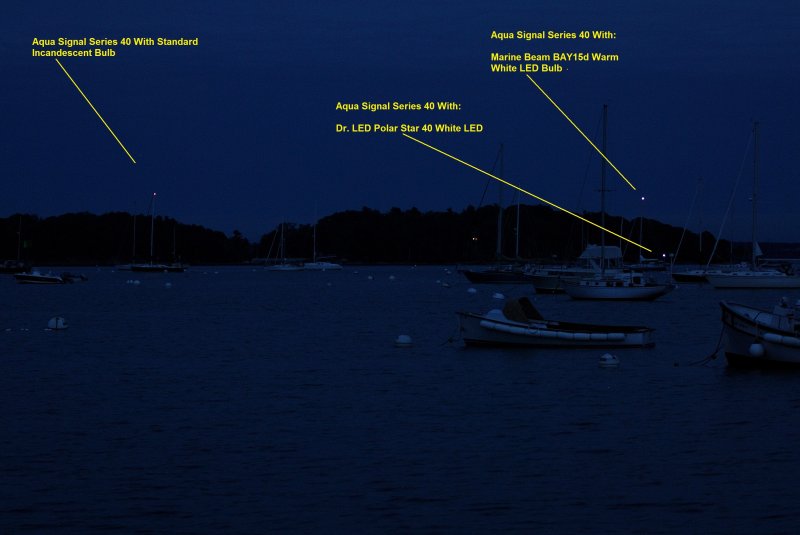
Oh and the newer LED's are actually brighter than a standard Aquasignal Series 40..
113494864.jpg
 
Last edited:
Flashing Lights

I like my flashing LEDs, one at the front and one at the back. They use 2 "D" cell batteries that have lasted 2 seasons and don't run my boat batteries down. 360 deg. visibility from quite a distant and no running my engine for hours to recharge my batteries.
 
Top