Leccy question

Twister_Ken

Well-Known Member
Joined
31 May 2001
Messages
27,584
Location
'ang on a mo, I'll just take some bearings
Visit site
For reasons too tedious to mention I'm currently without a shore power battery charger. The boat does have a battery meter which shows aH in/out and voltage across the battery terminals for the leisure side. What is the 'danger' voltage for a 12v system - the point at which I should either turn stuff off, or start the engine to generate more sparks?

Thx in advance
 
are they standard engine starting batts, or deep discharge, or AGM ? "Leisure" can cover a multitude of types.
 
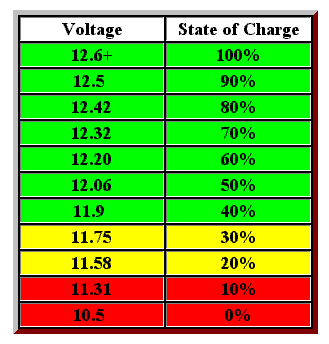
About 50% is getting low imho, so about 12.1V. I would be uncomfortable letting my batteries get into the yellow area; let alone the red.

voltchart.gif
 
Last edited:
But those voltages perhaps refer to batteries at rest? In which case one would underestimate the state of charge if the reading is made while there is a load on the battery.
Maybe it is better to trust the Ah out meter to determine when 50 percent SOC is reached?
 
Essentially 12 volts is the minimum. Measure at the batteries with no load.

12.2 volts is better from the point of battery life, I recharge at this point if I have to. Big solar package usually keeps me up to snuff unless we get two cloudy days in a row. .

The odd descent into high elevens is not too damaging but avoid if you can.
 
If mine get to 12.2V, even with a load up to about 5 or 6 Amps, I want to be charging them up. I try to do a couple of hours a day, and as long as I can one day a week, up to about 8 hours.

Even with that philosophy, the batteries I bought last March, (2012.... 3 x open Lead Acid 110Ah batteries), were knackered by Xmas. They were the cheapest I could find at £70 each, and I suspect I got what I paid for.
I've just bought 3 x Varta A28 110Ah Hobby Leisure Batteries for £100 each, and am hoping for better things.
 
I and I suspect many others have collected a huge range of plug pack and transformers for various electric devices. Many of these are rated at 12v or more DC output. The type that have a transformer inside. (heavy weight) are best as these tend to have a poor regulation. So typically might give 14v or more no load falling to 12v full load. Often more. These can be used as useful trickle chargers for batteries. The simple trick is to connect to the battery via an amp meter ie digital volt meter on 200milliamps or 2 amps and check if there is any useful charging current.
The current will remain fairly constant falling just a bit if and when the batteries get a charge. usually though they will just give a bit of charge that may help solve your problem. Current is usually so low that you can't harm the batteries by overcharge.
have a look and have a fiddle. If current into the battery seems excessive compared to the rating of the transformer then fit a series resistor. Try 1, 2 or 3 ohms of about 1 or 3 watt rating. good luck olewill
 
If mine get to 12.2V, even with a load up to about 5 or 6 Amps, I want to be charging them up. I try to do a couple of hours a day, and as long as I can one day a week, up to about 8 hours.

Even with that philosophy, the batteries I bought last March, (2012.... 3 x open Lead Acid 110Ah batteries), were knackered by Xmas. They were the cheapest I could find at £70 each, and I suspect I got what I paid for.
I've just bought 3 x Varta A28 110Ah Hobby Leisure Batteries for £100 each, and am hoping for better things.

I have 4 x 110 lead acid batteries, now 4 years old and working well, at the time they were the cheapest leisure batts around at £75 each, still operating at full power and running everything, tested again this year and working fine. may need a new fridge battery but its now 5 years old and not sure how old it was before that.
 
I and I suspect many others have collected a huge range of plug pack and transformers for various electric devices. Many of these are rated at 12v or more DC output. The type that have a transformer inside. (heavy weight) are best as these tend to have a poor regulation. So typically might give 14v or more no load falling to 12v full load. Often more. These can be used as useful trickle chargers for batteries. The simple trick is to connect to the battery via an amp meter ie digital volt meter on 200milliamps or 2 amps and check if there is any useful charging current.
The current will remain fairly constant falling just a bit if and when the batteries get a charge. usually though they will just give a bit of charge that may help solve your problem. Current is usually so low that you can't harm the batteries by overcharge.
have a look and have a fiddle. If current into the battery seems excessive compared to the rating of the transformer then fit a series resistor. Try 1, 2 or 3 ohms of about 1 or 3 watt rating. good luck olewill

Olewill,

I have a solar panel which performs well as a trickle charger and boosts the batteries up to about 13.5v between visits to the boat so don't need to try and adapt a device charger to work in that role. Interesting idea though!
 
Check with a multi-meter across the battery terminals, with the battery at rest. Those "battery gauge" gadgets, especially if analogue, are pretty inaccurate IMHO.

I just use a multi meter for voltage and separate ammeter to keep an eye on things; I do my best to keep the batteries above 80% of charge.
 
Top