Leaky stern gland - advice sought

yodave

Well-Known Member
Joined
31 Dec 2010
Messages
400
Location
up North
Visit site
I’ve transferred this post from another thread to avoid hijacking the existing thread.

We recently picked up our new boat. It had around 100 hours on the replacement Lombardini engine. On the day we were leaving the Netherlands [nice timing] the broker told me that the stern gland leaks when the engine is running, and I'd need to pump the bilges every two or three hours. In the end, we had to run the engine for four 24 hour days to get back home, and pumping the bilges seemed to do the trick. There has been no further leaking since we popped her on her [drying] mooring.

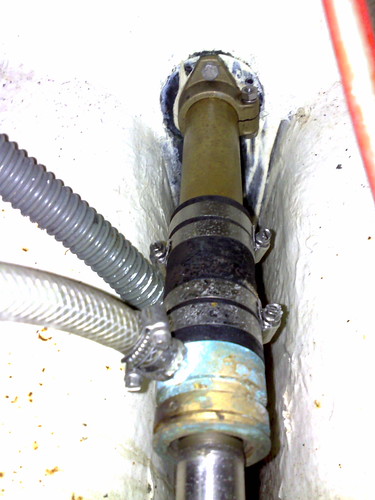
I don't know the make of gland/seal, but I have uploaded photos here:

http://www.flickr.com/photos/46992350@N03/sets/72157626531045671/with/5691559704/

[Also scroll down on this page for a photo].

The broker reckoned that I'd need to replace the 'rings' at the end of the season.

Not sure I'd put too much weight on the brokers input. He initially told me that the gland only needed burping and then tightening, but our hired Dutch skipper couldn't see any way of tightening it.

Then later the broker said that the 'rings' / 'seals' would need replaced. Please keep in mine that his first language wasn't English, so I'm not putting too much faith on the terms he used.

So the question is: is it safe to wait until the end of the season, or should I panic?

Thanks in advance for any pointers or opinions.
 
Last edited:
That bronze housing will almost certainly have lip seals inside it. Don't know the make of the unit, but chances are the seals are standard size. They are cooled and lubricated by the water feed from the engine. They should have been replaced when the engine was fitted as to get at the seal you need to uncouple the shaft, remove the half coupling, unclamp the hose and slide it all off the shaft. Clearly an out of the water job. Was the boat originally fitted with a Bukh engine as they often used this type of seal.
 
It looks like a PSS seal. They are the best IMHO.
Its worth cleaning the face between the carbon a SS rings. Sometimes a small amount of debris will cause a leak. If this doesn’t work pushing the SS ring back a few mm can fix the leak, but unless the SS ring has shifted it indicates the rubber bellows are loosing their elasticity and in that case it is time for replacment.
PSS recommend replacement every 5 years, but most boats exceed this recommendation and around 10 years seem the useful life.
If you Google PSS there are instructions and a handbook on the web.
My internet on the boat is very slow so Google searches are difficult for me, but if you cannot find the instructions I am sure I can dig them up.
The instructions have details on the the installation, adjustment and cleaning the carbon face.

Edit
Sorry forget all of the above my slow internet connection finally downloaded a higher resolution photo of your stern gland and I don’t think it is a PSS.
 
Last edited:
I concur with Tranona; this appears to be a watercooled sternseal using standard lip seals available off the shelf for £5-10 each. Definitely an out of the water job. While dismantled check the shaft hasn't got grooves worn where the seals bear on it, as this will cause premature wear and leaks. If it has, it may be possible to move the seal to an unworn section of the shaft by changing the length of the rubber hose.
 
We have been discussing your photos over the weekend. Son Owen has seen one before but we don't know the make. Definitely a lip seal type, our opinion is that leakage is unlikely to suddenly increase to drastic proportions. If it isn't leaking when the engine is not running we think it should be perfectly safe to leave until the end of the season, pumping occasionally when using the engine.

However, if you are on a drying mooring it could be worth pulling the seal carrier off to investigate the seal part numbers, or measure up if not easily seen, so that replacements can be bought just in case.
 
@Vyv; many thanks to you and your son Owen.

"However, if you are on a drying mooring it could be worth pulling the seal carrier off to investigate the seal part numbers, or measure up if not easily seen, so that replacements can be bought just in case"

I'm far from being Mr DIY, and wouldn't know one end of a stern gland from the other. I am keen to learn though. Any pointers as to what the seal carrier actually looks like [colour/shape/material] and suggestions of how I remove it without dismantling the whole kit & kaboodle?

On an aside, I've been told that the type of stern gland I have isn't ideally suited to the East coat of Scotland because the water can be pretty mucky, and this means that the water cooling action introduces dirt into the gland. Is that fair comment?
 
Would not worry over much about water quality. The gland is cooled and lubricated by the water bleed off the engine (the pipe going into the housing). The seal will be a straightforward rubber seal probably with a stainless spring insert in it to keep the shape of the lip. similar to many such seals as in water pump shafts, crankshafts and numerous other applications where there is a revolving shaft going through a housing and water or oil on one side.

To get it off you need to uncouple the shaft from the engine, push the shaft back, take off the coupling, slacken off the clamps on the tube and the housing with the seal will slide off.
 
I can't make out in your photograph what the little circle is in line with the hose nozzle and on the next raised land towards the camera. Could it be a grub screw? The brass housing must come apart somehow to get the lip seals in it. Undoing a grub screw may release the front sleeve that holds the seals inside. You couldn't replace a seal like that but you may be able to examine it.

Otherwise the method Tranona describes will release it completely. It's easier than it reads. Some hints on my website.
 
Had a couple of lip seal type seals albeit not one that looked like yours. Both mine had three lip seals in them with two seals back to back at the sea water end and one seal at the engine end - the space in the middle ( ie the bearing bit) being filled with oil from a gravity reservoir above water level. Worked like a dream

My seals were an interference fit - the two at the sea water end butting up against the lip of the central bearing part.

If indeed it does have just one lip seal I would not trust it. You need some redundancy.

The lip seals themselves are available from people like Sealmasters ( google) and are very cheap. They are made by the millions and they will be a standard size. You need the ones with the stainless spring - most people recommend the Viton ones.no
 
On an aside, I've been told that the type of stern gland I have isn't ideally suited to the East coat of Scotland because the water can be pretty mucky, and this means that the water cooling action introduces dirt into the gland. Is that fair comment?

I have the same concern as you about these types of seals in mucky water. If I take a bowl full of water from the sea where I sail, there will be sand in the base of the bowl once it settles. I can't believe it is a good idea to be pumping sandy water through a seal like this. It seems like a recipe for wearing the shaft to me. I'd be much happier if my boat had an older school type of stern gland that was not water (and sand) lubricated.

Please bear in mind that the above should be treated as my point of view rather than as a fact.
 
I have the same concern as you about these types of seals in mucky water. If I take a bowl full of water from the sea where I sail, there will be sand in the base of the bowl once it settles. I can't believe it is a good idea to be pumping sandy water through a seal like this. It seems like a recipe for wearing the shaft to me. I'd be much happier if my boat had an older school type of stern gland that was not water (and sand) lubricated.

Please bear in mind that the above should be treated as my point of view rather than as a fact.

I note your location is given as Avon. That suggests the Bristol Channel. As we all know, the sailing medium there is thick, glutinous brown-black ooze, even at HW. There is far more sand in there than water....
 
However, the water does not go THROUGH the seal. It first cools your engine then is pumped into the stern tube. The seal just stops it from coming back into your boat. If there is any additional wear with dirty water it will be in the cutless bearing. The seals in your raw water pump are much more vulnerable, being much smaller and running at at least twice the speed of the prop shaft.
 
I have the same concern as you about these types of seals in mucky water. If I take a bowl full of water from the sea where I sail, there will be sand in the base of the bowl once it settles. I can't believe it is a good idea to be pumping sandy water through a seal like this. It seems like a recipe for wearing the shaft to me. I'd be much happier if my boat had an older school type of stern gland that was not water (and sand) lubricated.

Please bear in mind that the above should be treated as my point of view rather than as a fact.

I sail the Bristol channel and both the lip seal set ups I refer to above were used in the channel without problem. I would be more worried about the trad type seal since you have to let a small flow of water through the seal into the boat and this is bound to deposit some grit into the grease on the packing
 
Thanks to all contributors for your thoughts and opinion.

Tranona: taking the gland and surrounding components apart sounds a bit scary for a man of my limited skills. I'll try to have a closer look over the weekend ...maybe losen a few nuts and bolts when the tides out and see if I can spot any further clues.

Vyv_cox: The Vetus does look like a possible match, so I'll do some exploring.

Bosun Higgs: Not sure I trust the seals ...but I have even less faith in my ability to fix something that's not totally broken at this point in time.

Thanks again for now!
 
That sinking feeling...

Hello,

Thought that I might ask for some views on this existing thread rather than starting a fresh one. The leak discussed on this thread hasn't stopped, but things took a turn for the worse on Wednesday night.

We were asleep on-board in a drying harbour when I was woken by a loud bang at 11.30pm (around the time that we floated). As everything was strapped down, I thought that I'd better get up and check. This was an exceptionally good decision.

When I was putting on my shorts and deck shoes it slowly dawned on me that I could hear water running. When I opened the engine bay cover, the torch revealed that there was a leak spouting out of the stern gland and the water was not far below the shaft itself.

I didn't panic too much - but I certainly woke up quickly.

Fortunately I have been reading my PBO articles, and following a recent article, just three or four weeks ago I purchased some wooden bungs and a mallet (thinking that I'd never use them). For the record, if I hadn't been reading PBO and making use of the advice of generous contributors on this forum, there would have been a real chance that we would have panicked and lost the boat.

After pumping out the bilge, I thwacked a bung in the hole, and then over the next three hours we walked the boat along the pier to the emergency bay where we let her settle at high tide.

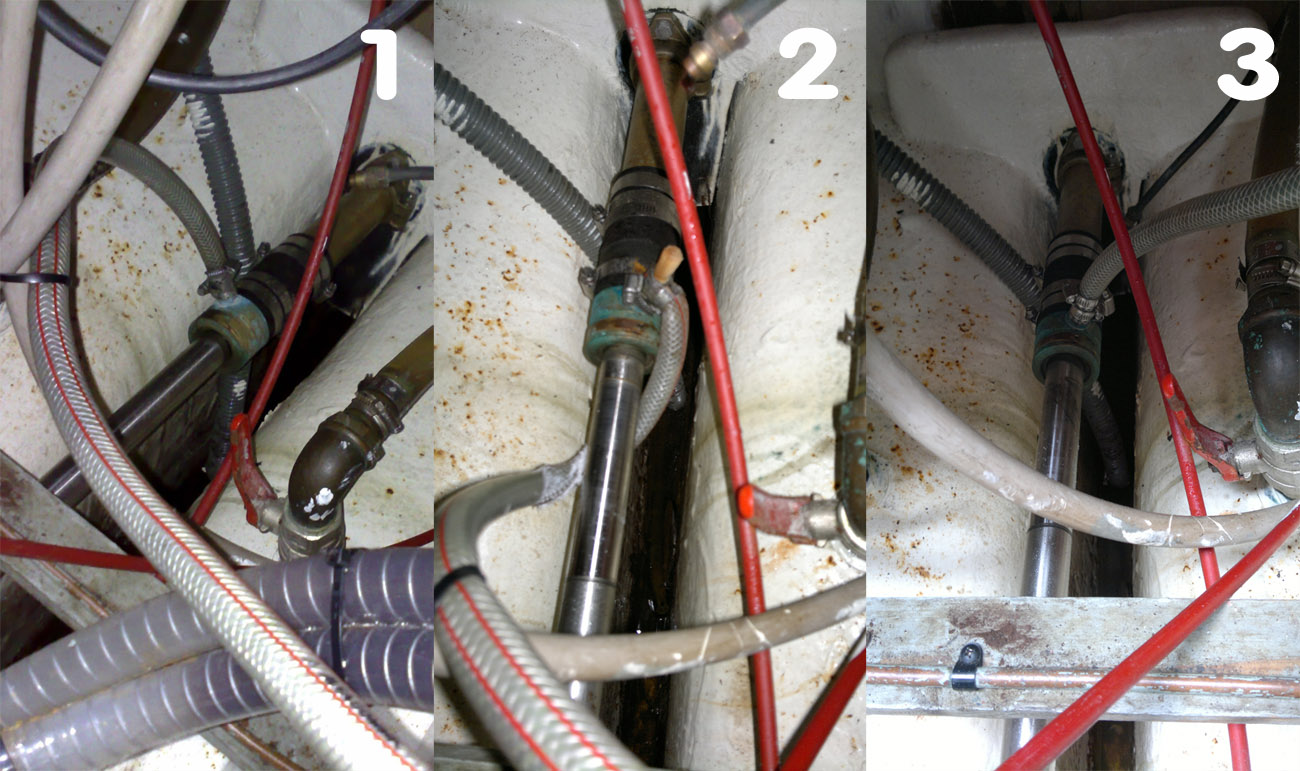
As it turns out the leak was coming from a tube which allows the air to escape from the gland. Looking a photographs that I had taken previously for this thread, it seems to me that the seal must have rotated and twisted the air outlet tube around the shaft - eventually causing the tube to rupture. Please see photo:

sternglandstage01smallest.jpg


1) Before leak. 2) Bung in place. 3) Repair.

Apologies that the image is a bit on the large side; I wanted to retain some detail.

Given that the repair used the existing pipe, and that the cut-down pipe only just stretched the required distance ...it seems to me that we really can't use the engine until we crack the problem of the rotating stern gland.

Any thoughts?
 
How did it manage to rotate? I can only assume the big rubber tube between the gland and the stern-tube isn't tightly clamped to one or the other, or it would either have prevented the rotation or been wrung and broken itself (a much harder leak to seal - you were lucky!).

There ought to be lugs on the stern tube and the gland which interlock to prevent the rotation - if the rubber tube is too long then the lugs won't engage and it's only the tube preventing rotation. Or not, if it's not clamped on tight enough.

Reckon you need to undo the four big jubilee clips on the rubber hose (while above water!) and slide the whole lot apart to see what's inside.

Pete
 
Think the housing can only rotate if the clamps onto the stern tube are loose. Normally the shaft revolves freely inside the housing supporrted by the seals.

So first job is to check that the clips are sound - one of the reasons for having two clips is that they can fail because the worm drives threads are stripped, so the screw will turn but the clamp will not actually tighten (guess how I found that out!). With the hose firmly clamped to the tube, it should not rotate. New all stainless clasmps are cheap even if you use the type with bolts rather than worm screws.
 
From your third photo of the 'repaired' gland I notice that it seems to show the seal is now squeezed at the engine end of the shaft and protruding from the end plate of the gland, that I'm sure can not be right.

If the water is being pumped by your engine and pipe into this gland I don't see any outlet pipe, unless it exits at the cutless bearing which, if it does have two seals, defeats the object rather.

It definitely means an out of water repair.

ianat182
 
Top