Leaking stern gland - brass greae type

sabresailor

Well-Known Member
Joined
5 Oct 2003
Messages
113
Location
Somerset
Visit site
Hello. I am in the process of moving my newly purchased Snapdragon. The stern gland / seal drips badly when the engine is run for several hours. After about 6 hours mooring I had about 4 or 5 pints in the bilge. Giving a quarter turn stops the drips until the engine is run again.

I plan to leave her on my mooring for a few weeks until she is ashore. My previous boat had a different type of seal. Any thoughts on the problem and solution appreciated.
Cheers
Mike
 
Quarter-turn on what - the greaser or the packing nut?

Sounds like it's the latter that needs tightening - pumping more grease in is only a very short-term fix.

Pete
 
If it's a conventional packed gland type stern gland, you need to tighten the gland nut until it doesn't leak. If you can't tighten it any more, the packing needs replacing which is a fairly simple (if fiddly) procedure described in most maintenance type books (I've got Simple boat maintenance by Pat Manley which is good apart from the photos which I think were taken with a Polaroid). If your stern gland has a rubber hose to connect it to the stern tube, i would renew it using the special reinforced stern gland hose. As far as I can see, the greaser is only necessary to seal the gap when you're not motoring and can probably be chucked.
I think Cox Engineering's web site has details of various types of stern gear. Personally I prefer the traditional type without the rubber tube. http://coxengineering.sharepoint.com/Pages/Sternglands.aspx
 
They are designed to drip when the shaft is turning, but gland nut should be adjusted so they don't drip when engine is stopped. Water is the lubricant and coolant.
 
There is more info on the website (thanks ghostlymoron) but in a nutshell, tighten the packing nut or nuts whilst turning the shaft by hand. It is safe to tighten the nut until you feel resistance from the gland. It should then be dry when stationary but may drip when the engine is driving. One or two drips per minute is the recognised figure but I have found it perfectly possible to eliminate all drips with persistence. Once motoring, check the temperature of the assembly with your hand. It should be no more than warm, preferably cool.
 
Once ashore you'll no doubt be tempted to refurbish the whole assembly. You may well find a choice of materials for the packing, the original type and a PTFE type, which is self lubricating.

Rob.
 
Auto bilge pump until you get her ashore?

It is pretty easy to do, and not all that exciting, with the boat afloat. I did a 35 mm shaft packing around two weeks ago and the bilge pump didn't operate once during the refurbishment. That despite a previous owner having packed what should have been 8 mm packing with short lengths of 6 mm, which took quite a lot of ingenuity to pull out.
 
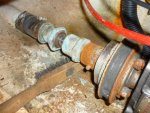
Stern gland.jpgI've finally managed to undo mine after removing the raw water filter, exhaust box etc. etc. The cup part which I think must hold the packing, faces aft. One piece of packing which I removed was stuck to the flange. How do I get the old packing out and how do I cut the new packing to the right length? I've tried using a mirror but difficult to see in the cramped space. There is no greaser on mine - see photo.
Sailorbaz
 
I've finally managed to undo mine after removing the raw water filter, exhaust box etc. etc. The cup part which I think must hold the packing, faces aft. One piece of packing which I removed was stuck to the flange. How do I get the old packing out and how do I cut the new packing to the right length? I've tried using a mirror but difficult to see in the cramped space. There is no greaser on mine - see photo.
Sailorbaz

Get the old packing out with a small long screw. Screw it into the old packing and pull it out. You may have to pick away with a small screwdriver and bits of wire etc for some of the bits, but eventually you will get it clear. Check with a mirror.

To repack, take a length of packing of the correct size and wind it round the shaft (or another object of identical diameter) in a tight spiral. Take a stanley knife and carefully but along the spiral to leave you with several bits of packing the correct length to 'just' fit round the shaft. Pack the appropriate number in (from memory its about three or four) making sure that the joins are in different places.

Please make sure you don't over-tighten the packing. Its easy to score the shaft and have the whole thing over heating and not only will it start leaking again, but it will be impossible to sort it out without replacing the shaft. See other comments above.

Like Vyv, I've managed to eliminate all drips from a traditional stern shaft seal with careful adjustment but a few drips while the engine is running is quite acceptable. Giving a turn on the stern gland greaser used to be a regular part of boating. Nowadays lots of people fit modern drip free seals...
 
It would be normal to cut at about 45deg rather than straight across. It would also be normal to have two hose clips on each end of the hose below the waterline.
 
I suspect you have a back to front gland. The surface where the packing would normally be looks like brass which suggests
the packing may be up inside the deep nut as you say .Make sure the lock nut is screwed right down out of the way after repacking and tighten the nut till
drips stop and only then screw the lock nut back up to secure.
 
I did mine last winter & very glad I was that I didn't do it afloat.

Although I got a pair of C-wrenches there way no way I could shift the locking nut. since I was replacing the shaft anyway, I pulled the shaft & took the gland off. I ended up with the gland in a vice & a pipe on a c-spanner to get it apart.

I was very wary of putting too much pressure on the gland while it was in the boat in case I damaged the flexible pipe which was looking dodgy too. Plus, I wasn't sure what size packing I needed.

Now I know exactly how mine comes apart & it's locked but not so tight I can't shift it, I'd certainly consider packing it wet if I had to but woudl still prefer to dry out.

So, if it's only leaking under power, sqeeze loads of grease in & leave it until you're ashore.
 
Top