Lead Carbon Batteries - Experience?

dje67

Well-Known Member
Joined
20 Sep 2007
Messages
360
Location
Largs
Visit site
https://www.kuranda.co.uk/product/s...tachment_id=32179&download_file=5e1dca8adce3e

Been thinking about replacement batteries for my 3 off 110Ah domestic batteries. Because of COVID we’ve used the boat loads but not used many marinas this year. Particularly off-season, with high Ah of heating and lighting, my domestic bank is often down to 50% SOC and I want more capacity that will accept charge faster under engine or on the generator with 30A charger.

lead carbon batteries look to fit the bill. I think 4 of 110Ah able to cycle down to 20-30% SOC and charge quickly will be perfect.

So, any experience of this technology? Prices seem about twice that of conventional lead acids, but the advantages look appealing. Typical spec/link attached. If correct, I reckon I can use 300Ah from 4 of them with over 1000 cycles, which will outlive me! Currently have about 100Ah useable, so a big improvement.

Thoughts?
 
I stumbled upon another brand yesterday, PLH.

That is not another brand, but possibly another series of batteries from the same manufacturer; Leoch.

FWIW, I renewed my house bank this year with 'carbon' AGM's from Leoch, 3 x 90 AH.
Far too early to make any judgement of course, but my understanding is that these are basically AGM's designed for deep cycle and with a slight refinement, in the form of carbon added to the negative plate. Supposedly, this should make the batteries less vulnerable to sulphation, if left not fully charged, and so they should have a longer life compared to 'standard' AGM's.
 
If correct, I reckon I can use 300Ah from 4 of them with over 1000 cycles, which will outlive me! Currently have about 100Ah useable, so a big improvement.

Thoughts?

That sounds a bit optimistic to me.
Regularly using 300 Ah out of 440 would mean bringing them down to almost 70 percent depth of discharge. If I read the chart correctly that would give you approx. 700 cycles, provided you accepted that the capacity had fell to 80 percent (so the 300 Ah would then only be 240 Ah towards the end).
Still, not too bad.
 

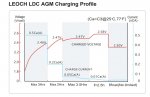
First question I would be asking about is the charging profile on the linked PDF. Are the limits compulsory for warranty and long battery life and if so what sort of battery charger can manage those profiles, or is the graph just un-realistic and not achievable in real life.

Also, looks like there are two ranges, superior lead carbon and pure lead carbon, the difference? well its in the Leoch catalogue.

Pete
 

Attachments

  • AGM.jpg
    AGM.jpg
    81.6 KB · Views: 47
  • Leoch.png
    Leoch.png
    39.8 KB · Views: 46
Last edited:
First question I would be asking about is the charging profile on the linked PDF. Are the limits compulsory for warranty and long battery life and if so what sort of battery charger can manage those profiles, or is the graph just un-realistic and not achievable in real life.

I do not read that chart as a prescription for real life charging, more likely relates to some standardized testing regime used in the laboratory.
 
I suspect they're just vastly overpriced AGM batteries. There are so many inconsistencies in the marketing blurb that I wouldn't rely on any of it being true.
 
I do not read that chart as a prescription for real life charging, more likely relates to some standardized testing regime used in the laboratory.

Did they then use that testing regime to calculate the number of battery cycles. Its difficult to know who to believe now, guess you pays your money and hope for the best. Certainly be interested in how you get on with them.

Victron also make carbon lead batteries. This is what they have to say:

Pete
 

Attachments

  • Victron.jpg
    Victron.jpg
    51.4 KB · Views: 39
I've just done a bit of internet searching, Leoch is an absolutely massive Chinese company, check out their website.
My experience of buying from large reputable Chinese companies has been very good, both in quality and price, although you can argue about the extent to which these companies are subsidised and whether that's fair or not. But technically they are often first rate.
You have to be aware of marketing hype, but that's not confined to the Chinese.
Inconsistencies in description are often down to poor translation, I wonder how many UK companies could market effectively at a technical level in Mandarin? But they often wouldn't have to, as almost all the technical people I've met speak excellent english and are often educated in the Uk or the USA.
If you look at the published data on the Leoch website for the batteries it's quite detailed.
I looked at the LDC12-115-G31-DT, which is advertised as a 130amp hr battery, but is only 118amp hours at the normal 20hr rate, this appears to be a standard AGM, with normal lead acid chemistry.
I also looked at the PLH+C 100 (12v 100Ah) which is rated at 100amp hr at a 10hr rate down to a battery voltage of 10.8 volts, no info is given on the 20hr rate but you'd expect that to be better
This is a slightly different chemistry, with carbon added, I don't understand the chemistry, but I have a set of Elecsol AGM's ( the company no longer exists) installed in 2013 and still going strong. These batteries have carbon incorporated into the chemistry, I don't understand the difference in chemistry in these batteries either. I just know that they are long lasting (the manufacturer's boosted a 15year operational life, although I don't expect to see that) and completely maintenance free.
However, I'm am keeping a watch on possible replacements, which is why this thread attracted my attention.
I've also had a detailed look at Lithium Ion Phosphate using the Victron system, but hey would be very difficult to install in my boat, it would require major re-wiring.
 
I've also had a detailed look at Lithium Ion Phosphate using the Victron system, but hey would be very difficult to install in my boat, it would require major re-wiring.

Understood, but what if someone suggested mixing lead acid and LifePO4 in the same bank? You might think they were barking, well how about this article which I am still ploughing my way through:

Lithium-Hybrid
 
Understood, but what if someone suggested mixing lead acid and LifePO4 in the same bank? You might think they were barking, well how about this article which I am still ploughing my way through:

Lithium-Hybrid

Thanks for the link. Interesting stuff.
Won't the higher voltage LiFe bank just want to discharge into the lead acid continuously? Or will the lead-acid's naturally low charge acceptance once nearly full prevent that from happening?

I had been thinking about a slightly different hybrid system. The LiFe bank would get charging priority, and be connected to the lead-acids via a B2B charger. The idea was that during the day you have plentiful solar power, but only for a few hours. Use this time to charge up the LiFe bank. Then once the sun has set, the B2B charger has all night to slowly top up the lead-acids. You wake up to empty LiFe banks, and fully charged lead-acids. This should suit the cycling requirements of each type of battery, prolonging the lifespan of the lead-acids.
 
I did not find them to be overpriced.

When replacing, I looked closely at these two (although the Leochs I finally decided on are not exactly the same, but was similar in price):

Exide EP650 DUAL AGM Leisure Marine Battery

Leoch Superior Lead Carbon AGM 93Ah Battery (SLCA-1295 DT)

The Exide battery you looked at seems rather pricey. My boat came equipped with Exide EK920 AGM batteries, these have been superceded by the EK950 which are currently only £125 for 95Ah - EK950 Exide Start-Stop AGM Car Battery 95Ah 017
 
I replaced my old Lifelines after many years with Trojan 275 AGMs. They are also about £250 a pop for 100 A/H and maybe worth a look. I have been very please so far. I have an Exide AGM for engine starting so can use the same charging regime.
 
Top