Lazyjacks, stackpacks etc.

How do you stow your main?

  • Stackpack

    Votes: 102 52.0%
  • Lazyjacks

    Votes: 36 18.4%
  • Flake down by hand

    Votes: 39 19.9%
  • In-mast or -boom furling

    Votes: 15 7.7%
  • Other

    Votes: 4 2.0%

  • Total voters
    196
I don't have lazyjacks, but often wonder about them, especially as I'm often single handing. Despite the numerous adverse comments on here (e.g catching battens, noise) I'd like to give it a try sometime (might try a temporary arrangment from the signal halliard blocks on the spreaders).

At 23ft LOA the main is not very big, but it's still requires a bit of dancing around on the coachroof, usually when there's limited clear water and other boats milling about that need my attention.

I'm interested in the idea of being able to tie the lazyjacks forward. Does that necessarily mean having an extra cleat on the mast, and a line going up to the spreaders or wherever the lazyjacks are suspended from that can be released and extended? Or is there some other cunning arrangement?
 
I don't have lazyjacks, but often wonder about them, especially as I'm often single handing. Despite the numerous adverse comments on here (e.g catching battens, noise) I'd like to give it a try sometime (might try a temporary arrangment from the signal halliard blocks on the spreaders).

At 23ft LOA the main is not very big, but it's still requires a bit of dancing around on the coachroof, usually when there's limited clear water and other boats milling about that need my attention.

I'm interested in the idea of being able to tie the lazyjacks forward. Does that necessarily mean having an extra cleat on the mast, and a line going up to the spreaders or wherever the lazyjacks are suspended from that can be released and extended? Or is there some other cunning arrangement?
That's the arrangement I have
 
I

I'm interested in the idea of being able to tie the lazyjacks forward. Does that necessarily mean having an extra cleat on the mast, and a line going up to the spreaders or wherever the lazyjacks are suspended from that can be released and extended? Or is there some other cunning arrangement?

Normally on mine I just loosen the lazy jacks line so that I have plenty of slack, gather them together, hook them around the reefing horns on each side of the boom and then pull them tight again.
So instead of leading from the stack pack straight upwards, they lead along the boom to the mast, around the reefing horn and then up the mast to.

Once they're out the way I roll up the sides of the stack pack and secure with velcro.
 
Looking at the stack packs on many yachts in a marina recently it looks to me as if there's no quick way of pulling the lazy-jacks forward out of the way. So to prevent the battens fouling the lazy-jacks, you have to be heading dead to windward when hoisting sail. The only way to do that is to use your engine. I wouldn't want to have to be dependant on an engine to hoist sail.

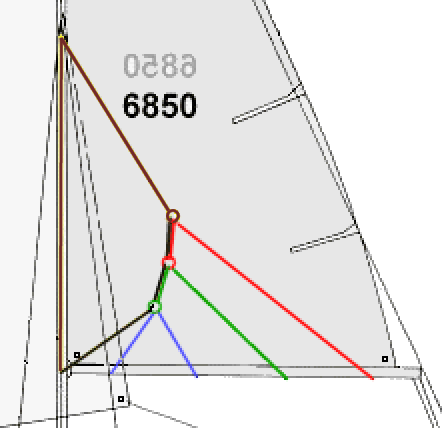
My lazy jacks like most have 3 rings 2 lower and one upper. I have threaded a line from the aft most lower ring through the fwd most ring to a block on the mast to allow the lazy jacks to be pulled forward to the mast for raising the main with not battens catching. I can then release the line and pull the lazy jacks tight to lower the main as normal.

Several people in our marina has done the same. Mine are at the mast but they could be taken back to the cockpit is required.

This is another way

lazyjack-1.gif
 
Last edited by a moderator:
Looking at the stack packs on many yachts in a marina recently it looks to me as if there's no quick way of pulling the lazy-jacks forward out of the way. So to prevent the battens fouling the lazy-jacks, you have to be heading dead to windward when hoisting sail. The only way to do that is to use your engine. I wouldn't want to have to be dependant on an engine to hoist sail.

The boat doesn't have to be "heading dead to windward". It's only necessary to free off the sheet so that the boom and sail are lying to the wind. No need for engine.
 
We had a system with plastic pulleys at the joins of the lazyjacks. The battens caught on them every time. I replaced them with plastic thimbles this year. Now it's no problem at all. I also allowed enough line so that I can pull them forwards if necessary.
 
Have very basic lazy jacks due to be improved but I would welcome comments about stowing the sail and getting it up for that matter.

i used to set the boat on an upwind course motoring slowly under autopilot to stow the main.
it frightened me how far the boat could travel whilst I concentrated on the sail whilst not looking around as much as I should (singlehanded)

Now I try to stop the boat drop the main and get it stowed before the boat has gone too far""...............
 
I have lazy-jacks on my Achilles 24, and am considering getting rid of them—there are (if I remember correctly) three attachment points on the boom, and I find myself almost invariably up on the coachroof while hoisting the sail to grab the leech and pull the first batten or two clear of the lazy-jacks (if not dead into wind). I don't much like that problem, and don't find them all that much help when stowing the sail, a bight of which often seems to flop out of the aft end. I suspect the positioning of the boom attachment points could be improved, but given the comparatively small sail I am inclined to do away with them completely, though I might investigate StormNorm's solution.
I have sailed with stack-packs on larger charter boats, and I must say they are excellent when set up right, provided you are willing to live with being almost dead into wind to hoist the sail.
 
Surely the issue with positioning the boat to more or less to windward when handing or reefing the main with lazyjacks fitted (which you have to fit if you've got a stackpack covering system) is that you have to do this anyway even if you don't have lazyjacks!

You want the airstream from well forward of the mast so that the sail flutters up/down, so there's no excessive friction due to side forces acting on the sliders, and so your battens are clear of the aft shrouds anyway.

My habit it to always let off the mainsheet a bit and adjust my heading to ensure that there's a very slight press of wind on one side (the starboard side for obvious reasons in crowded waters), and so that the boom is sufficiently out for standing-room and for safety if I have to go up to deal with (eg reefing) lines at the mast.

Don't tell me I have to motor rigidly to windward to achieve any of this with lazyjacks?
 
I do find the top batten has a tendency to catch on the support lines of the stackpack, Slacking the lines and bringing them forward would solve that but I can't be bothered, it only takes seconds to clear the sail for hoisting. The ability to release the halyard clutch and have the main drop tidily in seconds so I can get back to the helm is worth any hassle involved in hoisting.

Rounding up isn't an issue for me as the rig rotates 360°. In fact I prefer to do it with the wind aft and the boom over the bows as it reduces apparent wind, especially when reefing.
 
Last edited:
Our new boat has roller furling self tacking jib with an in-mast furling main. It has a Lewmar electric winch to make it easy.

I dont think I will be able to bring myself to use the electric winch for furling but it will be used for unfurling.

We have only set both sails while alongside and it is obvious that both furling gears need servicing. The jib furling line is too thin also.

Down to the boat tomorrow to get on with things.......................
 
Don't tell me I have to motor rigidly to windward to achieve any of this with lazyjacks?

Certainly I can bring Ariam's main down with the wind from a variety of directions and without motoring. Hoisting it is a little more limiting; motoring to windward is indeed preferable, but certainly I've sailed off a mooring or from the anchor under jib alone and then hoisted the main while sailing. Part of the technique is to luff briefly to flick the battens past the lazy-jacks.

Fair to say though that it is all a lot more hassle than it was with Kindred Spirit - gaff sails slide up and down with hoops and jaws around a circular mast and don't really care which direction the hull underneath happens to be pointing.

Pete
 
I have lazy-jacks on my Achilles 24, and am considering getting rid of them—there are (if I remember correctly) three attachment points on the boom, and I find myself almost invariably up on the coachroof while hoisting the sail to grab the leech and pull the first batten or two clear of the lazy-jacks (if not dead into wind). I don't much like that problem, and don't find them all that much help when stowing the sail, a bight of which often seems to flop out of the aft end. I suspect the positioning of the boom attachment points could be improved, but given the comparatively small sail I am inclined to do away with them completely, though I might investigate StormNorm's solution.
I have sailed with stack-packs on larger charter boats, and I must say they are excellent when set up right, provided you are willing to live with being almost dead into wind to hoist the sail.

I don't view a Stackpack as an automatic neat storage system. It means I can let go the clutch and drop the main quickly, stowing it properly later. The main won't be draped all over the coachroof, or fill with wind at an awkward moment.
 
Then you get crazy people like DanCrane who sticks lazyjacks on a dinghy...

Ouch! :biggrin-new: Although even after three years, I guess bad publicity beats none. :rolleyes: Lazyjacks are just as welcome if you're alone in a big dinghy, as on yachts where the mainsail may not flake obediently without lines to keep it on the boom.
I found this thread, trawling for descriptions of lazyjacks to discover whether anybody manages without adjustment-lines running from the shrouds down to the mast-foot...

...my arrangement has always run from boom up to tangs high on the mast, down to the shroud-bases, so it would seem an enormous improvement if the lazyjack line going up one side, could simply run round the front of the mast and back to the other side of the boom, as Alahol described here (page two). It simply never occurred to me before. Is there any downside to that?

Perhaps things have moved on a bit since this thread, but when I found the ends of my battens snagging the lazyjacks, I simply shortened the battens so they could be recessed inside their pockets. I've never understood why they are often too long, and stick out.

33883732968_a3249a32c4_c.jpg


Is there any good reason why mainsail battens often can't be snugly pocketed in order not to snag the LJs?
 
Last edited:
Fitted a new stack pack two weeks ago to 28ft boat. I followed a tip on this forum and ran the lines up to the spreaders /mast junction with a temporary fixing to test function. Much lower connection point than most and not adjustable. I will add eye nuts to the mast/spreader bracket this weekend as a permanent fixing point.

Seems to work well on test sail with no batten catching yet and drops the sail well. Also enables a full range of boom movement without getting too tight.
BFE410FD-0DC6-436A-BA0D-BFEE6E96512F.jpg

Not the best picture but just about shows that the jacks are low and quite far back. I wonder if fixing the jacks too high on the mast contributes to the issues with battens catching and need to loosen system to raise main ( which somewhat defeats the work saving objective it in my view). The sail catching is done at the bottom of the sail so why have a tall jack set up?

No connection other than being a happy customer but worth a shout out to Sabre Sails in Swansea. They made the Spray hood using the old one as a template and stack pack for £725 including battens, bolt rope and delivery. Very pleased.
 
Last edited:
Just to be controversial, I love my furling main. Don't need to go head to wind, just slack off a bit, it furls better under a bit of tension.

Tighten the topping lift, let off the outhaul and just wind the main into the mast and it's gone - no tidying up or anything :encouragement:

.... must admit, the old worn sails could catch in the slot and jam when unfurling, so it had to be unfurled on a port tack, but that is no longer necessary since I got stiff new sails in 2016 - works like a dream for both reefing and furling/unfurling. ;)
 
Top