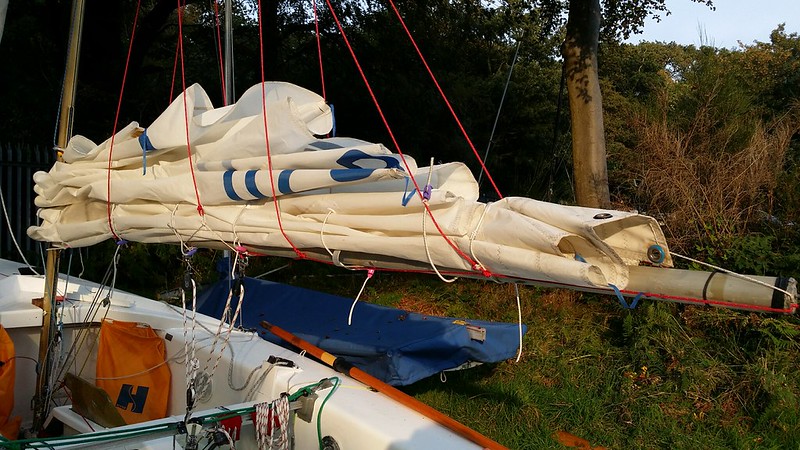
Lazyjacks re-think

My shock cords are similar to the picture except that they only extend from halfway along the spreaders. They only widen the slot slightly but serve their chief purpose, which is to keep the lines away from the mast.

I think that the battens will always be prone to catching on the lines but it must be better to have smooth ends. Many modern sails seem to achieve this by having the battens retained by a fold-in flap. These work well but I find them sometimes hard to insert.
 
The shockcords seem like a good idea but how long do they last, exposed to the weather?

The ends of my battens are flush with the leech but they still catch on the lazy jacks, which is why I pull the LJs up to the mast when not required.
 
Last edited:
... I've no idea whether it is normal to loosen the topping lift when sailing - I assumed it always bears the boom's weight, rather than only replicating the effect of a boom crutch at rest.

I didn't see anyone else comment on this. I'm sure that where yachts have a topping lift (rather than a sprung strut, for instance) it is certainly normal to loosen it when sailing, especially up-wind. That would be how to minimise twist and maximise flatness. Otherwise the mainsheet is merely tensioning the topping lift...

Mike.
 
I see what you mean Mike, thanks.

Not having needed or encountered certain items and lines, really messes with my understanding of what they're for.
 
I experimented with shock cords or partial shock cords and found that the sail weight would drag the bag to one side as they stretched and it would flop down.

I ended up using thin line to each spreader connected where the spreader joins the mast. This low and narrow connection resulted in the lazy jacks triangles being close to the mast and narrowly spaced. On my boat this geometry means that the batons do not catch because they are aft of the lazy jacks after only a few meters of hoisting. Sail drops well.
 
That's interesting Dutch, thanks. I was afraid shockcord might flop under that strain.

Your comment about the LJs not snagging if closer to the mast (as Daydream Believer said above) makes good sense, except that when I've moved my lazyjacks forward, a lot of the lowest few feet of leech flapped about untamed until I put ties around it. You say the system works "after only a few metres of hoisting", but the infuriating trouble I've found was mainly in that initial period.

Also, in the absence of a topping lift, the reduced angle and the weight of boom and sail on the lazyjacks near to the mast made me worry about the load on the mast-tang. Not a problem that a normally-equipped yacht will encounter.

I wonder if a pair of 'retractor-lines' that can temporarily haul the LJs forward of the leech, would stop the snagging issue best?
 
48683616483_78fa5ec603.jpg

:

If you replace the shock cord with a fixed block or bullseye fairlead that will deflect the lazy jacks in the same way, there will be no load or very little load on the spreader.

I have also feed a line through lower the splitter rings / divert direct to the mast that allows it to easy pull back the lazy jacks back to the mast for ease the hoisting of the main.

This pull back line can be routed back to the cockpit and the lazy jack line down the mast to the tensioned with shock cords it make it easy to raise the main from the cockpit and keeps the lazy jacks from chafing the sails if left in position
 
This may not work, or even be worth trying...just a thought. The long down-parts on my lazyjacks are a pain, leading to the shroud bases. These tails almost double the length of line required, they tangle easily and aren't close to hand when I need to adjust them.

I'm thinking that if the line on each side began at the spreaders and led down through the usual triangles to the boom, the aftermost part of which was adjustable with a boom-mounted clam-cleat, then the tension could still be altered but the amount of rope needed could be much reduced.

Also, is there an overpowering reason why lazyjacks are attached close to the mast, rather than out on the spreaders? If the lines could be spread (permanently, or temporarily with an adjuster), there'd be much less snagging of battens.

I haven't read everything, but I think you have a pretty small boat, no?

Here is something I did on a small boat
- tie lazyjacks (one line) to spreaders at the mast, then run down towards end of boom and make it off with a rolling hitch
- put a loop in the lazy jack line about 1/3rd from the top (any knot that will give you a loop in the middle of a line - e.g. figure 8 on a bight)
- run another lazy jack line from near the middle of the boom to near the gooseneck, via the loop. Make it fast in the middle of the boom with a bowline and towards the gooseneck with another rolling hitch.

If the boat is small enough you can adjust the tension on the lazyjacks by adjusting the rolling hitches. Obviously you have to adjust them so that the hitch is not too high when the lines are tight.

As I think about it, you could even modify this system so the two adjustable hitches are mid-boom and near the gooseneck.

Downside is you need to adjust four rolling hitches - two each side. But that isn't normally a problem on a small boat.

And use thin lines. Maybe 3 mm.
 
That's interesting Dutch, thanks. I was afraid shockcord might flop under that strain.

Your comment about the LJs not snagging if closer to the mast (as Daydream Believer said above) makes good sense, except that when I've moved my lazyjacks forward, a lot of the lowest few feet of leech flapped about untamed until I put ties around it. You say the system works "after only a few metres of hoisting", but the infuriating trouble I've found was mainly in that initial period.

I think that maybe the best solution is different for every boat. I had to experiment a bit and discovered what worked for me. Fixing points on each side of the mast at spreader height and a short aft triangle means that the sail goes up without catching and drops into the bag properly. My boat is a 28 foot Dehler with a reasonably tall and narrow sail.
 
Here is something I did on a small boat
- tie lazyjacks (one line) to spreaders at the mast, then run down towards end of boom and make it off with a rolling hitch
- put a loop in the lazy jack line about 1/3rd from the top (any knot that will give you a loop in the middle of a line - e.g. figure 8 on a bight)
- run another lazy jack line from near the middle of the boom to near the gooseneck, via the loop. Make it fast in the middle of the boom with a bowline and towards the gooseneck with another rolling hitch.

It certainly sounds practical, thanks. And I've learned to tie a rolling hitch since reading this! :encouragement:

I made lazyjacks for the dinghy out of spare 6mm braided line. Not very scientific but it works okay and keeps the cockpit clear. I've probably superimposed the minor issues they've given me, upon the set-ups employed by yachts, which are better thought out.

48691129327_f8773c6b61_c.jpg
 
I sense there's a degree of agonising over solutions which are unnecessarily complex and expensive. F'r example, there's no need to buy/fit expensive blocks - which will generate wear on the sail where they rub - for simple, cheap s/s rings will do very well.

There's no need to drill holes in spreaders to affix s/s eye-straps, when a pair of 6"-8" half-inch webbing straps with Velcro fitted, and a s/s ring each, will do a better job.

'bbg', Dutch' and 'dancrane' have effective answers, and I fitted such an arrangement to a friend's Rival 34 more than a decade ago. The webbing straps were fitted around the spreader roots. Another crew member was suspicious of the Velcro straps 'in shear', but two of us bouncing on each line couldn't shift them. The set-up is still up there today.

Yes, we found that occasionally a batten-end would catch on a line during hoist. So we learned to do that early part of the hoist slowly, picking our moment to heave on the halyard and easing it down a foot if we got it wrong. Having the two lines adjustable at the boom-end using a short loop-back and rolling hitch was more convenient than a trip to the mast and back - especially at night, in lumpy weather.

This is from the Harken page....

Raising Sail
When hoisting sail, check to make sure the sail does not get caught in the Lazy Jacks.

The headboard or battens may catch between the mast and the Lazy Jacks or jam in the angle between the lines. If the halyard is forced, this could result in a broken batten,
ripped sail or damaged Lazy Jack. To avoid this, look aloft*** as you raise the mainsail and stop if the sail gets caught. Also, make sure the boat is facing head-to-wind.
The sail is less apt to catch on the Lazy Jacks if the topping lift is used and the Lazy Jacks are somewhat loose. This way they will deflect out of the way easier when the
sail makes contact with them.

***I find looking aft at the battens/lines contact point more helpful. And, the boat does not need to lie head-to-wind, provided the mainsheet is loosened such that the mainsail is 'feathered' into wind.
 
I agree with the over analysing observation.

Following fitting a new stack pack bag I researched all sorts of lazy jack methods, solutions and products but then realised I was due to leave on a trip in a couple of days and still had not sorted it out. I tied lines to the spreaders/mast junction and fitted rough triangles leaving lots of spare line. I then fiddled about with lengths and raising / dropping the main for an hour until I got the geometry right for my boat. I then added small carabineers to the line ends to tidy it all up.

Job done in 2 hours max at less than £30 and no need to adjust anything when using the solution. One of the advantages of keeping the fixing points near to the mast is that there is enough slack in the system to allow for boom movement without adjustment. My boat is only 28 foot length so appreciate that a bigger boat may offer different challenges.
 
+1.

When I wanted to try lazyjacks, I got a length of polyprop washing line for a couple of quid and set something up. I then used them and adjusted until I was somewhere near right before doing it properly. The last thing I did was to add a line each side a little closer to the mast than the end of the first batten, which has helped, but not entirely cured the batten issue.
 
Top