
Layup for repair to side decks

Keith-i

Well-Known Member
Joined
4 Jul 2012
Messages
1,474
Location
Jersey
Visit site
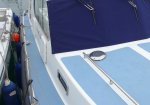
I'm shortly to embark on a fairly major repair to the side decks on my Channel Island 32 due to water ingress causing saturation and localised rot in the basla core. My plan of attack is to strip off the outer skin, dry and/or replace defective areas of balsa and then lay up a new outer skin. There is no great merit in trying to salvage and refix the existing skin/deck finish as it's pretty old and rough, plus the fact that I want to renew the non-skid with Kiwi-grip anyway so the quality of surface finish and lack of gelcoat is not critical. Any exposed areas can be painted with 2-pack as a very acceptable substitute to trying to flowcoat.

I'm putting together my list of supplies that I need to order but am not quite sure what I should be aiming for with regard to cloth layers to renew the outer skin. I'm guessing something like 6 layers of 450gsm would work, but is that best as tri-axial cloth, or maybe a mix of bi-axial and woven? I'm using epoxy for the resin. Any thoughts would be welcome.
 

Attachments

  • side decks.jpg
    side decks.jpg
    824.7 KB · Views: 26
6 layers would be overkill , a couple of layers of 450 gm double bias should suffice , double bias drapes really well
 
Yes, 6 is probably overkill, but I’m not sure about 2 - maybe on a aircraft fairing or a vehicle body kit, but nowhere on my boat does 2 x 450g suffice, I’m afraid!

I do agree about the biax for ease over any anything else (tri/quad) being overkill and woven being old hat. But I’d go 600g biax, as I find it barely any harder to work with than 450 but - obviously - thicker, so fewer layers. That said, for an area like this, you might find biax/csm combination mat helpful for building up thickness and adhering well to the balsa.

So a layup schedule could be something like;
1 layer 450g combi matt
450/225 Combination Matt - 1.27 mt wide - East Coast Fibreglass Supplies
3 layers 600g biax:
600g Biaxial cloth - 1.27 mt wide - East Coast Fibreglass Supplies

...with the combi matt going on first and chopped side down, although upside down combi matt at the end can be great for reducing print through and fairing required.

This might be ‘too strong’ but I doubt it’d be too thick (I’d estimate 4-5mm). And ultimately if you’re fairing with the same resin, it doesn’t add much cost to use a higher ratio of glass rather than a thin layer and lots of fairing to make up the original thickness.
 
Last edited:
This might be ‘too strong’ but I doubt it’d be too thick (I’d estimate 4-5mm).
Thanks for the feedback and thoughts. I did a sample layup last night of 6 layers 450 bi-ax and it came out a shade under 3mm thick. I am looking primarily to match thickness rather than strength as what I will be removing is a mix of CSM and gelcoat. I don't think I specifically need CSM when using epoxy on balsa so I'll probably go for 3 or 4 layers of 600 bi-ax. At least I have an idea of how much cloth to order. I've used the combi mat before and find it hard to wet out with epoxy so will probably avoid that.
 
My 34-foot cat is almost entirely 2 layers of 600 biax (slightly different US spec) over core, even on some large spans, and this is a tiny span. Zero cracks and some hard use. What matters is wetting and rolling it well.

Even if you are going with non-skid you may want to finish with a light cloth to reduce texture. Otherwise, you will have to add fairing to the finish. This thin layer of glass cloth will reduce the work IMO.
 
Thanks for the feedback and thoughts. I did a sample layup last night of 6 layers 450 bi-ax and it came out a shade under 3mm thick. I am looking primarily to match thickness rather than strength as what I will be removing is a mix of CSM and gelcoat. I don't think I specifically need CSM when using epoxy on balsa so I'll probably go for 3 or 4 layers of 600 bi-ax. At least I have an idea of how much cloth to order. I've used the combi mat before and find it hard to wet out with epoxy so will probably avoid that.
Yup, this is what I had in mind - i.e. matching the thickness, rather than thinking about strength... You definitely don't need the combi/CSM. I mainly find it helpful for adding thickness to the layup (2 in 1!). When you think about it this way, the fact it eats more resin and takes more time/hassle to wet out is (somewhat?!) justified - it is two layers, after all!

And in bold, above, is I think the issue with boats of our vintage. I fully appreciate that modern constructions use thin, high-strength, glass layers in a sandwich. But although structurally cored decks in older boats function the same, they were build quite differently - with a thicker, 'cruder', layer of glass. So to match this thickness either needs a layup that is otherwise excessive in strength terms - or lots of fairing!

As my (modest) glass skills are better than my (meager) fairing skills, I tend to max out the layup and aim for a few mm of fairing at the end!
 
Top