laying to two anchors.

I had a thread a few months ago inviting reports from owners of modern anchors dragging. Many people had anchors of the size recommended on the sizing charts, a surprising number had gone one size up and a few 2 sizes up. A small minority had gone undersize. There were reports of these new designs dragging but attributed exclusively to factors beyond the scope of the anchor, supermarket trolleys, crab pots, gas cylinders etc. Excluding these factors that would defeat any anchor there were no or minimal admission that their new investment had let them down - and there were a cross section of locations and weather conditions.

The basic conclusion was that by and large the newer anchors were reliable.

On the basis one is using a new anchor (and has new anchors as spares) I fail to see why suddenly simply becuase they are used in a pair they should suddenly become prone to dragging, when many use the same anchors singly in similar winds and they do not drag.

In a decent seabed a 15kg modern anchor will not drag util loads exceed 2t, look at the Sail magazine results and then scan to VetV etc. What is it that suddenly makes these anchors drag - as in a 'V' they are not subject to the surging and veering caused when one uses a single anchor. As a second project define why 2 anchors, say 30kgs each, are not better than one anchor of say 40kgs (on the basis the 30kg anchor is the one on the sizing chart for the yacht).

In difficult seabeds we have a different scenario - as for example in soupy mud most anchors will not work, at all, and it will be necessary to forget the 'normal' anchor and use a Fortress. In weed, again different scenario - and I'd rather not go there, too prone to thread drift :)

Jonathan
 
Last edited:
Rocna Solomons data.jpg

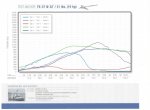
Yes, it is a poor bottom. Popular place, none the less. A modern 45# anchor good for perhaps 250 pounds on the average.

Fortress 32 Anchor Test.jpg

Yup, Fortress is better. But look at the setting distances on both. 30-80 feet. And what about wind shifts? Unless you have a ton of power to set it, they can come out on tide reversals, which means you are setting 2 anyway. I'd still set a second, to stabilize the Fortress.
 
Last edited:
I fail to see why suddenly simply becuase they are used in a pair they should suddenly become prone to dragging, when many use the same anchors singly in similar winds and they do not drag.

Jonathan

Because if there is a steady pull on both anchors the vector chart shows that load increases exponentially once spread exceeds 130deg, and in the extreme, almost unachievable 175deg spread the load is increased by over ten times on each anchor, but only when both are loaded. Of course in such a case you would probably just drag them both until they close together and the loads reach manageable levels.
In fact, the boat will range from one anchor to the other and if both are adequate there may be no problem, except that at the point where the boat swaps from one to the other both are loaded and if the spread is sufficient, over 120degs, load on each increases and is more than the boat itself pulls.
 
We frequently anchor to a 15 kg Rocna and a Fortress FX16 in a V, aiming for between 60 and 90 degrees. I have yet to see the anchor loading divided equally between both for more than a nanosecond as the boat alternately yaws between the one and the other. Far from leading to dragging, I believe firmly that the repeated loading and unloading cycle causes each anchor to bed more deeply. This differs from the situation where all the yaw acts upon a single anchor, where I have seen the shank being pulled from one side to another, unlike the situation with two anchors where they remain pretty much static. We do not use two anchors to increase the holding power of the anchors, which are both perfectly adequate for our boat, but to cut down the yawing and make life aboard more comfortable.

Photos show a little study carried out last year. The Fortress was set by motoring the boat upwind, rather than by dinghy as we normally do. It seems not to have bedded itself quite as well as usual but remained like this for about 24 hours.
P7160063_zps7z6yyjuj.jpg

P7150038_zpsatxnlk21.jpg

P7110029_zpsokbupmkk.jpg
 
......... but to cut down the yawing and make life aboard more comfortable.
Have you (or anyone) experimented with a drogue off the bow hoping for the same results ?

This site is behind a Paywall unfortunately so most will be hidden..
https://www.morganscloud.com/2015/02/23/stop-swinging-around/

But the conclusion was favorable..


"As I write this, we are sitting through winds of 30+ knots with the Mark-III version attached, we’re hardly sheering around at all. Pèlerin is lying as quietly as can be imagined, given the conditions.
I know from experience that this device works even better in stronger winds, so I’m really pleased with the result. The sole change we made beyond the Mark II was to have a sailmaker stitch in a wire mouth to the drogue to keep it permanently open, and the result is…perfect."


Drogue-and-kit-700x466.jpg


Certainly sounds worth investigating.
 
The only time I have needed to deploy 2 anchors in a V was when chartering in Sardinia. The wind got up and we went for some shelter in a small sandy bay which was deserted. The anchors were pretty poor and another yacht decided to come in and anchor directly behind us. We noticed that we were dragging on the main anchor, all-be-it slowly and it appeared that it was simply insufficient to hold us, ploughing slowly through the sand. I swam another anchor out and deployed in a V. It helped and certainly reduced our drag so that we were only moving back occasionally and then only very slowly. The other boat was then dragging away from us faster and so the risk appeared less.

In normal circumstances I only use one anchor and since I am a long keeler we sit quite well to it. We have not dragged in conditions far more extreme than the example above and I put this down to an adequately sized modern anchor well set.
 
I've used twin anchors, set at about 90 degrees, to sit out nasty blows on a number of occasions. The bower is a Rocna on all chain rode, the kedge is a Guardian on five metres of chain and then rope. Each anchor is sized to be able to hold the boat without help and we've not experienced any dragging on a either once properly set no matter what the wind speed (so far anyhow....). The reason for setting twin anchors is both to reduce yaw (which is does quite well) and for the sake of keeping SWMBO happy, as she is convinced that if one anchor's OK, the two must be even better. I've sat out winds in excess of 50 knots on two anchors with no 'walking backwards' but have had a much quieter, smoother night than I suspect I might have had on a single anchor.
 
Years ago I found this animated gif on a USA sailing association web site. FWIW.


image hosting no sign up

Safe anchoring,
Brian

Hi Brian, That is our less preferred method because it is quite difficult to judge where the second anchor needs to be dropped, even in the crystal-clear waters of Greece. Rowing the kedge out in the dinghy is our No.1 method, as the rode length is known and the drop position/angle can be judged by crew on the foredeck. Regards, Vyv
 
Hi Brian, That is our less preferred method because it is quite difficult to judge where the second anchor needs to be dropped, even in the crystal-clear waters of Greece. Rowing the kedge out in the dinghy is our No.1 method, as the rode length is known and the drop position/angle can be judged by crew on the foredeck. Regards, Vyv
Perhaps possible with a hard dinghy but in the one instance I laid out a second anchor I was happy to use the illustrated method, especially single-handed, in the strength of the gale. My inflatable had to be lashed hard up to the stern to stop it acting like a kite and I doubt I could have rowed against the strength of wind and chop, then when reaching the chosen spot handling a heavy anchor before being blown back to the boat.
 
Perhaps possible with a hard dinghy but in the one instance I laid out a second anchor I was happy to use the illustrated method, especially single-handed, in the strength of the gale. My inflatable had to be lashed hard up to the stern to stop it acting like a kite and I doubt I could have rowed against the strength of wind and chop, then when reaching the chosen spot handling a heavy anchor before being blown back to the boat.

We have never had a hard dinghy. I have rowed my anchor out in a lot of wind but have a small modification that makes it somewhat easier to lay the anchor. A cleat on the inside of the dinghy transom holds the rode, with the anchor in the water. It is possible to trip the rode while still rowing, avoiding the usual problem of being blown back towards the yacht.
 
Brian's method works well if you recorded exactly, on your GPS, where you dropped the first anchor or you have been sitting at anchor and have a plot of how you are laying and can work out where the anchor is. We, like Vyv, prefer laying with the dinghy (folding dinghy), row by hand, as I like the exercise and I think its a more accurate method of laying, its not difficult and - other than fishing what else are you doing when the wind is going to pick up.


But other than setting anchors in a 'V', we tend to set at 60 degrees rather than 90 degrees, we do not set 2 anchors. We have never tried any form of tandem nor a bahamian moor. The tandem seems overly complex and a 'V' is easier, each of our anchors by itself is sufficient but one anchor or a tandem will not solve veering. A bahamian moor is said to be good for tidal anchorages but again we have never felt the need, one anchor has always been sufficient. I would not want to pontificate with out any application knowledge - but would value actual user experiences (of when/where they have found tandem/bahamian advantageous.

The only other situation we find is in tight or deep anchorages and we might then deploy 1 or 2 anchors and lines ashore so as to immobilise the yacht. This frees up space in the anchorage for other yachts or stops you hitting the shore. We do not subscribe to the idea you need a big anchor to use a short scope - use shore lines. In fact other than Dashew, who seems to use anchors 3 times the weight specified on anchor sizing charts and engines sufficiently large to set the anchors, I'm not aware of anyone ever anchoring on scopes of less than 3:1 - so think the big anchor/short scope is inapplicable for most yachts.

Jonathan

edit. When we deploy from the dinghy my wife would feed the nylon of the rode, neatly coiled in a milk crate, from the bow of the yacht. I'd have all the chain, currently 15m (specially made 6mm x G80), and anchor (always alloy) in the dinghy. I'd row to the full length of the nylon, 40m, and deploy the lot, quickly (Vyv's method would be better). Its difficult to row with a lot of chain hanging as a long loop behind you, which is why I keep all, or most of, the chain in the dinghy.

If a 40m rode is not enough we would simply drop the yacht back, rather than me try to row 15m of chain out.

Using G70 chain for the spare rode means that the amount you carry (all the time) and deploy from a dinghy (and then retrieve by hand) is much easier (lighter), on the basis you down sized the chain link. Unfortunately the smallest commercially available, currently, is 1/4" or 8mm.

close edit
 
Last edited:
There is no need to row the 2nd out. It can nearly always be placed by moving the boat. (Let out a LOT of rode on the first, then motor up and to one side.) Also, typically the 2nd is laid to protect against an expected shift (Come up on short scope, swing the boat to one side with the engine, lower, then back the other way with both at full scope--this is much easier, I guess, with a cat using twin engines. Real easy.).

I almost never need the dingy, not unless I am doing this because some knuckle head anchored too close to one side.
 
One reason to do it from the dinghy is the exercise involved, too much of cruising is sitting watching the world slowly unfold ahead - rowing the dinghy offsets the sedentary aspect of the passage. Carrying a bicycle also helps (with the sedentary nature of cruising).

But if its raining and/or middle of the night, and we have misjudges the wind - we, or I, wimp out, we work out where we want the second anchor, mark it on the chart plotter, Josephine motors the cat and I deploy. As you say simple - just lacking the physical challenge.

Jonathan
 
I think that deploying a second anchor off of the bow or stern (another topic!) is usually accomplished by using a dinghy, but I have heard reports from sailors who have cursed us when for looming storm conditions, they have deployed one of our lighter-weight, yet monstrously-sized anchors (ex. models 32 lb FX-55 or 47 lb FX-85) using this method.

Its a two person job, or should be.

Be safe,
Brian
 
My first riding sail :) An old foresail, some time at a sewing machine and a few hours splicing fiddling today. Might be breezy Friday, we'll see.

Has no one tried a drogue off the bow? I do have a spare chain sticking out of a hawse pipe at the bow so a vee wouldn't be that hard to sort out, investigating alternatives just seems worth a look.

LM2jjuy.jpg


Ps - whereizit then ;)
 
Last edited:
GHA,

I will try a drogue and let you know. When we measured yawing we found that the yacht and chain could yaw, the chain was off the bottom and the yacht simply swung with the anchor as the centre point. We also found that the yacht itself swung centred,, roughly, on the bow roller. So yacht and chain might swing through 50 degrees, side to side but the yacht itself would 'overswing' (the chain) by a further 12 degrees each side (so 25 total). The drogue, if it has any significant effect, is going to catch the big swing but not the swing at the bow roller.

The problem with yawing and/or sailing at anchor is that when we measured a 75 degree yaw, one extreme to the other, then the yacht was roughly 35 degrees off centre. The is obviously cause by the wind hitting one side of the yacht - and the wind is possibly more than 35 degrees offcentre - you only need to catch the yacht well off centre on one swing and the wind can be hitting the side of the yacht at 90 degrees, - windage needs to take into account length, boom covers etc.

The RN did practice deploying a second anchor so that it just skimmed the seabed, a sort of friction brake. Maybe a drogoe will be a more convenient answer.

Jonathan
 
Perhaps possible with a hard dinghy but in the one instance I laid out a second anchor I was happy to use the illustrated method, especially single-handed, in the strength of the gale. My inflatable had to be lashed hard up to the stern to stop it acting like a kite and I doubt I could have rowed against the strength of wind and chop, then when reaching the chosen spot handling a heavy anchor before being blown back to the boat.

My normal is also to use engine. With one difference from the diagram. After setting the first anchor, I motor around the arc with helm turning away from the set anchor, so that the anchor pulls the bows around.

I fix the dropping point by taking a bearing abeam as I drop the first anchor, and when I reach that bearing again while going around the arc, I drop the kedge and drop back.

This was of necessity - often single handed, the winds usually too strong, and the boat sheering too much to use the dinghy! But that's the Aegean for you.

Incidentally, when I do use the dinghy to set an anchor or take a line, then I use Vyv's trick - the anchor is held outside the boat by a quick release line. Chain (not more than 5m) and rode (anchor end first) are then flaked on the dinghy floor. The bitter end is then cleate to the mother ship. Then I row, and the rope pays itself out, and doesn't have to be towed towed through the water. When you reach the chain, pay it out quickly and drop the anchor. Back to the boat to pull in.
 
Last edited:
The forked moor, or Bahamian moor, is primarily designed to cope with the tendency of most sailboats "sail" from side in winds over 25kts or so.

Salty John has kindly pointed out to me that the Bahamian moor is designed to cope with reversing tidal streams, thus it is the same as the tidal moor, or running moor, using English parlance.

Sorry about that mis-use. I'll try to keep up at the back, here.
 
Top