
Largest mast taken down with an A frame.

ash2020

Well-Known Member
Joined
7 Jun 2010
Messages
849
Location
Fowey, Cornwall
Visit site
I used to use an A frame to take down the mast on my Jaguar 23, quite straightforward. Now I have a Varne 27 with a heavier and taller mast. Would you attempt this with an A frame?
I can't bring myself to pay nearly £300 for unstepping/stepping.
Thanks.
 
Joys of a bigger boat - on the margins, but I guess possible with a tabernacle and a well engineered A frame. I have dropped a 33' wooden mat in a tabernacle without an A frame on a couple of occasions, but would not do it again through choice. Only worth investing in the gear if you drop the mast every year - otherwise bite the bullet and pay for the typical once every 10 years or so you might need to do it £150 each way is on the lower end of the going rates.
 
Yes no problem re size of the mast provided you have good gear. I presume here by A frame you mean gin pole (x2) to improve angle of pull of the tackle to the bow. Just make sure you get the sideways sway controlled. Around here much bigger boats with 70ft mast regularly lower the mast on a hinged base or tabernacle while under way to traverse under low bridges. The biggest problem is sway control in wake of bigger mobos.
Interesting another lowering method has some popularity with fractional rig boats. Here 2 poles are hinged to the side deck about halfway down the cockpit. They come together at a special car that runs up the mast track. Typically starting a meter or so above the gooseneck. This car is controlled by down haul and topping lift sop that as the car is pulled up (or rises of it's own accord under downhaul control) the mast goes back ward (with forestay disconnected) The mast will typically drop to about 30 degrees from horizontal. (enough for bridges with 25ft clearance) This method keeps the mast siideways sway tightly controlled though I think if I used it I would also have gin pole and tackle on forestay. (belt and braces)
Note the value of this method is where cap shrouds chain plates are aft abeam the mast so shrouds go loose as soon as mast goes backwards. For a typical mast head rig chain plates are extended up so the top pivot point is in line with mast step hinge pin. Thus cap shrouds stay tight all the way down to horizontal controlling mast sway.
Note also with 27fter the mast will be heavy to man handle from the mast support at the transom down and forward to a point where access to mast top is easy. need a few helpers. good luck be careful . ol'will
 
I presume that by A frame you mean a vertical A frame which will initially lift the mast off its step.
There is a You Tube video of an A frame being used to lower the mast on a Catalina 27. Search You Tube for "Dropping the mast". I think you would have no problems. I have done it several times with a 9.4m non-tapered mast. Much easier than trying to use a tabernacle and gin pole.
 
Last edited:
The same You Tube search "Dropping the mast" should also bring up Sailing Triteia dropping the 10.6m mast of their Alberg 30 using an A frame.
 
Yes no problem re size of the mast provided you have good gear. I presume here by A frame you mean gin pole (x2) to improve angle of pull of the tackle to the bow. Just make sure you get the sideways sway controlled. Around here much bigger boats with 70ft mast regularly lower the mast on a hinged base or tabernacle while under way to traverse under low bridges. The biggest problem is sway control in wake of bigger mobos.
Interesting another lowering method has some popularity with fractional rig boats. Here 2 poles are hinged to the side deck about halfway down the cockpit. They come together at a special car that runs up the mast track. Typically starting a meter or so above the gooseneck. This car is controlled by down haul and topping lift sop that as the car is pulled up (or rises of it's own accord under downhaul control) the mast goes back ward (with forestay disconnected) The mast will typically drop to about 30 degrees from horizontal. (enough for bridges with 25ft clearance) This method keeps the mast siideways sway tightly controlled though I think if I used it I would also have gin pole and tackle on forestay. (belt and braces)
Note the value of this method is where cap shrouds chain plates are aft abeam the mast so shrouds go loose as soon as mast goes backwards. For a typical mast head rig chain plates are extended up so the top pivot point is in line with mast step hinge pin. Thus cap shrouds stay tight all the way down to horizontal controlling mast sway.
Note also with 27fter the mast will be heavy to man handle from the mast support at the transom down and forward to a point where access to mast top is easy. need a few helpers. good luck be careful . ol'will
That sounds like an interesting way of doing it. I like the slide idea because of the good sideways control. I was thinking of making up some side stays and brackets in line with the mast hinge, but I already have some long aluminium poles which would suit the slide idea.
 
I presume that by A frame you mean a vertical A frame which will initially lift the mast off its step.
There is a You Tube video of an A frame being used to lower the mast on a Catalina 27. Search You Tube for "Dropping the mast". I think you would have no problems. I have done it several times with a 9.4m non-tapered mast. Much easier than trying to use a tabernacle and gin pole.
Yes, I have two long aluminium poles which I used on my Jag 23, attached to the base of stanchions and taking the bottom of the forestay where they meet. I'm not a fan of gin poles.
 
Yes, I have two long aluminium poles which I used on my Jag 23, attached to the base of stanchions and taking the bottom of the forestay where they meet. I'm not a fan of gin poles.

I'm another Jaguar 23 owner and would be interested in further details of the method you used for mast lowering (and raising).
 
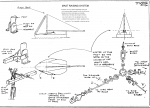
You may find this system useful which was devised by Colin Haines for the Etap 22i. It uses dummy shrouds to stop any sideways sway when it is in use, and I find it very easy and safe to use - maybe it could be adapted for your larger vessel.
 

Attachments

  • Etap 22i Mast raising system - C Haines.PNG
    Etap 22i Mast raising system - C Haines.PNG
    82 KB · Views: 89
Nope. if your unsure or a little apprehensive just get someone to do it properly. If it goes wrong your be buying a new mast and thats not the worst case scenario.

Steveeasy
 
Nope. if your unsure or a little apprehensive just get someone to do it properly. If it goes wrong your be buying a new mast and thats not the worst case scenario.

Steveeasy

Agreed. That's why I'm hoping to get some information from someone who has actually done the job on the same type of boat.
 
I used a similar system to the coveman's, each season, on a Marieholm 26 footer so you should be ok ash. I found the forward tackle was not needed if you have a couple of hands pushing the mast up and one winching in the cockpit. Raising it calls for a certain amount of elan, and it can get scary the last 15 deg to the vertical - if you can pre attach and contrive for the shrouds and backstay to come tight at 90 deg it really helps your heart rate.

Here are the boys of late lamented; Second Chance Sailing with a few pointers:


I think they had three goes and got very close.

.
 
My 30 footer with a 13m mast has a hinged deck plate. The mast supplier told me that the hinge was for lowering. Swept back spreaders. Never had the courage to use anything other than a crane.
 
I regularly dropped and raised the 30’ mast on my Invicta 26 at the start and end of each season using an ‘A’ frame.
The ‘A’ frame was originally marketed by Compass Marine and is made up of aluminium tube sections enabling the unit to be carried in a car when fully dismantled.
It was possible to raise and.lower the mast single handed using a block an tackle, but having a couple of crew around to assist makes the job a lot easier. A sling is led around the mast at the spreader point, a vertical lift of a few inches releases the mast from the mast step then as the mast is lowered the balance is such that the mast gently swings to a horizontal position as it is lowered.
I don’t know if this product is still available.
 
The compass marine a frame is no longer available, I’ve used one twice to step ours, at 11.5 metres just possible as the a frame is about 6m to blocks, you need to keep the lift point tight, you do need to keep some weight on the base of the mast, the problem we find is keeping the foil out of the way
 
I used a similar system to the coveman's, each season, on a Marieholm 26 footer so you should be ok ash. I found the forward tackle was not needed if you have a couple of hands pushing the mast up and one winching in the cockpit. Raising it calls for a certain amount of elan, and it can get scary the last 15 deg to the vertical - if you can pre attach and contrive for the shrouds and backstay to come tight at 90 deg it really helps your heart rate.

Here are the boys of late lamented; Second Chance Sailing with a few pointers:


I think they had three goes and got very close.

.
They were lucky to get three goes. It was only a tiddler after all. not sure who let go.

Steveeasy
 
The compass marine a frame is no longer available, I’ve used one twice to step ours, at 11.5 metres just possible as the a frame is about 6m to blocks, you need to keep the lift point tight, you do need to keep some weight on the base of the mast, the problem we find is keeping the foil out of the way

I should have mentioned that my Invicta was still hank on foresails, so keeping the foil out the way was not a problem, my current Sadler 25 had roller refine genoa so I do now have the extra difficulty of keeping the foil out of the way, it’s possible but does require the help of extra hands.
 
Nice /horrible video of mast raising. Note the guy at the back with a pole from ground. You have to be careful with a mast head rig type mast that it can become top heavy when settled in to support at stern. Makes it tricky to disconnect hinge. needs as in the video someone astern the boat with a support to near the top of the mast.
Note also in the video that they would have had an easier time of raising with a higher stern mast support. For my TS I have a pole with 2 mast support loops one high one lower. Note also how the mast base/hinge is the fragile part. Fortunate or hew would have broken the mast at middle.
It is not clear from the video just why the mast came down crash. You do need a robust tackle system and attachments. You need a method of stabilising the mast on the centre line. Yes the auxiliary stay wires can be useful when you have aft swept spreaders and chain plates. Or have some way of tensioning the cap shrouds forward is they loosen. (I have seen these aux stays on a Macgreggor 26)
This post brings up a language barrier problem. I assumed A frame meant 2 poles forming a 2 legged gin pole to improve angle of pull on forestay or halyard to bow. Lakesailer long ago advocated an A frame which is long enough to reach above the centre of gravity of the mast (plus space for tackle) set up central to the boat so mast can be bodily lifted up horizontally then swung manually to vertical and lowered in to place. For a big mast this needs very long A frame. It is however the only way to fit a keel stepped mast without a crane. (but needs even longer A frame) ol'will
 
I used to use an A frame to take down the mast on my Jaguar 23, quite straightforward. Now I have a Varne 27 with a heavier and taller mast. Would you attempt this with an A frame?
I can't bring myself to pay nearly £300 for unstepping/stepping.
Thanks.
Please make sure that your insurance company are happy to cover you, just incase something goes badly wrong.
 
Top