
lapping blakes seacocks

When you reassemble, only light clamping pressure is required as the taper plug will easily lock up. It can be the difference between of 1/8" turn between finger tip operation and lock up. After getting the clamping pressure correct, be careful with the lock nuts, as they may just turn the bolt a bit more and lock up the cone again. Very little pressure is needed to keep the cone from passing water.
True.

Also, I find that problem can be avoided by putting the locknut in the position shown here:
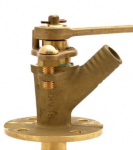
1617169163588.png

Seacock 3/4" (blakesandtaylors.co.uk)
 
Part of my laying up routine (on the hard obviously) is to always disassemble my Blakes seacocks at the end of the season - that way they don't seize up over winter. Bit late for advice if your seacocks have seized but worth remembering in future.
As others have said don't lap with a 360 degree motion use around 90 to 180 and always remember to give it a good cleanout afterwards. You dodn't want any traces of grinding paste left. and that includes up the pipes, before you reassemble for use.
 
I did all 17 of our Blakes seacocks last September. A very therapeutic most of the day when she was out of the water.
Most of the advice here is sound, but it distills down to:
  • Lapping is to match the cone to the seat - so don't put a cone in a different seacock after you have lapped it or you may just as well open a beer and save your time ;-)
  • Don't go round in circles when lapping, if in doubt check out some valve lapping videos on YT, but it's a "back & forth" motion - bonus points for lifting and rotating every few goes.
  • Blakes grease is expensive, but lasts a lifetime. Whether you feel that justifies it is up to you (I did).
  • If lapped correctly, you will only need to tighten the screws finger-tight (with two fingers). I opted to leave our looser, then work the seacocks a few times when she was back in the water, doing a final tighten on the ones that needed it. All seacocks are dry as a bone now and only need one finger to operate - it's a big difference if you are used to ball valves.
  • Really, really, really clean off the grinding paste thoroughly. I went through an entire roll of shop rags and two spray cans of brake & clutch cleaner when doing ours. The slightest piece of grinding paste left will wear down the valve every time it is used - and it won't wash out as it is oil-based. Make sure you remove any traces from the ports too.
  • If you have any that are seized, a long extension from a socket set works very well - 3/8" fits nicely in the smaller valves, and 1/2" for the larger ones. Loosen off the pinch bolts, but don't remove them entirely so the cone doesn't fly out, then two or three good hits with a lump hammer on the end of the extension will do the job. Don't tickle it - you need a short, sharp shock to "break" the taper lock.
 
Does anyone know: What size hole in the hull is occupied by a Blakes 3/4" heads inlet seacock?

I'm going to replace it with an ASAP DZR through-hull, ball-valve and hose tail.
Hopefully the DZR is the same or greater diameter; because if it is narrower, there will be a fair bit of wood butchery to make narrower the holes in the hull planking and internal pad.

I am replacing it because the access is impossible for lapping it in, so it permanently weeps into the bilges and into the heads.
 
Does anyone know: What size hole in the hull is occupied by a Blakes 3/4" heads inlet seacock?

I'm going to replace it with an ASAP DZR through-hull, ball-valve and hose tail.
Hopefully the DZR is the same or greater diameter; because if it is narrower, there will be a fair bit of wood butchery to make narrower the holes in the hull planking and internal pad.

I am replacing it because the access is impossible for lapping it in, so it permanently weeps into the bilges and into the heads.

I don't know, sorry.

But once you find out, if you need a larger fitting, just fit a larger through-hull and valve, then reduce down to the pipe size on the hose tail as you can buy those with different thread and hose sizes. I.e - could fit a 1" through hull & valve, then a 1" BSP to 3/4" hose tail - simples.
 
I don't know, sorry.

But once you find out, if you need a larger fitting, just fit a larger through-hull and valve, then reduce down to the pipe size on the hose tail as you can buy those with different thread and hose sizes. I.e - could fit a 1" through hull & valve, then a 1" BSP to 3/4" hose tail - simples.
I should have thought of that :) thanks!
 
Top