
Laminated frames

Joined
21 Aug 2014
Messages
30
Location
Wadhurst, East Sussex
Visit site
As I was cutting templates out of some skinny ply for the replacement frames on my 28" Gaff Cutter I got to thinking... (I know, a dangerous activity! :) But I got to thinking, if I cut enough frame shapes out of, say 18mm marine ply and laminated them together, would the result be as strong as laminating in the 'traditional' way?
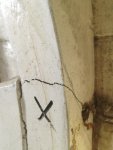
 
Hi burgundyben, This is my first (and probably last) restoration so I don't have enough experience to know whether that would be an issue. My original plan was to laminate Oak frames, do you think the same stiffness issue would occur? The originals are sawn Oak and have cracked alarmingly in several places where the grain is very short.IMG_0217.jpg
 
By laminating in the 'traditional way', do you mean laminating from strips of wood, instead of ply -- as you might do a tiller, for instance? Ply is only laminated strips of wood anyway don't forget, with the strips running at right angles to each other instead of all in the same direction. I would imagine that laminated ply would be stronger than laminated unidirectional timber.

ETA -- Ah yes, I see you do. Building up a thick curved piece from thin laminations is a recognised way of avoid that splitting problem you have. (My conclusion about laminated ply remains unchanged.)

Mike
 
Last edited:
To be honest I would expect a laminated plywood frame to be less strong than a steam bent or laminated oak frame of the same size as in plywood you will have half the thickness of the frame with the grain running across the frame instead of in line with the frame. A strip of thick plywood (laminated or not) is quite easy to break in comparison to the same strip of solid or laminated oak. In answer to the question I would not use laminated plywood strips. If you are concerned about sudden hard spots caused by doubling a frame over an existing frame for instance, just taper the ends of the new section gradually and any hard spot is almost eradicated. What you could do in repairing the broken frame in the photo is to cut a long scarf starting at the base of the crack both up and down the frame with the cut tapering out about three planks from the break and having made a section of laminated or sawn or steamed replacement section of the correct shape beforehand including the long tapered scarf, just glue & fasten this in place using the original fastening holes with perhaps an additional one or two in the middle of the planks. A minimum of three fastenings per scarf, but 5 is better, good glue & an accurate scarf and that will be as strong as the original frame without any hard spots. Also invisible if done well.
John Lilley
 
To be honest I would expect a laminated plywood frame to be less strong than a steam bent or laminated oak frame of the same size as in plywood you will have half the thickness of the frame with the grain running across the frame instead of in line with the frame. A strip of thick plywood (laminated or not) is quite easy to break in comparison to the same strip of solid or laminated oak. In answer to the question I would not use laminated plywood strips. If you are concerned about sudden hard spots caused by doubling a frame over an existing frame for instance, just taper the ends of the new section gradually and any hard spot is almost eradicated. What you could do in repairing the broken frame in the photo is to cut a long scarf starting at the base of the crack both up and down the frame with the cut tapering out about three planks from the break and having made a section of laminated or sawn or steamed replacement section of the correct shape beforehand including the long tapered scarf, just glue & fasten this in place using the original fastening holes with perhaps an additional one or two in the middle of the planks. A minimum of three fastenings per scarf, but 5 is better, good glue & an accurate scarf and that will be as strong as the original frame without any hard spots. Also invisible if done well.
John Lilley

I doubt anybody could hope for a more comprehensive response than that.
 
Hh'mmm, maybe I should revise that. I think I tend to agree with John on this after all, for this particular case.

Having said that, I do think that laminated ply, consisting as it does of many laminations both across and parallel to any load, is still a very strong material.

Mike
 
Months have passed since beginning this thread and I haven't actually found the time to make these frames! Still, New Year, new resolution to get a move on! I have another question for any experienced laminators out there.... Sawing the thin strips on a table saw means wasting almost one lamination per cut due the the thickness of the blade. I'm wondering whether the rougher but much thinner bandsaw cut would be ok? I watched a tutorial that recommended, sawing, then running each piece through a thicknesser which whilst it produced wonderfully smooth laminates and consequently very thin glue lines, does seem incredibly wasteful... Does anyone have experience of laminating straight from the bandsaw? Does the irregularity of the cut cause issues lining up the laminates when glueing? Given how strong modern glues are, I'm tending towards the opinion that as long as there is enough glue and no dry areas it should be Ok but I'm happy to be advised. :) Aesthetics are not really a problem here as the frames will all be painted.
Jonnie
www.justflamingo.com
 
Last edited:
One method is to bandsaw a laminate, then pass the remaining stock over the planer part of the planer/thicknesser to clean up the cut. Repeat. This gives you one smooth and one slightly corrugated joint face, with little loss of material, as long as your bandsaw blade is stable and you use a long fence, this works pretty well. I assume you are using époxy, so any slight inconsistancies will be filled.
I tried a thin kerf bench saw blade from Axminster, but found it a bit unstable if the grain was 'wiggly' as in iroko.

As above, I wouldn't use ply. Half the laminates not helping and exposed endgrain.
 
Last edited:
Thanks Graham and DownWest, I don't have a planer but I'm going to try a fine blade this weekend, the Oak is fairly clean and straight grained so hopefully there wont be too much wiggle. I'll let you know how I get on.
Jonnie
 
Cutting thin accurate sections on a bandsaw is fine with a really sharp & new wide blade (1/2" plus), however after a while the blade is apt to wander with the grain of the timber and more wasteful than a circular saw by the time it is cleaned up.
There are occasionally some builders who will use a section of oak, slightly oversized, & run several bandsaw cuts along the length all more or less parallel but not full length in order to be able to bend the length into required position without the need for individual laminates. This method has obvious benefits although much depends on the shape of the bend and the ease of gluing the loose leaves. Once fully fastened with nails & roves (not screws in this case) this could be an easier alternative depending on how well it is finished.

John
 
Top