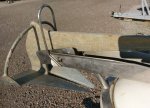
Knox Anchor Fitting on Bow Roller

Do you find the swivel roller help bringing the anchor back onboard and does it self-launch? My Bruce gives the windlass a fair jolt as the shank tries to negotiate the 90 degree direction change as the shank arrives at the single roller I have.

my knox runs on / off the swivel roller well
had a bruce on here before, knox fits fine and does not touch the hull either
the swivel roller is not fitted the correct way, longer bit forward
the knox is bigger than the bruce so it holds better :)View attachment 109283
 
Def self launches with the swivel / hinge
spelling mistake in my post, the swivel is noW fitted the correct way, longer bit forwards
this makes the recovery way smoother and less stressful on the windlass
have a shackle only on the end, over half the time it twists the right way if not I just let it go out a bit and try again
 
Why?

Jonathan

It let me down on one occasion with a linear reversal of current flow. The anchor failed to re-set and had I not been aboard at the time, it might have ended badly. Also when I bought it I thought it had a reputation for setting well on a short scope. I didn't find that to be the case. However, when properly set in a decent substrate, it held very well indeed, Although I went back to the Bruce, I don't necessarily think that was any better. Both were problematic on occasions.
 
Simon's swivel (or rotating) roller and rollers like it are very successful. As Simon says they remove the snatch load that occurs when the shackle and or the shank arrive at the roller itself as in Simon's design the change from chain to shank occurs when the rotating part is vertical and there is no snatch. I suspect they are not more common for the simple reason they add an extra cost for a boat builder. We overcome the snatch when the shank arrives at the bow roller as we would retrieve at the bow, foot switches, and manually house the anchor (ours only weight 8kg) for the last metre of chain. We have to be at the bow anyway as once retrieved we then need to manually secure it, using a chain hook and dyneema strop. Hand retrieval is not going to be so easy if you have a big and/or oversized anchor

Jonathan
 
It let me down on one occasion with a linear reversal of current flow. The anchor failed to re-set and had I not been aboard at the time, it might have ended badly. Also when I bought it I thought it had a reputation for setting well on a short scope. I didn't find that to be the case. However, when properly set in a decent substrate, it held very well indeed, Although I went back to the Bruce, I don't necessarily think that was any better. Both were problematic on occasions.

I don't believe re-setting after a reversal of tide or wind is something to which a Knox anchor is unusually sensitive. When you think it through:- when you originally deploy you use whatever scope you might desire and then you power set, maybe take transits and possibly set an anchor alarm. During re-setting in a change of tension direction we expect the anchor to conduct all these checks (or realistically these checks are not done at all). if you feel the need to check, touch the chain to see if the anchor is moving over the seabed, check transits, set an anchor position, set the alarm - then you should really be doing this at every tide change.

Normally the harder you power set the more likely you are to compact the seabed into a clump in the fluke of a concave anchor - and then the anchor will not re-set until such time that the clod of seabed washes out. The slot in a Knox is there to minimise the amount of seabed that is compacted into the fluke. Knox Anchors actually tested what happened when they closed the slot in the fluke, proving to themselves that the slot was advantageous. Slotted flukes are seen on Danforth, SARCA, Viking - they are there for a reason (and sometimes more than one reason)

What would be interesting to know is - why did the Knox not re-set.

Whereas fear the worst, losing your yacht, is a sobering lesson - but I might give the Knox at least another chance - being cognisant of the issue.

The problem is not new, Morgans Cloud (aka AAC), Practical Sailor and most recently the Panope videos have all looked at the issue - and come to the exact same conclusions

Anchor Resetting Tests - Practical Sailor

All anchors will return a less the optimum hold at short scope. If you want to use a short scope (and its not something that would be recommended) then set the anchor at a longer, or normal scope, set hard (and then the anchor will be deep set) - then reduce the scope. If your anchor is too big - you will never deep set it is well as an anchor of the recommended size. Once you have reduced the scope to what you desire - then apply a snubber - at least deck length and for a 35' yacht 10mm nylon. The snubber will offer a replacement to the loss of catenary through using a short scope. (10m x 10mm nylon offers the same advantage as the catenary offered by 30m x 10mm chain at a 5:1 scope - details will be available in, I think its June 2021 YM - order your issue now :) ).

As you point out - no anchor is perfect.

As long as you aware of the issues and don't ignore the weaknesses you are a good way toward having a decent night's sleep.

Jonathan
 
I don't believe re-setting after a reversal of tide or wind is something to which a Knox anchor is unusually sensitive.

The problem is not new, Morgans Cloud (aka AAC), Practical Sailor and most recently the Panope videos have all looked at the issue - and come to the exact same conclusions

Anchor Resetting Tests - Practical Sailor


Jonathan

Thanks - I hadn't seen that Practical Sailor test. I had read the Morgan's Cloud report. I have kept the Knox, and I don't mean to denigrate it's good points. At the risk of a little thread drift, I'm in the process of specifying gear for a new boat and have decided a Spade will the the primary bower, but I'll carry the Knox as a spare. My experience of the Knox is probably more to do with my unrealistic expectation of it than of the anchor itself. It certainly seemed a well-made item.
 
why set any anchor on a scope that is too short ?
always going to be less secure :unsure:

I agree completely - it's inviting problems. My point was that I had (perhaps mistakenly) understood the Knox to be capable of setting well with a scope that was shorter than some other anchors. If so, that has obvious advantages for anchoring in physically restricted locations.
 
I replaced my Delta with a Knox 27kg a couple of years ago. Geoff at Knox was very helpful with all questions including sizes and how to make a template. On my Moody 44 it's fine so went ahead with the purchase. When on the roller properly it doesn't self launch, needs a light nudge to drop forward on the roller.
Very pleased with it overall. Many nights at anchor or in cross winds when stern to a wall with anchor out. Worst occasion at anchor was a night when wind didn't go below 35 kn and gusting 55kn. We didn't move over a mud bottom but did have to keep a lookout for those dragging downwind past us
 
Top