
Knots at the ends of ropes ?

Figure of eight knots at the free ends of halyards ?

  • Yes, I have fo8 knots at the free ends of halyards

    Votes: 129 87.8%
  • No, I don't do that

    Votes: 18 12.2%

  • Total voters
    147
Other halyards and sheets figure eights but spinnakers should not have stoppers, I think the article is wrong to the point of being dangerous saying that you want stoppers in the spinnaker guy. The loads are huge and there is no point in having a stopper in the guy if there isn't one on the sheet as they run together.

Imagine this situation as you drag towards the shore trying to release a stopper, if it jams yes you could get a knife, but do you really want to be trying to hang on get a knife out and use it? when simply releasing a rope off a winch or letting a halyard jammer go would solve the problem.

Believe me when you want to let a kite go you want it to happen very quickly. I've been in worse situations than this.
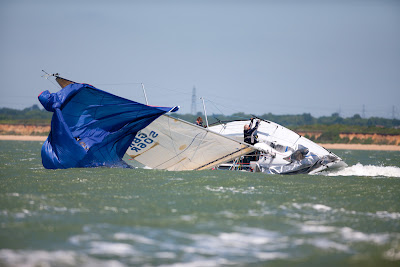
unsafe+again+3.jpg
 
but spinnakers should not have stoppers, I think the article is wrong to the point of being dangerous saying that you want stoppers in the spinnaker guy. .....

You have to put his article in context: single handed sailing with a spinnaker and the use of a slip knot, slippery hitch, which only needs a sharp pull to release it. He states that both the guy and sheet should be free to run and it's the very end of the guy that he advises the slip knot should be tied. The guy is the line that is likely to get pulled out the block when dropping the spinnaker as it has to travel up and down the boat as well as outboard as the pole end clew flies out in the drop. The single hander doesn't have a crew to manage the sheet and guy as the spinnaker is dropped. It makes sense to me and his tips are formed from experience.
 
Every single control line on my boat is made off with a stop knot
I see no point in loosing sheets through blocks which would be difficult or time consuming in a panic situation to re threadle & could be incorrectly threadled

I see no point in letting a halliard run through the mast
Sails can be controlled without loosing the tails of sheets etc
Of course one does make sure that all lines are long enough for the job. Ie spinnaker sheets will go right round the boat so sails can be recovered ok
Spinnaker halliard is plenty long enough
I have a permanently rigged MOB halliard in flourescent orange. This is deployed from a winch to hoist MOB on board. It has a plastic golf ball sewn in the mob end 10 metres from the end so if the crew at the winch starts pulling before the man is hooked the end will not go flying too far up the mast for the crew to reach. The winch end has a plastic ball knotted & whipped so that it can be released but the crew can let the end go knowing he can snatch it in a second & not have to worry about loosing it through the blocks& up the mast
The number of time that i have seen more problems arising from a simple one because stop knots have been fitted has taught me to do things my way

However, to each his own & if it suits you not to put them in the so be it
 
Last edited:
Other halyards and sheets figure eights but spinnakers should not have stoppers, I think the article is wrong to the point of being dangerous saying that you want stoppers in the spinnaker guy. The loads are huge and there is no point in having a stopper in the guy if there isn't one on the sheet as they run together.

Imagine this situation as you drag towards the shore trying to release a stopper, if it jams yes you could get a knife, but do you really want to be trying to hang on get a knife out and use it? when simply releasing a rope off a winch or letting a halyard jammer go would solve the problem.

Believe me when you want to let a kite go you want it to happen very quickly. I've been in worse situations than this.

unsafe+again+3.jpg

In the picture i would suspect that the vang & mainsheet have not been released. An empty flogging spinnaker is not enough to pull that boat over. If sheets were released & ran out with no stop knots the spinnaker could not be got under control again easily. The more ropes available to do this the better
The lack of knots or otherwise did not cause the broach but lost sheets will make it harder to resolve
 
One bloke I sailed with made off the free end of the kite sheets on the mooring cleats. Theory was you could release them under load if you wanted, but the would not come undone of their own accord.
If you are prepared to run the guy during a drop, it can be shorter. Less rope in the cockpit is always good, especially when you have to buy the dyneema.

Main thing is to have a plan, and to have practiced.
 
In the picture i would suspect that the vang & mainsheet have not been released. An empty flogging spinnaker is not enough to pull that boat over. If sheets were released & ran out with no stop knots the spinnaker could not be got under control again easily. The more ropes available to do this the better
The lack of knots or otherwise did not cause the broach but lost sheets will make it harder to resolve

The vang is the key.
Some dayboats will flood and sink at that point.
The mainsheet goes slack when the clew is well in the water.
 
One bloke I sailed with made off the free end of the kite sheets on the mooring cleats. Theory was you could release them under load if you wanted, but the would not come undone of their own accord.

That is another good approach, that I had not thought of.

The major problem is that those who have not got enough well-guided experience are apprehensive of any coloured sail at the front.

And I really don't want to come across as a know all on this subject.

Once a few facts are accepted, flying them is completely safe. If the halyard is long enough to hoist from a little further away from the hoist and drop positions, a figure 8 is fine. You don't let the halyard run
until the sail is under control. If you do, the centre of effort of the sail moves out and increases the heeling force.

Thee sheets and guys must be twice the 'circumference' of the boat. When dropping the sail the gut is freed - gently until the pole is approaching the forestay. It is then allowed to run unresisted until completely depowered. That will not even be close to the total length of a correct length guy. The sheet is only eased if the clew is aft of the point of the take down (hatch etc.).

The exceptions to the above all involve 'something else' shredded sail, dreadful wrap (avoidable) or failure of one of the three ropes.

I really should do a free clip of 'how to'. One day when health and finance permit...

But if your dim and distant recalls a sequence in 'Howards' Way' (last series?) when the spi went up in 20kts (rather beautifully), that was me, effectively single-handed, and I only had to do it half a dozen times in half an hour to satisfy the director in an effing expensive helicopter. Got a bit sweaty, but all were text book!
 
I follow Andrew Evans advise on putting a slip knot in the guy and halyard WHEN single handing, too many opportunities for something to run away when you least want it to, one person handling all these lines and things can go wrong. On the other hand, when single handing, could forget all about the spinnaker, but where is the fun in that.

BTW, A Happy Christmas from the middle of the North Sea, thankfully quietened down since Saturday
 
I just found this post, so you can get a reply direct from the horses mouth.

Yes, I have stopper knots in all my halyards. I can see no safety reason to not have them. I use a normal half-hitch, not figure 8 knots. And I may even have them sewn closed with a stitch of thread. The "cost" of losing the halyard through the mast is pretty high, in terms of the work required to replace it. If I ever needed too, I could always cut the halyard with a knife. But I know from experience that I can drag a fully loaded spinnaker in the water behind the boat.

For my spinnaker sheets, I use a slip knot at the end of the sheet and guy. Most people think that it is unsafe to use a knot at the ends because of the need to completely release them in emergency situations. I agree with this thought, and I have been in very bad situations. I use the slip knot because I can just pull the tail and release the knot when it jams in the snatch block on my rail.

When singlehanding it is very important to have the slip knots in place because there will be times when it is impossible to manage the sheets and the tiller at the same time, and one or the other will get away from you.

Only once have I needed to cut a sheet to release it. This was not caused by the slip knots. Rather the guy became wrapped around one of the stanchions in very high winds. It would not release and I needed to get the pressure off the spinnaker to take it down. So I cut the guy with my knife.

Andy
 
I just found this post, so you can get a reply direct from the horses mouth.
Hello Andy, nice to hear from you directly.

I think I have understood your reasoning behind the slip knots and I will try this when I pluck up courage to fly the spinnaker on my boat.

Did you see my other question on spinnaker foreguy/downhauls btw ? That was also based on your spi handling setup and I am interested to know your reasons for not having an afterguy on the spi pole itself ?

Speaking of your book, it has been a great help to me as a novice sailor, I have had huge numbers of questions for the people on these forums and have read several print books on single handed sailing from Amazon, but really it is your book with it's coherent setups that has helped me the most. I have printed a copy off for reference but tell me, do you have any plans to get it published ? I think it would be worth while and would help it reach a bigger audience.

Regards,

Boo2
 
I had a small boat with a small spiniker I routinly flew single handed or virtualy single handed. ie crew was a 9 yr old.
I never knoted sheet or guy never had a problem as a result. I never thought of using a slip knot. no imagination. I've got no objection to a slip knot.
 
Boo2, thanks for your comments about my book. Have you seen the 3rd edition with a new chapter on how to maintain a winning attitude during long distance races? sfbaysss.org/tipsbook

What about the Russian translation http://parusa.narod.ru/bib/books/aevans/singlehand_ru.pdf

I don't plan to put out a printed edition. I figured that I'd rather get 20,000 copies delivered electronically than 100 copies in paper.
 
Top