Ketch v yawl

.
.
Here's a Swan 55 yawl. Hard to believe designers like Nautor would have needed a mizzen, to correct inherent steering-imbalance...

To be pedantic, Nautor-Swan aren't designers, they're builders.
I've read that one reason for Olin Stevens, the designer, adopting the yawl rig for several early designs was because it gave a rating advantage. Perhaps that applied to his larger Swan designs too.
 
Does Kate ever fly a topsail
Yes.

But very rearly as the winds are generally too high here.

Kate has the flying jib rigged more often.

Not a good pic but anyway:


51392.JPG
 
Masts have got taller, sailcloth holds its shape better at large sizes, winches have acquired multiple speeds and self tailing, hulls can take far higher loads from single high aspect rigs, and headsails will furl and reef instead of being dragged off in a blow and replaced with Nos 2,3, storm, brown underwater..
And the concept of a 'spare' mast and sails for serious cruising has possibly faded with modern comms.
And autopilots and windvane steering take care of helm imbalance.

So in a sense perhaps the justification for breaking up the sailplane into a yawl or ketch and manageable multiple units has reduced...

Do HallbergRassy still offer big ketches?


I think the concept of a spread out low aspect ketch sailplan in a serious blow is as
valid as ever. As is travelling by submarine or 747 over under or around stormy weather
 
Last edited:
I'm wondering whether mizzen-staysails are only made to bespoke order?

I was under the impression that most sails are made to order, albeit for common classes the sailmaker will probably have measurements on file.

I don't think mizzen staysails are particularly complicated sails, so shouldn't be abnormally expensive.

Pete
 
Kate is getting one or these. The 'mast' spar will be 25'0" for later this year.

What an odd topsail. No sheet, and a sort of Cornish yard with a permanent timmynoggy. Planning to hoist it with the mainsail, I presume? I can't see any way of sending it up otherwise, short of someone climbing out along the gaff :eek:

Pete
 
What an odd topsail. No sheet, and a sort of Cornish yard with a permanent timmynoggy. Planning to hoist it with the mainsail, I presume? I can't see any way of sending it up otherwise, short of someone climbing out along the gaff :eek:

Pete

Yep, it is complicated setting it.

There are lots of extra bits of string to hoist and fiddle with.
The bits of string etc are attached before the main is hoisted, especially to the gaff peak.

It can be erected after the main is hoisted.
 
From a sailing pespective the mizzen on a kecth is a working sail giving drive. The mizzen on a yawl is brilliant for manoevering without an engine, you can back and turn the boat. Don Street in his enginless yawl was a master of the art.
 
It can be erected after the main is hoisted.

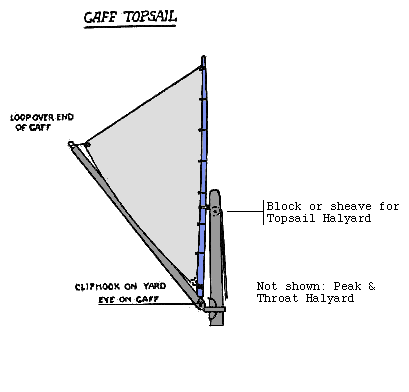
So how do you hook on the "loop over end of gaff"? How do you put the "cliphook on yard" onto the "eye on gaff"? Kate's quite large, so I can imagine you might have a mastheadsman for the latter, but I can't see any way of doing the former except on deck. Seems a very awkward contraption; are you sure the diagram's right?

Pete
 
So how do you hook on the "loop over end of gaff"? How do you put the "cliphook on yard" onto the "eye on gaff"? Kate's quite large, so I can imagine you might have a mastheadsman for the latter, but I can't see any way of doing the former except on deck. Seems a very awkward contraption; are you sure the diagram's right?

Pete

The Diagran is what she will be getting. Basically you will have the sail fixed to the 'mast'. There are two mast hoisting hallyards one to the point where the 'mast' will be positioned and one at the top of the mainmast. There is another line that is threaded through a pulley at the end of the gaff, this sets the sail.

Currently :There are two hallyards, one to the point where the clew (sail base is basically a tied down, tied off at the base of the main mast) and one to the top of the mainmast.
There is another line that is threaded through a pulley at the end of the gaff, this sets the sail.
 
The Diagran is what she will be getting. Basically you will have the sail fixed to the 'mast'. There are two mast hoisting hallyards one to the point where the 'mast' will be positioned and one at the top of the mainmast. There is another line that is threaded through a pulley at the end of the gaff, this sets the sail.

So the diagram you posted isn't right? That's what I assumed anyway, but I don't know everything :)

The diagram (go back and look at it) has no topsail sheet at the peak of the gaff, just a loop hooked over the end. The bottom of the yard (what you're calling a 'mast') is attached to the throat by a clip. It's almost as if it's describing the rigging of a model rather than a real boat.

The current arrangement sounds like a fairly standard topsail (I think one of your halyards might be what I know as a leader?), it's the picture of the new one I couldn't understand.

Pete
 
So the diagram you posted isn't right? That's what I assumed anyway, but I don't know everything :)

The diagram (go back and look at it) has no topsail sheet at the peak of the gaff, just a loop hooked over the end. The bottom of the yard (what you're calling a 'mast') is attached to the throat by a clip. It's almost as if it's describing the rigging of a model rather than a real boat.

The current arrangement sounds like a fairly standard topsail (I think one of your halyards might be what I know as a leader?), it's the picture of the new one I couldn't understand.

Pete
The diagram was the 'best' i could google.

COB_gaff-topsail.gif


It states it is missing peak and throat halyards.

Kate will have a halyards to get the new 25'0" yard to a) the top of the mast [about the 'centre' of it] and b) the throat of the Main gaff. There will also be a line to the clew of the topsail running through block at the peak of the main gaff. These will allow the sail and yard to be raised and lowered as required.
The sail will be lashed to the yard.
 
Re PRV :) smartphones eh? No match for natural illuteracy

Hope Kate's new flying kite is the Kevlar sparred winged chariot and terror of the race course:cool:
 
Basic definition - if the mizzen is forward of the rudder post then it is a ketch, not a yawl. For efficiency the further you can get the mizzen from the main the better (to create a clear gap between the sails to minimise interference. However for ease of use it is worth living with the disadvantages of the ketch rig (especially when on the wind) for the ease of handling.
 
To be pedantic, Nautor-Swan aren't designers, they're builders.
I've read that one reason for Olin Stevens, the designer, adopting the yawl rig for several early designs was because it gave a rating advantage. Perhaps that applied to his larger Swan designs too.

Yes. Under the CCA rule (one of the precursors to the IOR, along with the RORC rule), mizzen staysails weren't measured - they were "free" sail area. By using a yawl, with a small mizzen, you gain the extra area of a mizzen staysail, but you don't loose too much area to the mizzen - so more effective than a ketch - particularly if you drop the mizzen when beating.
 
Top