Keeping Generator Running During Passage

alandalus11

Well-Known Member
Joined
27 May 2016
Messages
369
Visit site
Please forgive me as this is possibly a stupid question but here goes.

My aircon/heating runs of our 240 volt system. I was thinking of running the generator whilst under way so that we could have some heating plus it would be good to be able to use sockets on the boat for other things.

Question is this, by running the generator whilst on a passage I assume it is supplying 240 volt power and also topping up the batteries but would the batteries run the risk of overcharging as the alternator is also topping up the batteries or doesn't it work that way. Sorry for being daft but this is all new to me as we have never had a generator before on any previous boats.
 
Imagine the generator is a shore power supply. What would you do?

I usually switch the battery charger off before starting the engines.
 
would the batteries run the risk of overcharging as the alternator is also topping up the batteries or doesn't it work that way.
It doesn't.
Both the battery charger and the alternator(s) should sense how much current the batteries need, and reduce their output accordingly, though the first is usually more "clever" than the latter, and it takes into account also the batteries temperature, for instance. Well, the best chargers do, anyway.

Anyway, since there's no reason to have both the charger and the alternators charging the batteries together, it's good practice to switch either one or the other off. Actually, I've never seen a boat where the alternators could be disabled, but switching the charger off is just a matter of tripping its thermal switch.
In some boats (mine included) the battery charger is automatically disconnected as soon as engines are running.

PS: for just using some sockets (for phone chargers or whatever), you might consider also connecting them under an inverter.
Better than keep the genset running for hours with close to no load, when you don't need AC for anything else.
 
Last edited:
We often run the geny whilst underway .Similar reason to run the aircon on the way back to the berth and charge devices .
You turn the charger on the AC panel off .
Turn the 220 /240 AC outlets on
Switch on the Aircon or Heating if reverses cycle eye .

You engine alternators will continue to top up the starter bats and domestic bats .

When you arrive at your berth we just hook up the shore power and using the 3 way switch ( off , shore , geny ) just flick it from geny to shore .Its a seamless transition the aircon doesn’t notice or care where it’s 220 v is coming from .
Then I let the geny cool down as it’s now got no load , then after a few mins turn it off .

Works at all speeds .Was concerned the geny water pick up would fail at 30 knots bit it seems ok .
Obviously can’t hear it when the main engines are running but I have warning lights on the dash that supposed to tell me if there’s a problem with the geny when running.

So in the saloon the switch console has D.C. and AC breakers it’s just a case of correct switching .
Keep the AC “ charger (s) “ off if the main engines and geny are running simultaneously.
 
It doesn't.
Both the battery charger and the alternator(s) should sense how much current the batteries need, and reduce their output accordingly, though the first is usually more "clever" than the latter, and it takes into account also the batteries temperature, for instance. Well, the best chargers do, anyway.

Anyway, since there's no reason to have both the charger and the alternators charging the batteries together, it's good practice to switch either one or the other off. Actually, I've never seen a boat where the alternators could be disabled, but switching the charger off is just a matter of tripping its thermal switch.
In some boats (mine included) the battery charger is automatically disconnected as soon as engines are running.
.

I knackered the charger on my S/Skr by starting and running the main engines ( long enough) simultaneously.
I think the charger could stand a short time so because noughts knackered I think folks are lulled into a sense of false security.

Obviously as Bruce says “ intelligently “ and boat electronic/ electrical s are imho a huge wish and if you don’t really know how it’s set up then don’t risk it .
 
I have been running my generator underway for 2 1/2 seasons now since I fitted a Seakeeper gyro, which needs 220V, and I can't detect any ill effects to batteries, chargers or anything else
 
It’s all fine Alan . I don’t agree some of the comments above. Your batteries will only accept the charge current they want. You would be better running the alternators thru intelligent devices https://www.mastervolt.com/products/alpha-pro-mb-charge-regulator1/alpha-pro-mb/ that regulate the excitation voltage so that the both alternators behave just like an intelligent charger ( standard fairline build!) but not the end of the world if not (though, you may be charging the batteries with too high a charging voltage, which is a minor offence not a felony).
(Btw, separate point, your post reminds me I’m going to have 230v generation off main engines pto on next boat!)
 
Last edited:
(Btw, separate point, your post reminds me I’m going to have 230v generation off main engines pto on next boat!)

"Next boat"?

Do you want to confess anything?;)

Btw that sounds like an excellent idea
 
Nothing to confess! I’m too busy next 2 years to build. But I plan a Tesla like 400v dc bus, then all ac loads are inverted off this. Pto and pti on gearboxes so main engines generate all electricity when running (genset only runs on anchor) and potentially one main engine can run both shafts st lower power. As can batteries just for harbour manoeuvres. As can genset at slow speed.
I reckon this hardware will exist off the shelf in 2 years.
 
Sounds like a great opportunity to get rid of all the stuff required for hydraulic fins, either... :cool:
 
Nothing to confess! I’m too busy next 2 years to build. But I plan a Tesla like 400v dc bus, then all ac loads are inverted off this. Pto and pti on gearboxes so main engines generate all electricity when running (genset only runs on anchor) and potentially one main engine can run both shafts st lower power. As can batteries just for harbour manoeuvres. As can genset at slow speed.
I reckon this hardware will exist off the shelf in 2 years.

Sounds great. Now all you need to do is find is a builder who'll work with you to fit it!
 
Sounds like a great opportunity to get rid of all the stuff required for hydraulic fins, either... :cool:
Electric fins are great in principle. But you still have (a) gearbox noise and (b) software that turns them down if the motor gets too hot (a feature cmc don’t go out of their way to admit). So today I would get hydraulic actuators but in the future maybe electric.
In the system I describe above the hydraulics would be powered by electric pump (with back up) not a pto driven pump
Thrusters could easily be 3phase ac motors powered off the dc bus via inverters/vfd, such is the vast array now of such equipment off the shelf now .
 
Thanks so much to all who have replied. It has given me an insight into how this all works and what to do whilst underway. At least the wife will be happier with a bit of heating during our trips away. Thanks again.
 
In the system I describe above the hydraulics would be powered by electric pump (with back up) not a pto driven pump
A bit of a Heath Robinson setup though, 'innit?
Anyhow, I was assuming that you're thinking to go for fins+gyro.
And for cruise-only fins, neither g/box noise (which can be soundproofed, anyhow) nor thermal throttling are an issue, obviously.
Otoh, installation is MUCH more streamlined already in a "normal" boat, let alone a heavily electric one like you are envisaging.
Btw, CMC also builds 3ph thrusters, so with up to 4sqm (fins) and 3+KgF (thrusters), you would have room for going as large as you wish...! :cool:
 
Nothing Heath Robinson about this in my book.
Yup fins and gyro together running off single software is the ultimate. With both items working at anchor, not just the gyro, but the gyro doing little when cruising, obviously. What I’m thinking of isn’t available today but will be from the few manufacturers doing heavy R&D - I’m expecting a lot of new products.
 
Nothing Heath Robinson about this in my book.
Yup fins and gyro together running off single software is the ultimate. With both items working at anchor, not just the gyro, but the gyro doing little when cruising, obviously. What I’m thinking of isn’t available today but will be from the few manufacturers doing heavy R&D - I’m expecting a lot of new products.

Hey J, why not have non STAR fins (small and low power requirement, balanced etc) that don't/can't work at anchor if you have a gyro?
(saves a special bow fender :))
 
I think it’s best to try before you buy .
Stuff can get lost in translation when fitting leisure boat stabs or attempting to fix stability issues .
I don’t think it’s a case of picking something from the self and coercing a boat maker to fit it .
You can of course. . But I fear patchy results more luck than judgement.
I know some one who had a Predator 115 I think with stabs and his wife hated the ride , the captain told me it used to judder at anchor as well .
He was a serial S/Skr man until then ....
Got rid of it after one season and went to a Pershing 115 which was far better , it had gyros .
As it cruised at 37 knots there was a nice none rolling dynamic stability and at rest it was all silent .Such was the install in a 115 . Wife loved going out on it .

There’s an other thread about the interior vol and floating apartments trend of new boats being taller than ever .There in lies the problem the up top shift in weight making std stabs a must to sort of reverse out the poor dynamics / motion of the thing .....in a attempt to make a silk purse out of a pigs ear ride wise .

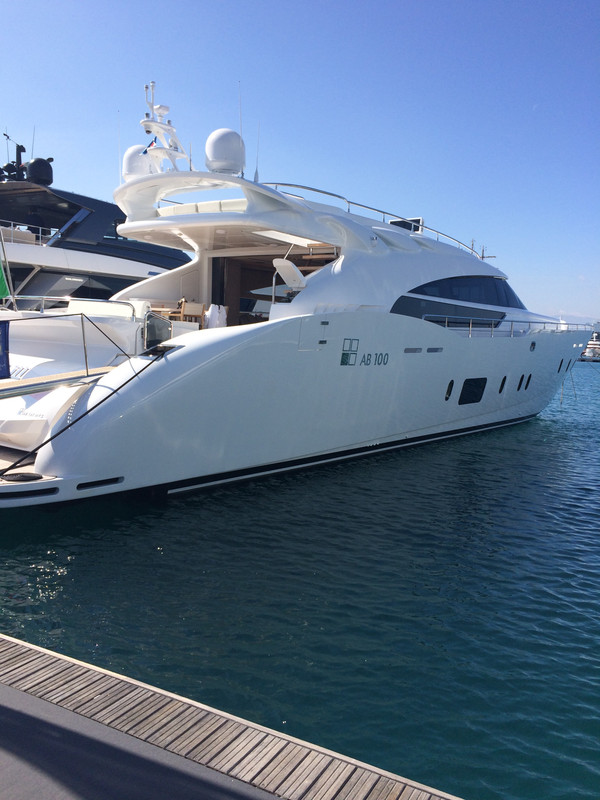
Something like this AB 100 ( under the 24 M rule ) is low and sleek with the weight ( triple MAN 1900 ,s ) doing there low COG assistances.
It’s just got a seakeeper and tops out at 54 knots , so ease back a bit to say 38 cruise and there’s enough to hull dynamics going on to give a nice ride .

https://m.youtube.com/watch?v=Z5fq-booOYY

lightshot

Obviously it’s not fighting physics it been designed WITH boat dynamics physics speaking .
Suppose over a 100 a whole new world opens up .
 
Last edited:
Top