Keel repair after collision

STOL71

Well-Known Member
Joined
17 Sep 2014
Messages
333
Location
London
www.shuda-sailing.com
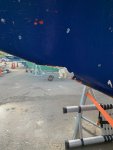
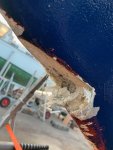
I've got little keel repair to do, the damage is about fist size. Let's just assume the damage is the result of hitting a shipping container at about 6 knots. I've a few images attached. I was thinking of grinding it out, cover the hole in expoxy resin, build it up with westexpoxy filler, then cover in fibre glass matting then fair it down, cover in exoxy, then primer and antifoul. Is that about the right course of action? The damage is not structural. Thank you for your help.
 

Attachments

  • IMG_3103.jpg
    IMG_3103.jpg
    429.8 KB · Views: 162
  • IMG_3102.jpg
    IMG_3102.jpg
    564 KB · Views: 160
  • IMG_3104.jpg
    IMG_3104.jpg
    241.2 KB · Views: 149
If the keel has encapsulated ballast and water has got into the keel via that damage you might need to drill a drainage hole at the bottom to drain it. I depends what the ballast consists of and how it is secured but I did know a boat where the ballast was steel punchings which I would not want to get wet.
 
The ballast is encapsulated lead. Looking at the damage, it doesn’t seem to have got to the lead. I was going to grind it out and let
It dry for a bit.
 
The ballast is encapsulated lead. Looking at the damage, it doesn’t seem to have got to the lead. I was going to grind it out and let
It dry for a bit.
Sounds like a good scheme. I am no expert on fibreglass repairs but I can see no reason why you should not grind out a bit more to have a look inside, let it dry and feather the edges of the damage so that a bigger area can be reinforced with fibreglass cloth.
 
Ouch - that could have sunk plenty of boats - or ripped the keel off completely.
let it dry and feather the edges of the damage so that a bigger area can be reinforced with fibreglass cloth.
I've no pretentions to expertise, nut that seems to me to be a good start. I'd be inclined to seal the hole with fibreglass cloth and epoxy, make up a form out of a rigid foam, expanded polystyrene, maybe, a bit over a centimetre smaller than finished job to give it the shape and build it up with more epoxy and cloth. Fair with the filler of your choice then antifoul.

Cue arguments: No you should use polyester - no, it doesn't stick - Oh yes it does, and a rapid decent into pantomime and vituperation ;)
 
Did you do it at sea, or on the trailer/stand? Helluva clean cut for a sea collision. Did someone reverse into it?

Just accessing how clean and dry.

May as well do all fibreglass and make it solid, starting with large piece first, I'd say. On the basis of if it's happened once ...

Lots of guides on the Yuniversity of Youtube.
 
Last edited:
Run into concrete groins at about 6 - 7 knots.
Concrete groins or a shipping container, make your mind up.

The first photo looks as if there is a sort of foam filler under the glassfibre. Is this the case? An epoxy repair will have a stronger bond than polyester resin on the existing keel. Try to get a 12:1 slope on the edge to ensure you get no hard edges in the new laminate.

Final question. Do you have comprehensive insurance? If so then make a claim and forget about doing the repair yourself.
 
Yes, I have comprehensive insurance but thought that repairing it would be a good school and I don’t have to faff around with the insurance company. Unsure what that is under the fibreglass. My guess was that it is the lead keel. I haven’t investigated much.

I said let’s assume it was a container, but it was indeed a concrete groin. ?
 
My only worry with the kinetic energy of maybe 3,000 kg hitting a solid object on that point would be if there has been any cracking or delamination that travelled away from the point of impact. I had a grp lotus elise that after a knock there was serious delamination for about a foot that couldn't be seen under the gelcoat.

I would think that grinding back you would be able to see but it could mean a larger area than you think.
 
Good point, but I'd expect to see the delamination as cracks when I clean up the the mess. If there are cracks, just keep going. At least it won't have ripped the keel loose.

I'm wondering what sort of damage such an impact would do to to a boat with a skinny fin and a big lump of lead on the bottom
 
I would think that grinding back you would be able to see but it could mean a larger area than you think.
Good point. Still not terminal but a must to explore, inside and out. Especially if you are thinking of selling it. Would you want that on your conscience.

Thanks to the OP for being honest, it makes a real difference.

I've never faced such an issue, is there a dye test or something to check for such cracks?

Remarkable cut. It's gone through it like a knife.
 
Section 8.1 onwards and Section 4.3 in West's Fiberglass Boat Repair & Maintenance book, link below may help you.

https://www.westsystem.com/wp-content/uploads/Fiberglass-Manual-2015.pdf

Warning from manual in Section 8.1 noted below. The West Manual has various methods for repair faults associated with separation.

Internally mounted ballast offers some structural advantages over external ballast, but presents some potential problems. When a boat with internal ballast is heavily grounded, the fiberglass skin takes the brunt of the collision. Unlike lead, the fiberglass laminate is not malleable, so repairs can become more complicated. Further, due to the difficulty builders encounter in trying to mate the cast lead ballast with the inside of the laminated keel pocket, irregularities and voids often occur between the lead and the fiberglass laminate. If moisture finds its way into these voids, additional delamination can occur, particularly in areas where freezing temperatures can cause expanding ice to further wedge the skin from the ballast.

The foam mentioned in post #8 if hard could be a resin dough. On my own boat it looks similar and on the drawings is called "Epoxy Dough" which was used to fill gaps. It could be a foam as my encapsulated keel has two void areas filled with a hard foam material according to the drawings and skinned over. I assume as a way of removing volume in a space before sealing up.

Other West Manuals which could be useful to you Epoxy Instruction Manuals - WEST SYSTEM Epoxy
 
Yes, I have comprehensive insurance but thought that repairing it would be a good school and I don’t have to faff around with the insurance company. Unsure what that is under the fibreglass. My guess was that it is the lead keel. I haven’t investigated much.

If it were my boat,although it would be tempting to do a repair myself, I'd perhaps have a niggling doubt as to what might happen when I sell it and a surveyor questions the integrity of my DIY repair. So I'd probably get a professional repair and let the insurance pay for it. That's what we have insurance for.
 
Did it happen at sea or on land?

If at sea, it's clearly under the waterline, hence hard to imagine how water would not fill up any voids. But it looks too clean for that.
 
I have been doing repairs a bit like this but less extensive on the bottom of my ballasted lift keel. it is at the bottom front corner and results from hitting rocks or running aground. it seems like almost every winter haul out there is repair to do to the keel. I have tried kevlar to try to toughen the area but that presents problems of having to grind it away next time. I have used carbon fibre strands cut short as a filler to help build up the void. Paint the area with straight epoxy to get adhesion then just epoxy with talc to make it thicker. I would do many lay ups of resin with an over night for it to harden so I can grind/file it to shape then ore filler. Eventually a thin coat of epoxy then anti foul paint. No problems over 40 years of doing this apart from the damage done the next collision. Fortunately a fairly light boat so not so much deep damage. So as said just clean it up dry it fill it with epoxy and paint it.
ol'will
 
Top