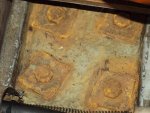
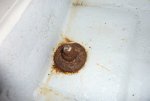
Keel bolt's heads and washers rusted (First38 )

pelissima

Well-Known Member
Joined
7 Aug 2002
Messages
400
Location
Athens Greece
Visit site
I am about to renew all of them (14) as the rust is excessive to bolt's head and space rings which I believe used to be 4mm.
This time I will go stainless.
I would really be obliged if anyone could provide or point me where to ask for the relevant Ben document with torque max-min but mainly the order of tightening them.
Thx in advance
 
I wouldn't even dream of using stainless. It's way too soft.

Replace like with like and paint them to prevent corrosion.

A dry bilge is the best solution if you can achieve it.

Tony.
 
My point is that the designer did calculations to back up his decision on the correct material to use for an application.

I believe it would be unwise to change his decision.

In fact I wonder how an insurer would react to such a major change.

You wouldn't use different bolts on your car tow bar, for example.

Tony.
 
I think that if you did the calculation you would find that most production boats are vastly over-engineered when it comes to keel bolts. I am somewhat surprised to read that Beneteau used carbon steel bolts - is the OP sure that it is not only the washers that are carbon steel, a common method with many builders.
 
I wouldn't even dream of using stainless. It's way too soft.
Replace like with like and paint them to prevent corrosion.
A dry bilge is the best solution if you can achieve it.
Tony.
I would assume then that ss bolts would call for lower max-min torque values. However, a Beneteau table for a First32, shows the opposite.
What would then be the explanation here?
 
friend of mine with a french boat of same make was concerned about what looked like rusty keel bolts. Boltheads and washers looked terrible, but when pulled the threads were in perfect condition and holes were bone dry. According to the manufacturer bolts can be replaced one by one when boat is in the water and this procedure was followed. It turned out to be easy with big enough wrench and a 31mm socket hammered on the old bolt. After much research decision was to replace like-for-like galvanized bolts which will be superior to stainless. After 30 years the galvanized bolts were still in good order although bolt heads looked bad. So it may be reasonable to expect new bolts to hold another 30years and probably next owner will replace them sooner due to surface rust on bolt heads. If they would've been stainless they probably wouldn't have been replaced and risk of crevice corrosion led failure would've been there. After one season the new bolt heads already show surface rust and in retrospect should have been treated with clear epoxy.

Key message: replace galvanized bolts like-for-like.

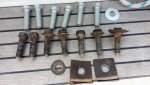
keelbolts.jpgkeelbolts-replaced.jpg
 
Here are my bolts / studs in s/s
Scan0003-2.jpg
 
Re Testmonkey . These pictures show exactly my case as well.
When I treated the rust with a hammer, the round washers were thin like rasor blades and the square ones dissapeared!!
The usual 30mm socket were useless and it was a 27mm one that did the unscrue job!!
 
My point is that the designer did calculations to back up his decision on the correct material to use for an application.

I believe it would be unwise to change his decision.

In fact I wonder how an insurer would react to such a major change.

You wouldn't use different bolts on your car tow bar, for example.

Tony.

And the builder, no doubt, decided to economise?

I would check, with a magnet, if the bolts aren't already stainless and the rust is from the washers?
If, perchance, the builder has used carbon steel the plan to "just replace" the existing may need a rapid review.
Whilst standard 316 stainless has a lower tensile strength than top end carbon steels, they're not that far apart as to invite an imminent loss of the ballast.
 
And the builder, no doubt, decided to economise?

I would check, with a magnet, if the bolts aren't already stainless and the rust is from the washers?
If, perchance, the builder has used carbon steel the plan to "just replace" the existing may need a rapid review.
Whilst standard 316 stainless has a lower tensile strength than top end carbon steels, they're not that far apart as to invite an imminent loss of the ballast.

Magnet test showed it is not SS. Do I understand correctly that you prefer to go SS ?
 
friend of mine with a french boat of same make was concerned about what looked like rusty keel bolts. Boltheads and washers looked terrible, but when pulled the threads were in perfect condition and holes were bone dry. According to the manufacturer bolts can be replaced one by one when boat is in the water and this procedure was followed. It turned out to be easy with big enough wrench and a 31mm socket hammered on the old bolt. After much research decision was to replace like-for-like galvanized bolts which will be superior to stainless. After 30 years the galvanized bolts were still in good order although bolt heads looked bad. So it may be reasonable to expect new bolts to hold another 30years and probably next owner will replace them sooner due to surface rust on bolt heads. If they would've been stainless they probably wouldn't have been replaced and risk of crevice corrosion led failure would've been there. After one season the new bolt heads already show surface rust and in retrospect should have been treated with clear epoxy.

Key message: replace galvanized bolts like-for-like.

Your photo shows bolts (with heads) on a presumably quite elderly boat, whereas the OP is asking about studs with nuts and washers on a relatively new boat. As I said earlier I am quite surprised that any Beneteau built in recent times has anything other than stainless steel bolts. Years ago stainless steel was far less available than it is now, my traditional 1972 motorsailer has wooden strakes, toe rails, bilge keels, all attached with galvanised steel fastenings. Every one is now a corroded mess that is taking months to remedy by replacing with stainless steel.
 
whereas the OP is asking about studs with nuts and washers on a relatively new boat.

Are you sure vyv .... the OP is referring to a first 38 which I believe is the big sister to my first 345. Both Beret designs of the same era and both have bolts, washers and spacers ....not studs.

jr
 
Are you sure vyv .... the OP is referring to a first 38 which I believe is the big sister to my first 345. Both Beret designs of the same era and both have bolts, washers and spacers ....not studs.

jr

Just been Googling it and it seems you may be right. Found some USA references that say they are stainless steel but others that seem to show photos of carbon steel but not necessarily the same design. So I don't know for certain.
 
boat in question is mid-eighties model. Keel is cast iron, there are threaded holes in the keel into which bolts go in. Someone posted a picture of lead keel with SS bolts - that is a different scenario as lead is softer and requires a different setup. So back to a French boat with iron keel with threaded holes. Rationale for replacing with like-for-like galvanized bolts is following:
1) initial reaction from many (self proclaimed) experts was to go for stainless steel
2) actually digging deeper with the historic question "why did the manufacturer use galvanized steel in first place" revealed that it was not based on cost, when this manufacturer built the first cruiser-racers in early eighties they wanted best and strongest long term solution which was actually galvanized steel bolts. Part of the thinking was immunity towards crevice corrosion and the fact that bolts would show rust pointing the owner to replace them way before any impact on structural safety would be there. 30 years later this seems to have proven to be the right decision, no keel failures are known to have happened to these eighties boats. Owners of these boats have duly replaced rusty keel bolts and the ones who have posted pics to the Internet show same thing - bolt threads are still good and rust was typically limited to bolt heads and washers. So that part of the thinking worked - people treated keel bolts as an item to actively monitor and periodically replace because they didn't look good anymore. Compare that with similarly aged boats from other manufacturers who used stainless steel bolts - quite often they are still original - and if dream of eternally dry bilges hasn't been true for past 3 decades those stainless bolts have been exposed to water and to risk of crevice corrosion (looks perfect until sudden catastrophic failure). If the keel - hull joint hasn't been 100% water tight crevice corrosion risk further increases. However, with galvanized steel bolts there would be very visible rust weeping from leaking keel-hull joint pointing the owners attention to do something about it before any significant risk.

Now - why did this manufacturer then change to stainless steel bolts later on? Well it turned out that owners were not happy with the superior fail-safe solution of galvanized steel keel bolts. Owners wanted immaculate looking stainless steel bolts that didn't show any rust marks even when exposed for years in watery bilges. The manufacturer gave in to customer demand and started using stainless steel bolts like most other manufacturers. Customers may be initially more happy, no perceived need to pay attention to keel bolts anymore as cannot see any rust. The flip side is risk of crevice corrosion and in extreme cases sudden catastrophic failure with no prior warning. Now - of course safety margins are built in and all that. But after this research the decision was to go for the like-for-like replacement with galvanized steel bolts, which by the way are available directly from the manufacturer or local dealer. Still convinced galvanized steel bolts are superior solution for this boat.
 
friend of mine with a french boat of same make was concerned about what looked like rusty keel bolts. Boltheads and washers looked terrible, but when pulled the threads were in perfect condition and holes were bone dry.
I've just had a survey done on my boat - and I had requested the surveyor to give an opinion of the somewhat rusty keel bolt heads of my 1993 vintage Beneteau. His opinion / advice was that the bolts on these boats generally exhibit surface rust that looks unsightly but that the internal structure of the bolts is unaffected. There was no evidence of water ingress around the keel/fastenings, nor any evidence corrosion around the keel/hull joint. A wire brush cleaned the bolts and revealed that, although the heads looked unsightly, the amount of corrosion is actually rather less than I thought.

He advised brushing back to metal and coating with something like Galvafroid to help slow down re-occurrence of the corrosion. I'm now content to leave the bolts undisturbed for a while yet.

Based on that, and on testmonkey's photo's I'd see no reason to replace the bolts with stainless just for the sake of it.
 
Down here (Australia) I replaced the keel bolts on a 25 year old Beneteau 320 six months ago. The heads were in a terrible state but when removed all shafts were clean and dry. My understanding was the original bolts were high tensile steel and for my boat 20mm diameter. I understand Beneteau changed to Stainless bolts a few years later but the shaft size increased to 25mm diameter. I was able to purchase replacement bolts which were identical except for the head size being 32mm compared to 28mm on the old bolts. These new bolts were certified for construction use and were supposedly the highest grade of high tensile steel, supplied as a kit with washer and nut (not required) at a very reasonable price. They were replaced one at a time while the boat was in the water. All good so far. Laurie
 
Top