Kad32 compressor kick in at low rpm/idle

Hangie

Active Member
Joined
8 Jul 2020
Messages
58
Visit site
Hi,

Come back into the water today and straight into 1st problem of the season.

One of the engine got strange problem with kompresor. It starts all fine and idle as expected.

When on revs, 1.2k RPM, for a minute or so suddenly kompresor kicks in.
Reverting to idle doesn’t change anything.
Only turning the engine off helps.

It correctly engage and disengage at higher RPMs.

What I’ve also noticed that when ignition is turned off then kompresor also kicks in until the key is rotated anticlockwise to shut the engine off.

Anyone seen something like that ?
Maybe proximity sensor plays up.

I got no issues on the 2nd engine so could do few swaps over the weekend.

Thanks!
 
There is a sensor that’s near the metal arm that the throttle cable connects to.
It’s meant to trigger only at large throttle openings to engage the Kompressor.
 
Thanks SC35.

I've found a nice document from Volvo describing whole electrical system of KAD series. It does make sense that if this sensor is opening the circuit unintentionally, then the clutch could be eager at lower RPM. Honestly if someone would not want to splash on new sensor and dont expect to use this "kick down" feature, you could potentially just short circuit G2 and G+ - maybe with small resistor inline.

BTW any clever way of removing the sensor ? It seems there is a nut at the back of the screw which would need to be hold in place but access is very limited. I could remove whole mounting plate but looks like 2 bolts are holding top part of fuel pump together - and I dont really want to mess with fuel pump.

I still got the 2nd weirder issues mentioned. During turning the engine off, at the moment when ignition key is put into 0 the clutch also engage.
From what I understand when key goes to "0" +12V is cut from the control module. But as clutch engage, module somehow must be connecting 31 and S1 connector providing ground which then engage the clutch (+12V is provided independent of ignition state.)

My electronics knowledge does know stretch that far to know exactly how 31 and S1 are connected when needed and why module could connect them when +12V is lost on connector 15.
Maybe early sign of bigger problems with the module.

I think I would need @FatherTed to share his wisdom.

Thanks!
 
There are 2 versions of the box and each one has a different throttle position sensor. One uses a traditional micro switch (Relay part number: 860434) and a later one that uses an electronic proximity sensor.
As mentioned if the electronic proximity sensor is faulty, or disconnected, then this will cause the unit to operate at idle.

You can remove the electronic proximity sensor to test it, and the easiest way is the 2 bolts holding the bracket on the top of the fuel pump. You will not affect the anything by doing this, the 2 bolts only hold the bracket, so don't worry about that.

Testing the proximity sensor is described in a doc I wrote, feel free to download it and ask questions. You will need a power supply and multimeter.
Volvo_Penta_Speed_Relay/Testing_Speed_Relay.pdf at main · nigelfiler/Volvo_Penta_Speed_Relay

The only other thing that can affect the engage speed (and I had this recently) is a damaged resistor array in the box, this is a custom part, it's the long thin component that runs the width of the board. If this is damaged, then it's a new unit.
 
Sorry for bit of delay. Was enjoying the first day on the water during the weekend.

Good to know there is a cheaper version of the sensor if needed.
Thanks for the confirmation that it is safe to undo 2 bolts from the top of the fuel pump. It indeed would be the easiest way together the sensor our / swap / do any adaptions.

Very nice doc you put together there - thanks!

What is not clear to me:
First you state that if sensor would be discounted then clutch should not engage as there is no signal.
Then in the testing chapter you state that in default state (clutch off) there is 11.31V seen on Black-Brown and when metal detected it drop to 0V which activate the clutch.

Is the clutch then activated via presence of 11.31V or lack of it ? If disconnecting of whole sensor would not trigger the clutch then 0V means disengage and 11.31V engage - right ?

Saying that during my last trip everything seems to come back to normal. Where I've just reseated 3 pin connector. Could be there was drop of voltage there and full 11.31V did not reach the controller which engaged the clutch.

Finally the biggest mystery is still not clear. In my case clutch is also engaging when I try to turn off the engine. When 12V is removed from the controller (via ignition switch), clutch will engage. I would assume somehow 31 and S1 connects and provide ground to the circuit which engage the clutch.

Any idea why it could happen ? Such case is not mentioned in the guide.

Thanks!
 
Hi

In the doc I state if you disconnect the RPM pickup from the camshaft, then the relay will not engage, if it is always engaged with this disconnected, then it is usually the power transistor internally. So this is a quick test. Normal operation, the relay must have a signal from the inductive pickup to detect the RPM and engage the clutch at the right RPM.

The proximity sensor normally runs on about 8.5v (P4). So don't expect to see 11v anywhere, except in a bench testing situation when you have a 12v supply.
The sensor is rated to about 30v, running on 12v to test on the bench is ok.

On the engine when the sensor is triggered with a metal object you should see about 7.5v on P3 (Black)

I will re-work the wording, it might be a bit ambiguous.......

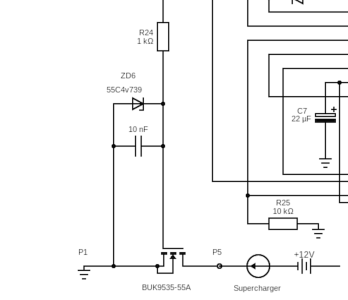
If the clutch engages when you remove the ignition, firstly this will flatten your battery. The supercharger coil is permanently connected to 12v via the battery isolator (is on my boat). There may be a circuit fault that is triggering the transistor. The transistor may be leaking. Touching it with your finger is enough to make it switch, so there could be dirt or damp in there.

Circuit diagram attached. You can see the 12v feed on the lower right, through the supercharger coil, then the transistor to ground.


Edit: Reworded the proximity sensor bench testing to make it match expected normal behaviour:

Connect proximity sensor to power:

Connect Brown wire on proximity sensor to power (12v DC)
Connect Blue wire on proximity sensor to 0v
LED (if present) on proximity sensor should be lit (May be covered with paint)
Leave the wires connected and go to next step

Connect proximity sensor to multi-meter:

With the proximity wires still connected to power, connect multimeter as follows:
Set meter to DC Volts.
Black lead on meter to Blue wire on proximity sensor
Red lead on meter to Black wire on proximity sensor

Meter will read about 0.66v

Activate sensor with a metal object on the target area indicated on the sensor
Multimeter will read 12v and the LED should go out.
 

Attachments

  • Screenshot 2026-03-23 at 16.12.32.png
    Screenshot 2026-03-23 at 16.12.32.png
    68.7 KB · Views: 3
Last edited:
Got it. You indeed say disconnecting speed sensor will stop clutch engaging. You could put it in bold "speed" as I just went "sensor blind" and missed you moved from proximity to speed one.

That would mean proximity sensor, when not triggered (clutch off), will provide a voltage of around 7.5V.
When metal is detected it will close and signal drop to 0V - which will then engage the clutch.
If proximity sensor would fail or get disconnected control module would see 0V and always engage the clutch - all make sense now.

That is very good point that such situation would drain battery as clutch would remain powered even with engine off. Next time when/if it will happen I'll check if clutch remain engaged (and for how long) by trying to rotate inner part.

Problem must be then around transistor. I will try to swap the whole modules to see if issue move to the 2nd engine. Then if issue remain, I'll open it up to check for any damp or dirt.
If all clear I would assume then a new transistor would be needed - as in case of burn out. Would you be possible available for such small task (in autumn if it wont go worse), my soldering skills are not neat enough plus I dont have one of those little solder suckers :)

PS. Once I also noticed, that with ignition off and engine still running, clutch was coming on and off. Could be this transistor leaking weak ground for a while after powering down.
 
I think if you turn the ignition off, but don't fully kill the engine, it does do something funny, I have seen that.

I do fix these as you will see from the video on Youtube, it's only £50 to change the transistor, test, check the speeds and return via Royal Main Special Delivery with full insurance for loss - not that helps, these things seem to be still out of stock.

Best thing to do is test the transistor with a multimeter, check the diode also. (see my doc). The transistor is cheap if you want to have a go yourself, but only go there if it's confirmed faulty. I don't think it is, from your description. I think you have a bad connection, dirt on the connectors, or suspect proximity sensor.

Happy to test proximity sensor and relay box (£ No charge) as long as you cover the return postage (£10) - 2 day turn around.
 
Top