KAD 42 Super charger clutch - quickie on wiring

BruceK

Well-Known Member
Joined
8 Feb 2015
Messages
8,361
Location
Conwy
Visit site
Put a new one on on Sat as the old one was getting a bit worn. Came without the diode that sits inline both magnet wires and both wires are black.

So I snipped off the old inline diode and connected it in parallel as on previous clutch.

Clutch spacers were slightly too small to fit on shaft so reused old and checked. It doesn't have a perfect gap but can freewheel without grinding.

Tested it and it worked fine.

All through the rough waters it was on the dime. Perfect operation. Then when nearing the journey's end coming onto the plane the clutch would engage per normal, hand over to the turbo normal, SC disengages fine. No further spinning.

About 30 seconds later you notice the synchroniser needle flick, 5 seconds later, flick. Then the engine fuse in the black box blows.

Come down below 1700 rpm and you can pop the fuse back in. Get back on the plane SC hands off to turbo, flick flick pop. You get it.

Unplug the clutch and the engines run like a peach.

So it's the new SC Clutch.

Diode? (As it was detatched with plug any polarity would have been retained.

Is there a + or - wire to the electromagnet

Very odd. Any words of wisdom appreciated before I badger VolvoPaul. I think he must be sick of KADs by now.
 
Anybody? Give it a punt. Even some troubleshooting tips. I doubt it's excessive EGT but if it's plausible I'll listen
 
Could the SC be starting to show signs it’s knackered , too much friction stiffness so the clutch struggles to engage somehow and it’s electrical supply over loads .
Assuming it’s actually correctly wired up , otherwise you wouldn’t have got this far ? It appears to work ....for a while ?


This is ESC :)
 
Could the SC be starting to show signs it’s knackered , too much friction stiffness so the clutch struggles to engage somehow and it’s electrical supply over loads .
Assuming it’s actually correctly wired up , otherwise you wouldn’t have got this far ? It appears to work ....for a while ?


This is ESC :)

That would make sense but as above. Fuse trips after it's done it's job and shut down. That's what is getting me scratching my head. I'll already be on the plane for a good 30 seconds with it having shut down and well on the turbo boost before the fuse blows.
 
The diode must be there to stop some current flowing in an undesirable direction - not sure what causes the current to flow in an undesirable direction (could it be some back EMF from the coil/magnet in the clutch when the supercharger is spinning?), but still thats what its there for, so it is possible you have installed the diode the wrong way round, so its allowing some current to flow where it shouldnt and is blowing a fuse.

Can you check on the other engine exactly how it is all wired using a multimeter to measure voltages,polarity etc and confirm you have this engine wired right?
 
The diode must be there to stop some current flowing in an undesirable direction - not sure what causes the current to flow in an undesirable direction (could it be some back EMF from the coil/magnet in the clutch when the supercharger is spinning?), but still thats what its there for, so it is possible you have installed the diode the wrong way round, so its allowing some current to flow where it shouldnt and is blowing a fuse.

Can you check on the other engine exactly how it is all wired using a multimeter to measure voltages,polarity etc and confirm you have this engine wired right?

Everything worked fine until changing clutch. As above it came without diode or plug and just 2 black wires. I removed the plug and diode from the old clutch so the polarity of the diode must be correct unless the clutch does indeed have a positive and negative polarity and I have it's two black wires the wrong way round. I have not tried swapping the wires over after the diode as it worked fine but if there is supposed to be a dedicated polarity that would possibly solve it.

Can anyone confirm from theirs if there is any colour differentiation to their wires to signify a difference?
Another piece to consider is this one carries an old stock / legacy part number that was dropped for quality issues. Can anybody enlighten me what those issues were?
 
Everything worked fine until changing clutch. As above it came without diode or plug and just 2 black wires. I removed the plug and diode from the old clutch so the polarity of the diode must be correct unless the clutch does indeed have a positive and negative polarity and I have it's two black wires the wrong way round. I have not tried swapping the wires over after the diode as it worked fine but if there is supposed to be a dedicated polarity that would possibly solve it.

Can anyone confirm from theirs if there is any colour differentiation to their wires to signify a difference?
Another piece to consider is this one carries an old stock / legacy part number that was dropped for quality issues. Can anybody enlighten me what those issues were?
Is there a thin white stripe on one of the black wires
 
possibly, I'll need my reading glasses onboard to see that one
From the kad42/3 electrical system manual....

"Fault-tracing
• The supercharger is not engaged
Disconnect connector to the supercharger sole-
noid. Run the engine above 1700 rpm, check
that there is power supply at connector terminal
using a circuit tester.
If there is current the fault lies in the solenoid or
the cable to the connection.
The fault can also be due to the signal from the
engine speed (RPM) sensor not being retained.
Check sensor and wiring.
If the connector has no current the transient
protection in the magnetic clutch may be dam-
aged (conducts through) which may cause
short-circuits. This in turn blows the fuse or
damages the engine speed (RPM) relay.
• The supercharger engages/disengages within
the operating range (oscillates)
Oxide or loose connections within the engine
speed (RPM) sensor or the electronic module
connectors. Cable breakage. Check and clean.
The terminal pins should be smeared with con-
tact grease.
• The fuse blows when the compressor engages
Remove the supercharger connector and check
if the fuse still blows. If it did not there is a
short-circuit in the magnetic clutch.
If the fuse blows despite the connector being
disconnected there is a short-circuit in the en-
gine speed relay.
• The supercharger disengages at the wrong
engine speed (RPM)
The disengagement engine speed is adjustable
with a 27 revolution potentiometer on the junc-
tion box. Each revolution on the potentiometer
corresponds to 48 rpm, in total 1296 rpm plus or
minus at the potentiometer limit position.
If adjustment with the potentiometer does not
work the electronic module must be replaced.
• The supercharger engages at the wrong en-
gine speed (RPM)
The cut-in speed is preprogrammed into the elec-
tronic box, except for “kickdown”, when the posi-
tion sender provides an impulse. Give full gas
“Forwards” on the throttle. Engine stationary!
Adjust the distance between the bracket (1) and
position sender (2) to 0.028"/0.7 mm."
 
From the kad42/3 electrical system manual....

"Fault-tracing
• The supercharger is not engaged
Disconnect connector to the supercharger sole-
noid. Run the engine above 1700 rpm, check
that there is power supply at connector terminal
using a circuit tester.
If there is current the fault lies in the solenoid or
the cable to the connection.
The fault can also be due to the signal from the
engine speed (RPM) sensor not being retained.
Check sensor and wiring.
If the connector has no current the transient
protection in the magnetic clutch may be dam-
aged (conducts through) which may cause
short-circuits. This in turn blows the fuse or
damages the engine speed (RPM) relay.
• The supercharger engages/disengages within
the operating range (oscillates)
Oxide or loose connections within the engine
speed (RPM) sensor or the electronic module
connectors. Cable breakage. Check and clean.
The terminal pins should be smeared with con-
tact grease.
• The fuse blows when the compressor engages
Remove the supercharger connector and check
if the fuse still blows. If it did not there is a
short-circuit in the magnetic clutch.
If the fuse blows despite the connector being
disconnected there is a short-circuit in the en-
gine speed relay.
• The supercharger disengages at the wrong
engine speed (RPM)
The disengagement engine speed is adjustable
with a 27 revolution potentiometer on the junc-
tion box. Each revolution on the potentiometer
corresponds to 48 rpm, in total 1296 rpm plus or
minus at the potentiometer limit position.
If adjustment with the potentiometer does not
work the electronic module must be replaced.
• The supercharger engages at the wrong en-
gine speed (RPM)
The cut-in speed is preprogrammed into the elec-
tronic box, except for “kickdown”, when the posi-
tion sender provides an impulse. Give full gas
“Forwards” on the throttle. Engine stationary!
Adjust the distance between the bracket (1) and
position sender (2) to 0.028"/0.7 mm."
The manual also shows white and red wires going to the supercharger clutch.
 
Thanks Pete I read the manual. What I dont get is why I have the clutch and no diode and plug attached. That I would have thought would have been a complete unit. I wonder if I have been sold an aftermarket part.

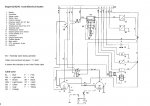
The troubleshooting tips doesn't describe my problem as the fuse does not blow when the clutch is engaged. Only at RPM over 3000 rpm. The wiring diagram shows the fuse connecting to it so it makes sense for it to blow but why after it has disengaged?

Untitled.png

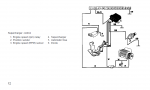
5 in this diagram
Untitled.jpg
 
On my compressor it says clutch out of production but it's the same compressor on later models of the KAD so I looked under
KAD32 /43 etc and got these part numbers also out of production
imgSymbolDot_blank.gif
(3581062), (860786)
I placed those numbers into Volspec and got the following replacement:
3581724


The above was one of a couple hits and apart from the wires is so identical in the flesh you cannot tell the difference. EnGEN also sell it and it's from Japan. I think it is an Ogura clutch and simply not rebranded.
 
The coil is not polarity sensitive - its just a coil of wire. When you put an electrical current through it it creates a magnetic field. One face will be N the other S. The friction plate is just steel so it doesn't matter about magnetic polarity it will still be attracted to the coil.
The diode is there to protect the S/C control electronics from the high reverse voltage that is created when the S/C controller turns OFF the S/C - all coils of wire do this. If you had the diode the wrong way around you would probably blow the fuse as soon as the S/C tried to turn on. Most multi-meters have a diode test function in the resistance range section so you can test it and compare to other engine.
I am puzzled why the fuse blows when the S/C is already disengaged - there should be no current flowing to the S/C once the engine is using the turbo. One side of the coil is connected to +12V via the fuse. The other side is switched to 0v via the speed controler module when it wants to enable the S/.C. Could be a trapped wire, damaged harness wiring somewhere shorting out the switched side of the wiring?

You mentioned a synchroniser needle flicking - do you mean the rev counter?
 
Last edited:
@kashurst I'm puzzled too which is why I brought it to the board. It just doesnt make sense.

I fitted a synchroniser so I could balance the engines. I found the harmonics could be misleading. Yes it may have been replicated on the offending engine's tacho too. Just a quick blip.

I recently changed the alternator, a week before, but the previous clutch worked fine on that. The new alternator can give more amps out but as the engine fuse is only 8 amps I dont think it has anything to do with that. You could be right that something has shifted during the clutch's maiden journey. The seas were heaving enough to throw a steering hydraulic reservoir off it's peg fitting but I cant see that damaging wiring. And looking at the wiring diagram there is nothing else in that circuit to cause it to blow. If it was on a different circuit unplugging the clutch would not have solved the problem.

I am at a complete loss.

I mentioned the spacers didnt fit and I had to reuse old. The gap was close and tighter than specification but it could freewheel without binding or grating. I wonder if the clutch heats up that gap reduces and there is a occasional snatch? I have not witnessed it but could that cause a current that might trip the fuse out?

I'm just grabbing straws at the moment. I'm tempted to fit the old coil back in and see if the problem goes away
 
Last edited:
Top