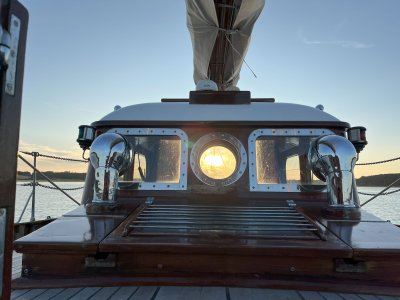
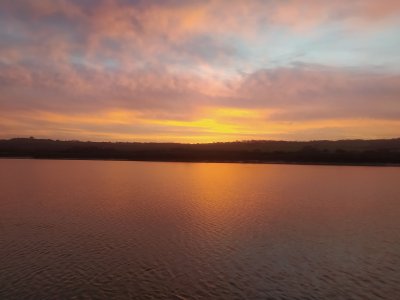
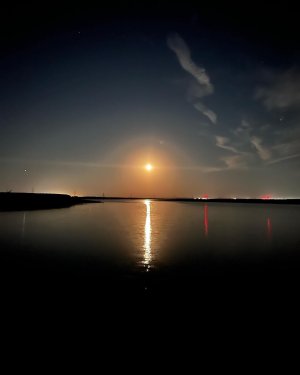
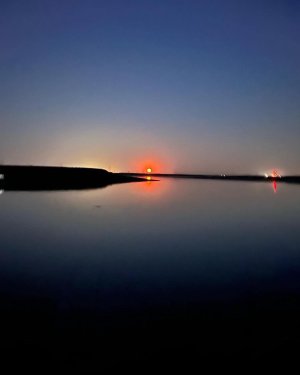
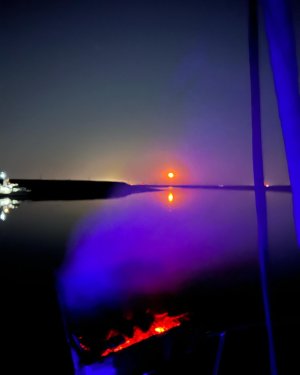
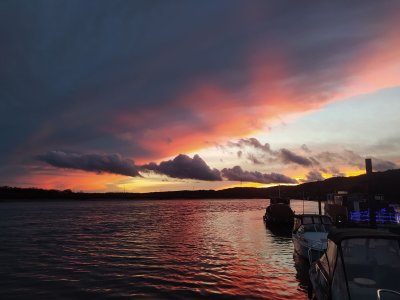
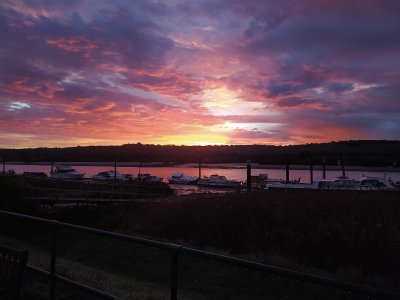
Just pictures

Pyefleet at dawn
Note for budding photographers. If you want to take a sunset, you need:
Something in the foreground
A level horizon
Correct exposure
Preferably an odd number of objects, usually three.
This photo has everything right, which is why we like it. Personally, I would have trimmed a bit off top and bottom, because I'm used to seeing things on a wider screen, and it might emphasise the horizontals, but that is just personal.
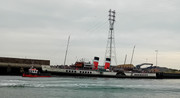
 
Came out of Ipswich this week and noticed Waverly coming off Cliff Quay.
She needed a tug to get off. Later she passed with a lovely unique sound of a paddler. Reminded me of that scene in the film Great Expectations.

 
Saturday, 27th September. I think she is returning home after at the Maldon Regatta races. Anybody know her home berth. I have others to send to them.

P1100187 by Roger Gaspar, on Flickr
Nice pic.
Quite old.
Lifted this from the Web.

ADC CK431 is a historical Aldous smack, a type of gaff-rigged sailing fishing boat built around 1890, which worked in the East Anglian waters and was known for its part in the local fishing industry and a notable visit to the Thames for Queen Victoria's Diamond Jubilee in 1897. She was a carvel timber-hulled vessel that was later fitted with an engine and served as a tow-boat for other vessels.
 
ADC now owned by Ellie Rule, kept at Brightlingsea. I'm a friend of her mum (who owned the bawley Bona) so you could send to me and I'll pass on.
I thought she was a Brittlesea boat. Send me your email via PM and I send you a Wetransfer link. Each image is 5MB so there is a lot of detail.
 
Came out of Ipswich this week and noticed Waverly coming off Cliff Quay.
She needed a tug to get off. Later she passed with a lovely unique sound of a paddler. Reminded me of that scene in the film Great Expectations.

Waverley handles really badly... A friend of mine is a retired Harwich Harbour Pilot who had a couple of work trips aboard.
1. The paddles wheels DO NOT work independently, as full ahead on one, full astern on the other can capsize paddle ships.
2. She has a tiny rudder which (obviously) has no prop wash over it.

I have done a couple of trips on her as a passenger, and close quarters manoeuvring is a joke. My trips were Ipswich to Tower Bridge and back to Gravesend, stopping at Clacton Pier and Southend Pier. She had to have the tug to turn off Cliff Quay. Coming alongside Clacton Pier was even more interesting. So the tide was flooding, and the skipper decided to come in DOWNTIDE(!). The main tool to assist in berthing was a heaving line and a deck hand with an amazing throwing arm. It took four goes.

Southend was a good indicator of turning circle. Obviously she's shallow draft (1.8m IIRC) and we were pretty much near the Knoll Swatch buoy off the Medway and turning to Starboard, and we just about made it in one hit. At least we turned uptide, and the berthing was first time. On to Gravesend, changed pilots and into the pool where we had a small tug to do the spin before coming back and docking at Gravesend pier, coach back to Ipswich.

I can only recommend the trip as being fantastically interesting. The engine room is open sided, and you can stand there watching all the polished steel and brass swishing away magically.

No commercial involvement other than as a customer...
 
Waverley handles really badly... A friend of mine is a retired Harwich Harbour Pilot who had a couple of work trips aboard.
1. The paddles wheels DO NOT work independently, as full ahead on one, full astern on the other can capsize paddle ships.
2. She has a tiny rudder which (obviously) has no prop wash over it.

I have done a couple of trips on her as a passenger, and close quarters manoeuvring is a joke. My trips were Ipswich to Tower Bridge and back to Gravesend, stopping at Clacton Pier and Southend Pier. She had to have the tug to turn off Cliff Quay. Coming alongside Clacton Pier was even more interesting. So the tide was flooding, and the skipper decided to come in DOWNTIDE(!). The main tool to assist in berthing was a heaving line and a deck hand with an amazing throwing arm. It took four goes.

Southend was a good indicator of turning circle. Obviously she's shallow draft (1.8m IIRC) and we were pretty much near the Knoll Swatch buoy off the Medway and turning to Starboard, and we just about made it in one hit. At least we turned uptide, and the berthing was first time. On to Gravesend, changed pilots and into the pool where we had a small tug to do the spin before coming back and docking at Gravesend pier, coach back to Ipswich.

I can only recommend the trip as being fantastically interesting. The engine room is open sided, and you can stand there watching all the polished steel and brass swishing away magically.

No commercial involvement other than as a customer...
Thanks for that. While it's true that full ahead with one paddle and full astern the other would capsize nearly and paddler, it's not the main reason that the wheels cannot be turned independently on steam paddlers. These ships were usually powered by double expansion steam engines with their cylinders arranged horizontally along the ship and the crankshaft athwartships roughly amidships.The main bearings are just inside the topsides so the ends of the crankshaft protrude through the topsides where the paddles are mounteded directly on them, so no clutches or transmission system, if the engine turns, the paddles turn with it and both the same way. To permit independent control of the paddle wheels would require cutting the crankshaft in two in the middle, effectively leaving two independent engines, the HP and the LP, fed by a single boiler.

In the 1950s, the Admiralty built the Director class class of diesel-electric padlle driven tugs, which could operate their paddles independently having a separate electric motor for each paddle. As protection against capsize, these were fairly beamy craft and I believe they aso had an interlock, preventing too big a difference between paddle speeds. Normally, the two motors were coupled by a clutch, preventing any differential paddle speed. I believe some survived up to 1980.

In this century. I have sailed on both the Waverly and the Kingswear Castle and am in awe of the skill of their helmmen. On the K.C, he took us up from Tower Pier, through Tower Bridge before executing what felt like a 20 point turn in the Pool before returning down river. The bridge operator had the good sense to close his bridge rather than await completion of the manoeuvre, re-opening to let us pass downstream. in my youth, living in Cardiff, I made several passages on the paddlers of Campbell's White Funnel Fleet which also had open engine rooms, as most passenger paddlers, to allowpassengers to admire the machinery. The thing that struck me was the antics of the engine room staff, who would step on and off the big ends, oil can in hand, to lubricate the bearings with the engine rotating. All, of cou6rse, well before the Health & Safety at Work Act (1974).

Peter.
 
Sharfleet in the Medway Aug 22
 

Attachments

  • 6E47FE89-938D-4DD1-8E0A-1CDAA50EB670.jpeg
    6E47FE89-938D-4DD1-8E0A-1CDAA50EB670.jpeg
    147.1 KB · Views: 19
  • 41770E98-FCAB-4D77-A412-5DC9AE08A401.jpeg
    41770E98-FCAB-4D77-A412-5DC9AE08A401.jpeg
    133.3 KB · Views: 19
  • 4DFC007F-7E30-4DF4-A38F-0DBAB27CF9AD.jpeg
    4DFC007F-7E30-4DF4-A38F-0DBAB27CF9AD.jpeg
    156.5 KB · Views: 18
Our boat (Lady Emma) is ready for Christmas .
She will be staying in the shelter of the marina over the festive period.
Not sure the decorations would stand much of a chance against the North Sea 🎄🎅

<a data-flickr-embed="true" href=" " title="Lady Emma Christmas 2025"><img src="https://live.staticflickr.com/65535/54979532210_f7d6eeff9a_z.jpg" width="640" height="440" alt="Lady Emma Christmas 2025"/></a><script async src="//embedr.flickr.com/assets/client-code.js" charset="utf-8"></script>
 
Top