Joining VHF coaxial cable.

Allan

Well-Known Member
Joined
17 Mar 2004
Messages
4,696
Location
Lymington
Visit site
Whilst installing new instrument wiring I found a plug/socket joint in the VHF coax at the foot of the mast. The external surface is very corroded and I couldn't easily get it apart to check inside. I would prefer to, at least, have a new connector available before I try open it. I've tried googling VHF connectors but they all seem to be for TV or satellite cables. Are there any recommendations?
Allan
 
it is actually possible to join wthout a connector by 'rebuilding' the structure. I've done this at times especially when a connector proves a bit too big.

The trick is to join the centre wire and then add sufficient insulation binding to build up to match the orignal inner sheath. Then carefully splay out the braided outer and silver foil to re-create the shielding .... then once done - bind whole with good quality self-amalgamating tape. If done well - it has literally zero loss - in fact tested with RF meter - I have had less losses with this than an over shelf connector designed for the job !

Best is of course no joint especially as you want to pass through deck - pass cable through a deck gland ... then have the connector INSIDE cabin - that way you can use the sat connector or do as I describe ..
 
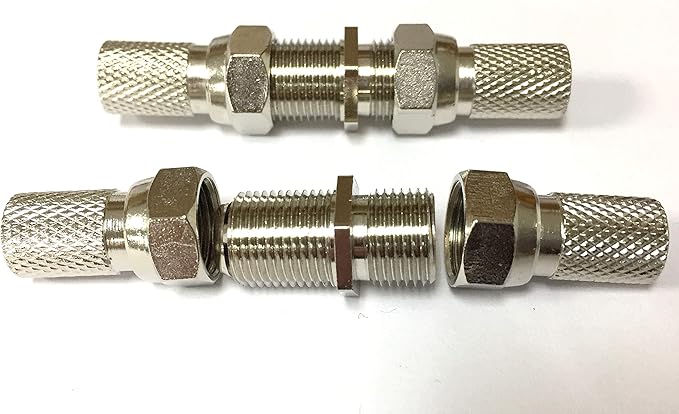
None of these is for VHF - at these frequencies stray capacitance really matters. I'd use a coax coupler, wrapped in self-amalgamating tape if it's outside. Maybe something like this, from Amazon?

81OalDbAycL._AC_SX679_.jpg
 
Whilst installing new instrument wiring I found a plug/socket joint in the VHF coax at the foot of the mast. The external surface is very corroded and I couldn't easily get it apart to check inside. I would prefer to, at least, have a new connector available before I try open it. I've tried googling VHF connectors but they all seem to be for TV or satellite cables. Are there any recommendations?
Allan
I have a Vtronix deck plug and socket which has given no trouble although I always put a thin smear of silicone grease on the threads, the central pin and on the outer insulation where the boot slides over it when connecting.
Also always fit the original protective cap/ plug when laying up

VHF deck plug and socket

If you need just an inline coaxial connector then they do exist. See for example

VHF connectors

I dont know if they are waterproof .. check for yourself ... but a smear of silicone grease will protect the threads

Keep an eye open for tubes of silicone grease in the " Middle of Lidl " offers
 
I have a Vtronix deck plug and socket which has given no trouble although I always put a thin smear of silicone grease on the threads, the central pin and on the outer insulation where the boot slides over it when connecting.
Also always fit the original protective cap/ plug when laying up

I had one of these on my Jouster. It generally worked well, but I had to replace the plug after a few years as the waterproof boot wasn't and it filled up from above.
 
I had one of these on my Jouster. It generally worked well, but I had to replace the plug after a few years as the waterproof boot wasn't and it filled up from above.
Perhaps my practice of lightly smearing with silicone grease has helped .
 
I think the simplest way to join coax is with two PL259s and a barrel connector. You can get these in many places, such as Moonraker Radio. Use a screw-in earth type, you need only solder the cable into the tip. 6mm for RG58 cable (which is actually about 5mm) and 7mm for RG8X ( which is a little over 6mm).
Best to take the cable through a deck gland and make the connection inside the boat. And use Vic's practice of lightly smearing with silicone grease.
 
Perhaps my practice of lightly smearing with silicone grease has helped .
Could be. As I remember, the shroud on mine went a bit funny and distorted, and I think may have as a result pulled away from the cable at the entry point. Maybe some sort of UV degradation?
 
Many thanks for all the suggestions. We have a deck gland so I will be buying some PL 259s and a joiner. I've yet to decide between silicone grease and self amalgamating tape.
Allan
 
Use rubber boot if silicone grease and self amalgamating tape if just plug and socket, I prefer tape as it leaves no gap for water to get in and cannot get rubbed off
 
If you use tape, use non-adhesive silicone compression tape. When you want to remove it just slit with a knife and peel it off - no sticky residue. Mocap is one brand, there are many others.
 
None of these is for VHF - at these frequencies stray capacitance really matters. I'd use a coax coupler, wrapped in self-amalgamating tape if it's outside. Maybe something like this, from Amazon?

81OalDbAycL._AC_SX679_.jpg
Not good for marine band frequencies. Not getting too technical but they are what is called 75 ohm connectors. Marine band need 50 ohm connectors.
The picture above shows what are called F connectors more for TV satelite cable and require a solid centre core to be able to make contact in the socket. Most marine band cable has a multistrand centre core.

As DAVERW says "Search for PL259 for the plug and SO239 for socket " and the wrap with self amalgamating tape.
 
Last edited:
Not good for marine band frequencies. Not getting too technical but they are what is called 75 ohm connectors. Marine band need 50 ohm connectors.
The picture above shows what are called F connectors more for TV satelite cable and require a solid centre core to be able to make contact in the socket. Most marine band cable has a multistrand centre core.

As DAVERW says "Search for PL259 for the plug and SO239 for socket " and the wrap with self amalgamating tape.
Many thanks, I had decided on two PL259 plugs and a joiner. I think I remember plugs being easier to solder than sockets but the last one I did would have been in the 70s!
Allan
 
Not good for marine band frequencies. Not getting too technical but they are what is called 75 ohm connectors. Marine band need 50 ohm connectors.

Whilst not disagreeing that the F type is the worlds crappest, cheapest connector and has no use on a boat ... don't get too hung up on the 50/75 ohm thing ... I defy you to measure any difference at VHF from using a 75 or 50 ohm plug ... insertion loss and SWR are unaffected at VHF ... in many situations, you'll find that it is common to use a 50 ohm BNC plug and a 75 Ohm BNC socket ... (hint: the entire BBC runs this way ... ). I have equipment that can detect the presence, but only above 2GHz and for all practical purposes, at VHF they are invisible, regardless of charecteristic impedance, as they are simply too short to be noticed.
 
Many thanks, I had decided on two PL259 plugs and a joiner. I think I remember plugs being easier to solder than sockets but the last one I did would have been in the 70s!
Allan

Good choice. They are simple to terminate and big enough to be robust and survive a bit of rough handling.
 
I am redoing the VHF and AIS cabling and looking for some nice low-loss, watertight connectors.

I guess i have to look for a gold coated central pin, clamp nut+compressible gasket - something like this one. Anything else?
 
Top